Search This Blog

De Omnibus Dubitandum - Lux Veritas

Showing posts with label Capital Gains. Show all posts

Wednesday, September 24, 2025

Part I: Yes, Taxes Change Behavior

September 23, 2025 by Dan Mitchell @ International Liberty

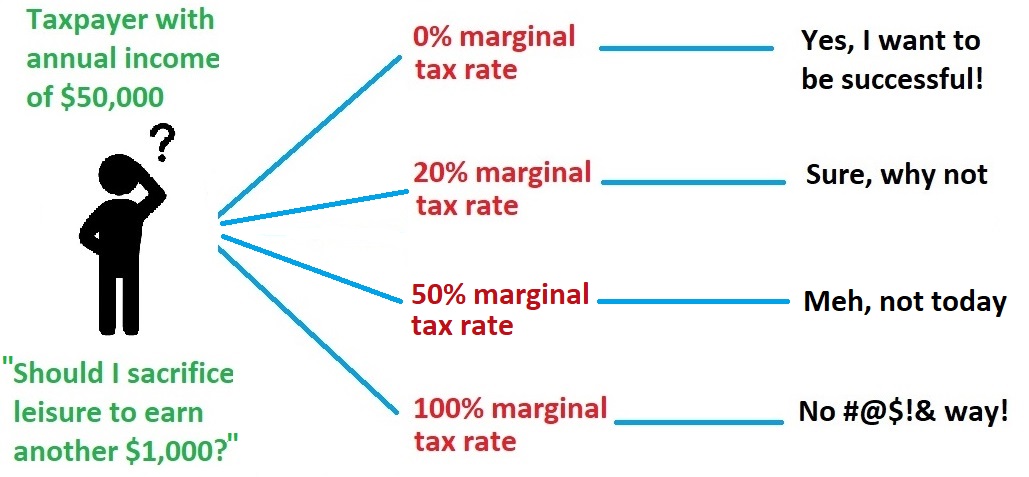
From a big-picture economic perspective, I worry most about the damage of high tax burdens on innovation, entrepreneurship, and investment.

Those are things that generate enormous benefits for society, yet also things that are very sensitive to bad tax policy (specifically high marginal tax rates and the tax code’s bias against saving and investment).
 

Sadly, I don’t have first-hand experience to share when writing about these issues.

Today, however, I get to write about a tax issue that directly impacts me.

I’ve been living in the same Virginia house for more than 30 years. It’s now way more house than I need since my kids are now grown up and living elsewhere. I would like to sell my house and become a snowbird with two modest-sized residences in Virginia and Florida.

And that plan might be financially feasible since my house is now worth a lot more than it cost me back in 1993 (thanks in part to inflation, but also because successful “rent seeking” by the parasite class has resulted in ever-greater demand for housing in and around DC).

Yet I’m not going to sell my house. And the explanation is that I love my kids more than I love government. Or, to be more accurate, I love my kids and have disdain for government.

To elaborate, here are some excerpts from a Washington Post column by Jim Parrrott of the Urban Institute. He starts by explaining there is a problem in the housing market.


Homeownership is out of reach for many Americans, a situation driven primarily by a shortage of homes for sale that has driven up prices. One factor contributing to that scarcity: Older adults are staying put…, keeping millions of homes off the market. …As older Americans pay for excess space, younger families are stuck in homes too small for their needs. …That cohort’s delay in advancing from starter homes has spillover effects for renters looking to become first-time homeowners. In short, empty nesters’ economics are creating a market-wide logjam.

He then correctly notes that the problem is caused by taxes.

Under existing law, sellers owe capital gains taxes on home sale profits exceeding $250,000 for single filers and $500,000 for married couples filing jointly. Most homeowners 65 and older have held on to their homes for nearly a quarter-century, a period of remarkable price gains. … 

Congress didn’t intend to saddle older homeowners with those costs. After lawmakers set capital gains exclusions to current levels in 1997, few sales resulted in federal tax liability. But they didn’t peg those limits to inflation or changes in home prices. So as prices shot up, the number of homeowners facing a federal tax bill upon selling increased as well. Today, a third of homeowners would owe federal taxes if they sold their home. 

As a result, many seniors are choosing to remain in their homes until death so that their beneficiaries inherit the houses with a stepped-up tax basis, eliminating the taxable capital gains. This makes sense for their family’s finances but creates a mess in the housing market. …Raising the exclusion to around $500,000 for single homeowners and roughly $1 million for married homeowners would be sufficient to remove the tax barrier for all but the wealthiest seniors.

This column explains my situation.

If I stay in my home until death, my kids benefit from my home’s increased value. If I sell my house, politicians get a big chunk of the increased value.

Needless to say, that make my choice very simple. Especially since a non-trivial share of the gain is only due to inflation and it’s outrageous that the government taxes us on gains that only exist because the government has irresponsible monetary policy.

I’ll close by shifting the discussion from what’s best for me and my kids to what’s best for the country. The bottom line is that there should not be any capital gains tax. Not on me. Not on anyone.

Indeed, it will be much more important for prosperity to get rid of the capital gains tax on investors rather than homeowners.

Wednesday, October 6, 2021

They’re Coming for You

Antony DaviesAntony DaviesOctober 4, 2021


For years, politicians have claimed that the rich weren’t paying their “fair share.” While it’s taken a decade or more for voters to catch wind of the truth, people are finally beginning to realize that the rich actually pay far more than the rest of us. According to Congressional Budget Office figures, the average household in the top one percent earns 120 times what the average poor household earns, but pays 2,000 times the taxes. Even after deductions, exemptions, write-offs, income deferrals, and whatever other accounting and legal arcana the rich throw at their tax returns, in the end, the typical one-percenter paid 32% of his income (all sources combined) in 2018 versus 13% for the typical middle class household and almost 0% for the typical poor household.

It’s clear that Americans have figured out the truth about who pays, because politicians are shifting the goalposts. Elizabeth Warren shifted the conversation from what fraction of income the rich paid to what fraction of wealth they paid. President Biden has upped the ante by talking about taxing unrealized capital gains.

This is unprecedented. The federal government has no constitutional authority to tax wealth, and never have unrealized gains been considered income – either in the realm of accounting or economics. An unrealized gain is simply an investment “in process.” What shows up as a gain today can easily turn into a loss tomorrow. Ask anyone who invested in Bitcoin in March 2021, or gold in August 2011, or housing in 2007. An investment’s tale isn’t told until the investor cashes out. Unrealized gains aren’t gains. They are hypotheticals.

What politicians want is to foment class warfare. If they can get the middle class and poor to resent the rich, those same politicians can expand the scope of federal taxation into areas it has never before touched.

But watch out. Politicians are only partially interested in the rich. They are very interested in the middle class. In 2018, middle and upper middle class households, combined, earned double what the top one percent earned. And the federal government currently taxes the middle classes at rates less than half of what it taxes the one percent. Politicians see the middle class as a largely untapped revenue source.

While President Biden says that a tax on unrealized gains would apply only to billionaires, once instituted, there is nothing stopping the government from applying it to everyone else. If it did so, the middle class would find itself awash in taxation. Most middle class wealth is tied up in home values. The median sale price of existing homes shot up 14 percent just in the past year. If the government applied an unrealized capital gains tax to all homeowners, the median homeowner would get socked with a $7,000 tax bill. And that’s for just one year. The value of the median home rises more than 3.5 percent per year. At current capital gains tax rates, the median worker would get hit with an additional $1,500 federal tax each year simply because his home was, on paper, worth more than the year before. The average 401K or IRA account is worth $135,000. Given stock market gains last year, the average saver would have seen around $13,000 in unrealized capital gains – and a $2,000 tax bill if those unrealized gains were taxed.

And what of higher education? The typical four-year college graduate earns over 60 percent more than the typical worker with only a high school education. Currently, the median difference is over $500 per week. Over a 40 year career, that wage difference adds up to more than $1 million. Should that be taxed?

The college graduate has made an investment in his education that has increased his expected future earnings by $1 million. Of course, the graduate hasn’t earned that money yet. But that simply makes it an unrealized gain. If the government can tax other investments before their gains materialize, why can’t it tax the graduate’s increased income before it materializes? The tax bill there, by the way, would be around $150,000.

What’s really going on is that politicians see a coming fiscal storm, and they are desperate to find new sources of revenue before it hits. The Congressional Budget Office estimates that by 2031 the federal debt will have reached almost $36 trillion. Historically, the CBO’s ten-year debt projections have underestimated future debt by more than a factor of two. If the CBO’s current estimate is off by that same factor, the debt will actually be over $80 trillion by 2031. That’s equivalent to running a $5 trillion deficit each year over the next decade. While that sounds unbelievable, it’s consistent with what we’ve seen in the past. Since the late 1960s, the federal debt has grown at an average annual rate of almost 9 percent. If the debt continues to grow at that historical average, by the end of the decade, it will be more than $65 trillion. That’s equivalent to running a $3.5 trillion deficit each over the next decade. For comparison, the federal government collected $3.4 trillion in taxes in 2020.

Federal spending is out of control. Politicians know it and they know that they can’t stop it.

Those same politicians have realized that raising taxes isn’t enough. They need new sources of tax revenue that haven’t existed before. Their first step is to institute new taxes on wealth and unrealized capital gains. Once established, their next step will be to expand those taxes to the middle class.

A day of reckoning is coming. Politicians hope that we’ll keep pointing fingers at the rich so we don’t notice who the real culprits are.

Antony Davies

Antony Davies

Antony Davies is the Milton Friedman Distinguished Fellow at the Foundation for Economic Education, and associate professor of economics at Duquesne University.

He has authored Principles of Microeconomics (Cognella), Understanding Statistics (Cato Institute), and Cooperation and Coercion (ISI Books). He has written hundreds of op-eds appearing in, among others, the Wall Street Journal, Los Angeles Times, USA Today, New York Post, Washington Post, New York Daily News, Newsday, US News, and the Houston Chronicle.

He also co-hosts the weekly podcast Words & Numbers. Davies was Chief Financial Officer at Parabon Computation, and founded several technology companies.

Get notified of new articles from Antony Davies and AIER.


Saturday, November 1, 2014

Does Hillary Clinton Hate Business?

Stephen Moore /@StephenMoore
So now, Hillary Clinton is saying: Never mind, I goofed.  The former senator, secretary of state and first lady on Friday declared that businesses and corporations don’t create jobs. Yesterday, she, ahem, clarified things.  “I short-handed this point the other day,” she said. “So let me be absolutely clear about what I’ve been saying for a couple of decades: Our economy grows when businesses and entrepreneurs create good-paying jobs here in America, and workers and families are empowered to build from the bottom up and the middle out — not when we hand out tax breaks for corporations that outsource jobs or stash their profits overseas.”
It’s no wonder Clinton was forced to retract. Her statement about businesses and jobs may have been the most mocked utterance by a political leader since Al Gore boasted that he invented the Internet.………Clinton also was wrong when she said Reaganomics–or what she calls “trickle down economics”–”failed spectacularly.” She need only ask her husband, who signed into law a capital gains tax cut in 1997 that created jobs and nearly doubled capital gains tax revenues from $62 billion in 1996 to $110 billion in 1999. Bill Clinton also promoted free trade. He reformed the welfare state; he didn’t grow it as this president has.
Under President Reagan’s supply-side policies, the economy grew twice as fast as under President Obama’s pro-government schemes. The economy would be more than $2 trillion larger today if Obama’s recovery had kept pace with Reagan’s…….To Read More…..