Search This Blog

De Omnibus Dubitandum - Lux Veritas

Showing posts with label Bank Failure. Show all posts

Wednesday, February 14, 2024

Another Bank Failure in the Making?

Meet New York Community Bancorp. 

by | Feb 13, 2024 @ Liberty Nation News Tags: Articles, Economic Affairs News, Opinion

As the first anniversary of the banking meltdown looms, the US is on the brink of experiencing another bank failure. This time, meet New York Community Bank, a regional institution proving that the challenges that gripped the financial system in March 2023 have yet to vanish. Could the nation witness the downfall of another entity? The coming month will prove to be vital.

Another Bank Failure on the Horizon

  Since January 30, New York Community Bank (NYCB) shares have cratered 53% to below $5. The company was slapped with three credit downgrades in about a week. Fitch slashed the firm’s investment grade rating to its lowest ever, Moody’s trimmed the organization’s rating to “junk” status, and Morningstar DBRS hit the downgrade button due to NYCB’s immense commercial real estate market exposure.

Experts think NYCB could endure a repeat of what happened nearly a year ago: Clients take the money and run. So far, liquidity has been decent enough after reports suggested the bank did not suffer any severe deposit outflows. However, with the stock tanking and business media reporting on the company daily, market analysts caution against “the adverse headline risk.”

But rather than be concerned about what graces the pages of The Wall Street Journal or CNBC chyrons, the company’s books should make investors lose sleep at night.

NYCB’s issues started when the company posted a surprise loss, announced a dividend reduction to bolster reserves, and revealed exceptional exposure to the commercial real estate sector. Moreover, more than a quarter of the $83 billion in deposits are uninsured, potentially creating another headache similar to what occurred close to 12 months ago.

The management team attempted to douse the flames by announcing that it would think about selling CRE portfolio loans or allow them to run off the balance sheet naturally. Additionally, Securities and Exchange Commission (SEC) regulatory filings confirmed that NYCB executives purchased approximately $850,000 in stock as part of efforts to signal internal confidence to the broader market.

In the meantime, the bank’s new executive chairman, Alessandro DiNello, attempted to assuage investors’ concerns about another bank failure, saying in a February 7 call:

“The challenge today is not easy. But this company has a strong foundation, strong liquidity, and a strong deposit base, which gives me confidence for our path forward. Overall deposits are up from around 2023, as all areas of the company have performed strongly, including our private banking and mortgage teams. We are already in a strong liquidity position, and we are committed to building liquidity further.”

The business’ troubles led to a selloff in the KBW Nasdaq Regional Banking Index (KRX), an investment fund that reflects the performance of US regional banks. The exchange-traded fund (ETF) has slumped about 10% since January 30 to below $100, though it rebounded during the February 9 session. It still has not recovered from last year’s meltdown when it traded at around $120 and cratered to $77.

Bailouts and Chill

The $2.7 trillion commercial real estate market has returned to the forefront of economic discussions. After widespread reporting on the subject, it faded into the background. However, Treasury Secretary Janet Yellen and Federal Reserve Chair Jerome Powell were asked about this corner of the property sector.
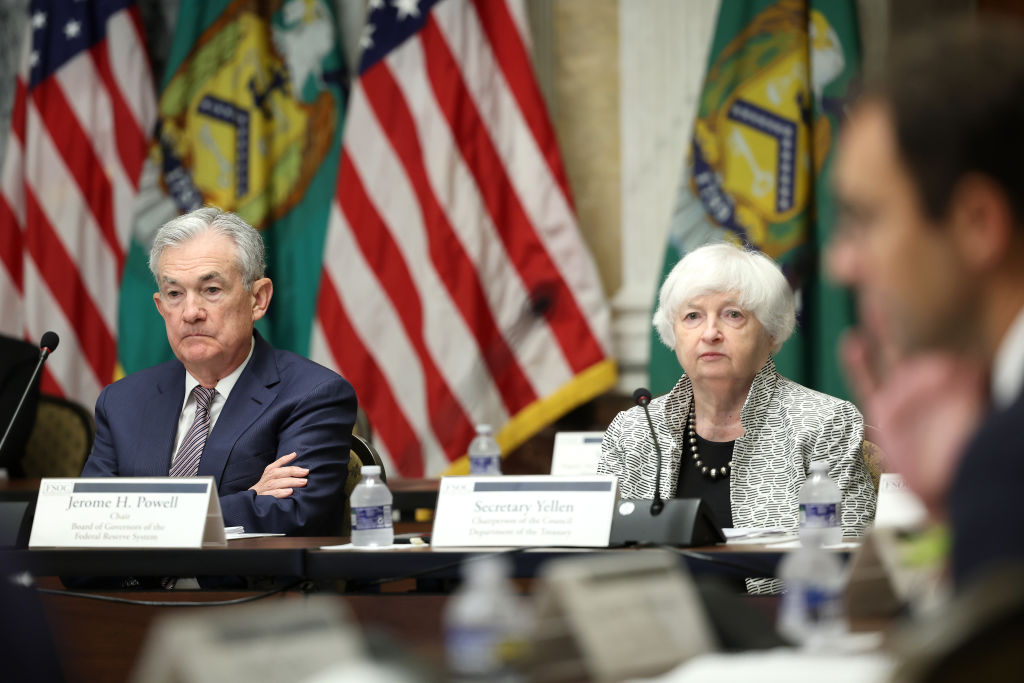
Financial Stability Oversight Council Meeting At The Treasury Department

(Photo by Kevin Dietsch/Getty Images)

The former warned at a Senate Banking Committee hearing on February 8 that “it’s obvious there’s going to be stress and losses that are associated with this,” although she thinks the system will manage the possible turbulence. The latter called it a “manageable” problem for the broader sector but conceded that “there’s some smaller and regional banks that have concentrated exposures in these areas that are challenged.” The Eccles Building kingpin dismissed concerns of repeating 2008, but he anticipated that “there will be some banks that have to be closed or merged out of existence because of this.”

Why not just bail out NYCB or the plethora of other institutions? If the White House, the Federal Deposit Insurance Corporation, and the Fed intervened to rescue wealthy depositors at Silicon Valley Bank or Signature Bank, why not do the same for these entities? Perhaps officials are hoping that another bank failure will occur before March 11. This is the scheduled date that the Bank Term Funding Program (BTFP), the central bank’s emergency lending facility launched in the fallout of the banking crisis, will officially expire. Of course, this should not stop the financial regulators as they will likely come up with another scheme to ensure the public really thinks that the banking system is safe, sound, resilient, and highly liquid. In fact, if you say this three times – safe, sound, resilient, and highly liquid – in front of a mirror, you might even receive a bailout right from the printing press.

 
Read More From Andrew Moran

Monday, November 27, 2023

The Entire Banking System Is Shaking

By Michael Snyder November 27, 2023 @ Discern Report

Editor's Note:  I've not asked for nor have I received permission to publish this in full.  If the author objects I will break this down to a link.  However I think this is such a serious crisis, and the most underrated and under reported crisis the nation is facing, I believe it needs the broadest distribution possible.  RK 

Why are big banks suddenly rushing to shut down so many local branches all over the nation?  As I have discussed in previous articles, U.S. banks are currently sitting on hundreds of billions of dollars in unrealized losses.  When financial institutions get into trouble, they start getting really tight with their money and they start cutting costs.  In addition to laying off workers, our banks have been cutting costs by permanently closing local branches.  For example, between November 12th and November 18th, the sixth largest bank in the United States initiated filings to close 19 more local branches

America’s sixth-largest bank, PNC, has confirmed the closure of 19 more branches nationwide, following a staggering 203 branch closures earlier this year. This decision, aligning with the bank’s shift towards digital banking, is raising concerns among customers who prefer traditional banking methods.

Scheduled for February 2024, the closures will primarily impact ​Pennsylvania, where the majority of branches marked for closure are located. However, several branches in other states, including ​Illinois, ​Texas, Alabama, New Jersey, Ohio, Florida, and Indiana, will also be shutting their doors, leaving customers in these regions with limited access to in-person banking services, The Sun reported.

Of course PNC has lots of company. During that exact same week, several other prominent banks made similar moves

JPMorgan Chase followed closely with 18 filings—three in Ohio, two each in Connecticut and South Carolina, and one each in 11 states, including New York, Illinois, Florida, and Massachusetts.

Citizens Bank came in third with eight branch closure filings—six in New York, and one each in Massachusetts and Delaware. Minneapolis-based U.S. Bank filed for seven closures—three in Tennessee and one each in Missouri, Wisconsin, Ohio, and Illinois.

Bank of America made five filings—two in New York and one each in Texas, Massachusetts, and California.

Citibank filed for two branch closures, and Sterling, Bremer, First National Bank of Hughes Springs, Windsor FS&LA, and Aroostook County FS&LA made one filing each.

Altogether, banks filed to shut down 64 branches.

Read that last sentence again.

In just one week, U.S. banks decided to shut down a total of 64 branches. That is stunning.

What we are witnessing right now is a tsunami of branch closures.

  • Unfortunately, even more trouble is coming for our banks because the real estate industry is a total mess right now.

Existing home sales have fallen to depressingly low levels, and we just learned that new home sales in the U.S. dropped 5.6 percent last month…

New home sales in the United States fell in October as typical mortgage rates reached their highest levels this year.

Sales of newly constructed homes fell 5.6% in October to a seasonally adjusted annual rate of 679,000, from a revised rate of 719,000 in September, according to a joint report from the US Department of Housing and Urban Development and the Census Bureau.

Prices for new homes are falling as well

So the median price of new single-family houses sold in October fell by 3.1% from September, to $409,300 (red line), the lowest since August 2021, down by 17.6% from a year ago, which had been the peak, according to data from the Census Bureau today. The three-month moving average is down by nearly 12% from its peak in December last year (green).

These are contract prices and do not include the costs of mortgage-rate buydowns and other incentives such as free upgrades. But they do reflect the lower price points due to smaller footprints and the “de-amenitizing.”

Meanwhile, the commercial real estate crisis just continues to intensify. Just check out these new numbers that were released several days ago by Trepp.

The volume of CMBS loans that are classified as delinquent increased by 49.4% during the 10 months through October to $27.91 billion. That volume amounts to 5.07% of the $601.98 billion universe tracked by Trepp. In contrast, delinquencies at the end of last year amounted to 3.03% of the $616.15 billion universe then extant.

Wow.

It turns out that office buildings are the primary reason why delinquencies are rising at such an astounding pace…

The driver of the increase was the office sector, which had a 261% increase in delinquency volumes over the 10-month period through October. A total of 199 loans with a balance of $9.59 billion, or 5.91% of all CMBS office loans were at least 30 days late with their payments, as of the end of October. At the end of last year, 115 loans with a balance of $2.65 billion, or 1.63% of office loans, were delinquent.

The sector’s prospects are unlikely to improve as office occupancy rates have declined in most of the country’s major markets. That’s been driven by a substantial pullback in demand from office-using tenants.

All of this reminds me so much of what we witnessed in 2008.

When the real estate industry falls on hard times, a financial crisis is usually right around the corner. Needless to say, it isn’t just U.S. banks that are in trouble right now.

Major banks all over the globe are getting hit really hard, and that includes Metro Bank in the UK

Metro Bank shareholders have backed a multi-million pound rescue deal aimed at securing the bank’s future.

The vote was on a package the bank agreed last month to raise extra funds from investors and refinance debt. Metro’s share price had plunged in September following reports it needed to raise cash to shore up its finances.

In the days ahead, we are going to hear about a lot more banks that need to “shore up” their finances. And it is inevitable that more banks will fail.

A number of people have asked me questions about their banks lately, and I have told them the same thing that I tell everyone. It is never wise to put all of your eggs in one basket.

We are moving into a period of time that is going to be extremely chaotic, and so you don’t want to have all of your assets in a single place.

What we have seen so far is just the beginning.  Our banks are going to get into even deeper trouble during the days ahead, and that is really bad news for all of us.


US Witnesses Another Bank Failure – Swamponomics

Bank failures, US Postal Service loses money again, and foreigners ditching US debt. 

By  Nov 22, 2023 @ Liberty Nation News

Recent House and Senate committee hearings involving the top US regulators suggested that America’s banking crisis had been contained because of Washington’s smartest men and women. While the calamity witnessed earlier this year has quieted down, the situation is far from over. Case in point, another bank failure occurred, lifting the annual number of collapsed institutions to the highest level in six years. Just wait until next spring!

The Never-Ending Bank Failure Story

Citizens Bank, an Iowa-based company, became the fifth bank failure of 2023. Its closure did not capture national headlines because it possessed fewer than $66 million in assets as of Sept. 30, contributing very little to the $553 billion total assets of other shuttered banks this year.

According to the Iowa Division of Bank (IDOB) and Federal Deposit Insurance Corporation (FDIC), Citizens Bank’s demise was caused by “significant loan losses” related to a single industry: trucking. The two organizations noted that they submitted a consent order with the entity in August, mandating it reach out to a third-party loan consultant to manage the firm’s commercial trucking loan portfolio and produce a credit risk reduction plan. But it was not enough to prevent a bank failure.

GettyImages-1248249758 FDIC

(Photo by Nathan Posner/Anadolu Agency via Getty Images)

In the end, it maintained $58.9 million in deposits and $38.2 million in loans, with real estate loans accounting for nearly 42%. The IDOB was forced to close it on Nov. 3 and appointed the FDIC as the receiver. Iowa Trust and Savings Bank assumed all its deposits and purchased close to all its assets.

Citizens Bank joined Silicon Valley Bank, Signature Bank, First Republic Bank, and Heartland Tri-State Bank on the list of failures.

Could more come to face to face with doom? The real test of the banking system’s resilience will occur in March when the Federal Reserve’s loans are due. When SVB and Signature folded faster than Superman on laundry day, the US central bank launched an emergency funding facility to prevent further closures. It reached a fresh record high last week, rising $7 billion to $113 billion.

Mailing a Loss to Taxpayers

Despite projecting it would break even, the US Postal Service (USPS) lost $6.5 billion in the fiscal year 2023. The government’s money-losing venture proclaimed it was on the road to profitability, so the latest results are disappointing, particularly for taxpayers. The USPS reported a net income of $56 billion last year, thanks to 2022 legislation that injected a one-time $57 billion gain into the organization. The legislative effort adjusted how the post office accounted for its retiree health care expenses.

GettyImages-1450094453 USPS

(Photo by Alejandra Villa Loarca/Newsday RM via Getty Images)

Postmaster General Louis DeJoy blamed inflation, noting that higher prices impacted operations. The most notable increase was the jump in printing prices, which primarily deterred junk mail marketers from sending flyers. In other words, because the cost of ink and paper has skyrocketed, companies are shipping out fewer materials, so households are not receiving 15% discount coupons on hair loss treatments.

“We are just in the early stages of one of the nation’s largest organizational transformations,” he said. “We are already providing more consistent, reliable, and timely delivery to America’s businesses and residences. We are also addressing near-term financial headwinds relative to inflation as we make strong progress in our long-term cost control and revenue generating strategies.”

The World Sells US Debt

Foreign investment into US government debt might have come at the worst time possible. The world reduced its holdings of America’s bonds by 1.25%, or $44.6 billion, in September, according to the Treasury Department’s monthly TIC report. To no one’s shock, China continued to diminish its exposure to US debt by $27.3 billion, or more than 3%, to $778.1 billion. Over the last 12 months, Beijing has decreased its Treasury holdings by 14%.

Japan, the world’s largest holder of US debt, trimmed its pot of American IOUs by $28.5 billion to $1.087 trillion. The United Kingdom and Canada also sold off approximately $30 billion and $15 billion, respectively. Other nations to adjust their holdings lower on a brisk September afternoon: Switzerland, Taiwan, India, Norway, South Korea, and Hong Kong. States to lend a helping hand to the US government during the back-to-school season: Luxembourg, Singapore, Saudi Arabia, and Germany.

This comes as domestic investor demand for US government debt has been abysmal over the past few months. The financial markets have signaled that they fear Washington’s fiscal picture will only deteriorate, a concern supported by Moody’s latest downgrade. Another bank failure, waning foreign interest in US bonds, and a ballooning budget deficit – is anything good happening in the economy?

Read More From Andrew Moran

Tags: Articles, Business News, Good Reads, Opinion