Search This Blog

De Omnibus Dubitandum - Lux Veritas

Showing posts with label Cows. Show all posts

Friday, March 8, 2024

Cows on Trial in New York

New York lawsuit against beef producer JBS is doomed to failure. 

By | Mar 8, 2024 @ Liberty Nation News Tags Articles, Climate Change, Opinion
 https://www.libertynation.com/wp-content/uploads/2024/03/GettyImages-1265239281-cows.jpg

New York Attorney General Letitia James has filed suit against the world’s largest beef producer, JBS USA Food Company, claiming its false advertising of climate-remediation efforts induced consumers to purchase products that are not environmentally friendly. Essentially, an attorney is leveling climate science allegations against cows and livestock, claiming JBS can never achieve “net zero” in its operations. The issues raised by this case will put bovine grass-munchers center stage.

The JBS Suit

The crux of the lawsuit is the allegation that JBS “repeatedly assured the public … that they are taking substantial and definitive actions to reduce greenhouse gas emissions … ” and yet engaged in beef farming. The suit alleges:

“Industrial animal agriculture … has a substantial environmental footprint. Beef has the highest total greenhouse gas emissions of any major food commodity, and beef production is linked to large-scale deforestation, especially in the Amazon rainforest, which further drives climate change by releasing greenhouse gases and eliminating trees and plants that absorb and store carbon dioxide (referred to as ‘carbon sinks’).”

Some cow facts will now be on trial. Not all of JBS’ cows are in the Amazon – one pilot project of 30,000 cows in Colorado was apparently grass-fed.

The lawsuit goes on:

“Even if it had developed a plan to be ‘Net Zero by 2040,’ the JBS Group could not feasibly meet its pledge because there are no proven agricultural practices to reduce its greenhouse gas emissions to net zero at the JBS Group’s current scale, and offsetting those emissions would be a costly undertaking of an unprecedented degree. As of 2021, the JBS Group’s estimated annual greenhouse gases were more than those of the entire country of Ireland, and the JBS Group plans to substantially increase its meat production over the coming years.”

Countering Carbon With Cows

The allegation that “there are no proven agricultural practices” to reduce JBS Group’s emissions is false, and yet the whole case hangs on it. There is no question that industrial agriculture harms the environment – especially from chemicals, erosion, and water loss. Major food producers such as Perdue, Tyson Foods, General Mills, and others are moving quickly to respond not only to consumer and regulatory demand but also to environmental urgency: It is not in their interests to destroy their own assets. And in the effort to reverse soil and environmental degradation, no player is more key than cows. The bovines attacked by James as environmentally destructive are actually the solution to the problems she raises, and JBS is way ahead of her in taking steps to implement that transition.


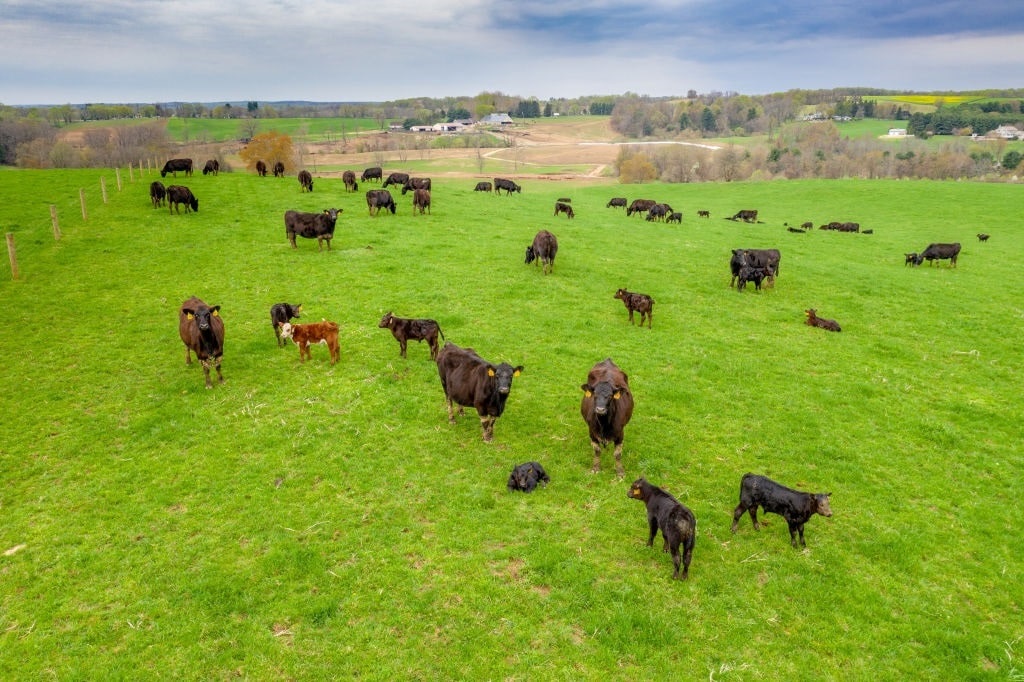
The cows themselves are in court now, in a tug-of-war between the world’s largest beef-producing corporation and the might of New York’s attorney general. But this is not Greta Thunberg’s bully pulpit – facts are required. Ample studies and entire books establish that cows rotationally grazed on grass rebuild soils and preserve water, supplant synthetic fertilizers with their manures, and sequester both carbon dioxide and methane in the soil. If JBS shifted enough of its existing industrial CAFO (concentrated animal feed operations) to grass-fed or rotational systems, it could sequester more carbon than its operations have released in the last five decades and offset some of New York City’s greenhouse gases to boot.

Clearly, James and her cow-slandering cohorts did not confer with soil scientists or evaluate the regenerative farming impacts of JBS’ plans to shift its grazing methods. Chickens and pigs, raised in massive industrial facilities, cannot be returned to the land effectively, but cows can.

Cows are the quickest path to restoring soils and sequestering carbon, which is why JBS and others are focusing there (and in reduced tilling practices) first. New York has set itself an impossible legal burden against JBS – it lacks the facts to win its case, however much faux environmental puffery is on display.

Climate Change and Farming

For Americans truly interested in reversing environmental damage, the JBS complaint offers an opportunity to delve more accurately into the loosely bandied notions that all cows are climate culprits, or that plant diets will help the ecosystem. Synthetic meats are made from mono-cultured GMO crops that destroy the soil microbiome and toxify humans – perhaps New York’s attorney general should file suit against the claims of that industry. Instead, she has leveled her legal sights at gentle, soil-nurturing cows.

It will be a challenge for JBS Foods to achieve net-zero by 2040, but it is possible with rotational grazing: it is not possible with EV cars, solar panels, or heat pumps that mine the earth, burn coal, and pollute yet again on disposal. None of those fraud-dependent schemes sequesters an iota of carbon dioxide like cows. The case is weakened by these factual problems, but, still, the state must prove that JBS acted willfully and not in good faith. All this without proving actual damages – the state has no consumer victims harmed by the alleged malfeasance that it vaguely alleges increased profits, a second factual hurdle. But it is the plaintiff’s burden to prove damages. Government-as-plaintiff cases without proof of actual harm seem to be trending in the Big Apple lately, as seen in the massive award against Donald Trump in his New York civil fraud trial.

Punishing Good Behavior?

The public must also ask, if James succeeds in this case, would JBS be barred from advertising its environmental clean-up efforts in the future? If so, will it help consumers (or the environment) if the company abandons legitimate regenerative farming transition efforts because there is no market return? Consumers want companies to try to make their products less environmentally destructive. James is punishing this company for that very effort.

The burden is not on JBS to prove that it can achieve its emissions goals by 2040  — only that it is trying to, in good faith. James and the state of New York, on the other hand, hold the burden of proof to establish the impossible: that JBS cannot meet its goals, and that cows cannot heal soils destroyed by decades of errant agricultural practices.

 
Read More From John Klar

Monday, October 30, 2023

America Next? Irish Farmers Face Killing 41,000 Healthy Cows Over Regulations to Fight ‘Climate Change’

 
More than 40,000 Irish cows are in danger of being on the receiving end of an “animal welfare catastrophe,” according to one farming politician, although it appeared more likely that the cows will be saved by applying government funds to wastewater management.

Ireland, which remained a member of the European Union even after the United Kingdom withdrew from the multinational body, has been granted an exception to rules designed to limit the amount of nitrate levels produced by agricultural activities. However, because of what the Irish Examiner called “water quality issues,” the country’s allowance of 250 kgs (about 550 lbs) of nitrates per hectare for some farmers will fall to 220 kg (485 lbs) at the first of the year.

According to the United Nations Environment Programme, excess nitrate in the environment “exacerbates climate change and depletes the ozone layer.”

Nitrates enter the environment “from the use of synthetic fertilizers, the discharge of wastewater or the combustion of fossil fuels,” according to the UNEP, all of which would obviously be connected with dairy farming................To Read More..

Friday, September 15, 2023

Ethical Dilemmas About Killing an Animal for Climate

Ruminations on the rights of cows. 

By John Klar September 14, 2023 Articles, Opinion, Politics

California and other states (and many nations) have enacted laws to regulate “ethical” treatment of animals in agriculture. This trend accompanies modern jurisprudence shielding domestic pets and criminalizing animal cruelty. Advocates for animal welfare legislation, such as PETA, invoke claims of “animal rights” — but these same groups call for boycotts on products made from these animals.

To erase meat, milk, bacon, leather, and honey from human use is to eliminate (rather than ethically regulate) the animal husbandry that gives life to these creatures. This is a strange way to address the “rights” of these animals — raising questions not about the morality of farmers, who mostly strive to take good care of their livestock, but of the moral reasoning of animal rights activists.

Animal Thinking

There is a philosophical question about animal awareness implicit in this debate. How, for instance, do humans know that dolphins are not chatting at some very high level of communication? Border collies easily learn hundreds of words, as do crows. Are animals aware of death and suffering, and does that awareness impact the view of their “rights”?

PETA sidesteps this question with accustomed irony, appealing to end the existence of animals by exploiting not merely claimed but often nonexistent suffering and assertions of cognate awareness. Says PETA: “We believe that every creature with a will to live has a right to live free from pain and suffering.”

It is bizarre that PETA would assign a right “to live free from pain and suffering” to creatures only “with a will to live.” What of the animals PETA wants to put forever out of a job by eliminating the industries of which they are the core, or the dogs and cats PETA so efficiently euthanizes humanely – do they not have “a will to live”? A similar circular argument is heard by abortion proponents who assert that “terminated” babies are spared a life of hardship. But don’t they have as much will to live as a cow in a field, or a sow suckling her shoats in the shade?

Ayn Rand argued that ethical treatment of others – including animals – depended on awareness of life and death and the values that arise from that consciousness. The Atlas Society (named for Rand’s classic Atlas Shrugged) related:

“As Ayn Rand argued, value depends on the existence of a being that faces the alternative of continued existence or the end of existence — and a being that must act to continue in existence. Values, then, are those things that are required for the being’s continued life. Therefore, a value is always a value for some reason (it is required for life) and to some organism (the being acting in the face of the alternative of life or death) … Humans are the only organisms that are capable of volitional rationality and, as such, are the only organisms capable of morality. And while animals certainly face the alternative of life or death and thus pursue value, they do not react to this alternative by choosing what actions to take and what values to pursue to maintain their lives. They do not and cannot pursue moral values.”

Bovine Philosophizing?

This is visible in cows, who spend most of their lives seeking forage, then gacking up cud to masticate while contemplating the view. What are they thinking?

As ruminants, bovines have four stomach chambers. When they are not churning green gunk around in their bellies and chomping mouths (while multi-tasking with manure distribution and methane flatulence/burpation), they are likely taking a snooze. But what are they thinking?

Cows are not contemplating their endless struggle against that dark night we humans see as death. Cows will look past the electric or barbed-wire fence for greener pastures but don’t dream of a pastoral afterlife on the other side of their own mortality. They don’t even look past one meal to the next,or even past chew to chew.

Animal Souls

C.S. Lewis pondered the idea of animal spirituality in his tome The Problem of Pain, suggesting domesticated animals might accompany humans to heaven. G.K. Chesterton dodged the issue – in accustomed fashion – by hitting it straight and bluntly head-on:

“Mr. G.K. Chesterton after stating frankly that the subject is one of the many questions on which he is content to be an agnostic, says: – ‘About one thing I am quite clear, that it is perfectly right that the two ideas of the immortal man and the immortal mongoose should be treated as quite distinct. The second is simply a speculation about the mystery of nature that lies around us; the first is a practical question affecting the common conscience of a man and the consequences of his own action.’”

Some Closing Ruminations on Ruminants

A cud-grinding heifer may see her image in a window and reflect on her rumination – perhaps ruminating upon her reflection. We will never know, but we know she is alive. She is also tended by a human steward without whom she would quickly perish with assured pain and suffering. Unaware, the heifer is not a slave to the human, nor is the human slaving away to maintain water, food, healthcare, clean bedding, and sanitation for her bovine charges a slave to her cows. It is a symbiosis, ancient and bountiful.

PETA and its army of anarchic animal activists speculate about the mystery of the rights and consciousness of dolphins, cows, and coyotes. But a rational being would ask how killing creatures – man or beast – in the name of being humane is humane. Only humans are asking this question, which much concerns “the common conscience of a man and the consequences of his own action.”

 
Read More From John Klar