Search This Blog

De Omnibus Dubitandum - Lux Veritas

Showing posts with label Climate Alarmism. Show all posts

Wednesday, October 5, 2022

The Climate Crisis Of 536 AD

Written by the I&I Editorial Board

Earth’s climate is always changing. But despite the warming hysterics’ wild claims, it’s not changing at an alarming rate. Remember, when they cite United Nations reports warning of soaring temperatures and rising sea levels, the projections cover many decades, not just a few years. Of course there was a moment when the climate did change rapidly. It was so long ago, though, none of us can remember it.

Yet it happened. Many centuries before the first oil well was drilled. Almost 1,500 years ago. 

The foundation of the global warming obsession on the left is largely based on U.N. predictions that assign significant but unrealistic increases in global temperatures and sea level due to increasing levels of CO2 in our atmosphere.

For instance, the U.N. has said the global temperature could increase over a range from 4.5 degrees Celsius to 6 degrees Celsius some time between 2081 to 2100. It has also said sea levels could rise 2 meters by 2100. Neither is possible, says H. Sterling Burnett, director of the Heartland Institute’s climate and environment center. Both would require us “to burn every molecule of fossil fuel and more” than can be found on Earth. Not only are these worst-case-scenario estimates that will never unfold, the disasters predicted are far into the future, meaning the numbers so easily tossed around are useful for only one thing: scaring the public and ramming through expensive and worthless green legislation.

Despite the assurances from the fanatics that we’re heading into, or are already in, a crisis in which the climate abruptly shifts, even their ugliest fever dreams can’t compare to what happened in 536 AD.

According to the History Of Yesterday:

From the research done by scientists, it is said that AD 536 was the coldest year in the last 2300 years, which made the winter season a survival season for most cultures. Contemporary scholars also tell us that it is not only the fact that it was a really cold winter that made it a bad year but also many strange events where the climate changed all of a sudden.

During this period of sudden climate change, it snowed in China during the summer, South America endured three months of heavy rain followed by three months of drought, and famine was apparently widespread enough to  contribute “to the collapse of many cultures around the world.”

Science says it was “the worst year to be alive.”....................To Read More....


Wednesday, June 15, 2022

Dr. Jay Lehr and Tom Harris On Energy and Climate

By Dr. Jay Lehr and Tom Harris

Dr. Jay Lehr is a Senior Policy Analyst with the International Climate Science Coalition and former Science Director of The Heartland Institute. He is an internationally renowned scientist, author, and speaker who has testified before Congress on dozens of occasions on environmental issues and consulted with nearly every agency of the national government and many foreign countries. After graduating from Princeton University at the age of 20 with a degree in Geological Engineering, he received the nation’s first Ph.D. in Groundwater Hydrology from the University of Arizona. He later became executive director of the National Association of Groundwater Scientists and Engineers.

Tom Harris is Executive Director of the Ottawa, Canada-based International Climate Science Coalition, and a policy advisor to The Heartland Institute. He has 40 years experience as a mechanical engineer/project manager, science and technology communications professional, technical trainer, and S&T advisor to a former Opposition Senior Environment Critic in Canada’s Parliament.


The Human Side of Pennsylvania’s Capitulation to Woke Environmentalism

We have people falling for climate scares and willing to risk impoverishing an entire civilization to finance windmills and solar panels that cannot possibly sustain a modern society. And it’s not just government. It’s big business, big labor, and practically all of academia. This state of affairs has had a terrible negative impact, particularly on the state of Pennsylvania…


Americans Seek Truth with The Heartland Institute as Opposed to Radicals Like Al Gore and Greta Thunberg

Americans Seek Truth with The Heartland Institute as Opposed to Radicals Like Al Gore and Greta Thunberg

Once a mid-west-focused conservative think tank, today’s Heartland Institute is a nationally recognized force for freedom. Its public policy reform success is a result of a strategy to constantly educate policymakers with the best free-market research and to interact with them directly and personally. Heartland operates five policy centers as follows…

The Fatal Attraction of ESG and Banks for a Socialist Utopia

The Fatal Attraction of ESG and Banks for a Socialist Utopia

Banks have promised to use ESG to fight climate change throughout their portfolios and business activities. The most influential financial institutions worldwide have openly said that they will use their wealth to force the global economy to move to net-zero by 2050. This is, of course, physically impossible, but installing communism around the world is not…

The Ignorance of Politicians Wishing for a Non-Carbon Future is Insane

The Ignorance of Politicians Wishing for a Non-Carbon Future is Insane

Congressman Don Beyer (D-VA) seems unaware that in a “non-carbon future,” everything would be dead since carbon is the primary building block of life. Undeterred, the AP release from Beyer’s office claimed: “Warmer temperatures are lowering workers’ incomes, and the increased severity and frequency of natural disasters is lowering overall economic growth…The cost of inaction will be catastrophic.”

A Climate Emergency Driven by Fraudulent Computer Models and Deep Pockets

A Climate Emergency Driven by Fraudulent Computer Models and Deep Pockets

The problem arises because of the way we fund modern science. Various issues like climate change, AIDS, and the Wuhan Coronavirus all compete for a finite amount of resources. There is no doubt that this biases all government-funded forecasting towards promoting a dire future. Otherwise, the funding stops, and that’s the end of your Business Class travel…

One World Socialists Trying to Defeat Capitalism Under the Guise of a Climate Emergency

One World Socialists Trying to Defeat Capitalism Under the Guise of a Climate Emergency

By obligating the United States once more to the Paris Agreement and by signaling clearly that “climate” will be central to its policies, the Biden administration has joined other governments in the crusade against a supposed “climate emergency.” Happer and Lindzen used the word “crusade” advisedly since the frenzy over climate resembles the medieval crusades against foreign infidels…

Will Europe’s Green Energy Nightmare Infect America?

Will Europe’s Green Energy Nightmare Infect America?

European elites are starting to recognize that their dependence on Putin for critical resources was a strategic mistake that must be corrected as soon as possible. But rather than advocating an expansion of domestic conventional energy production, Europe’s “progressive” intelligentsia says that all this shows that we must move even faster away from fossil fuels…

Germany’s Surrender to Climate Extremism a Cautionary Tale for America

Germany’s Surrender to Climate Extremism a Cautionary Tale for America

Germany will be closing its last nuclear power station at the end of this year and will shut down all remaining coal-fired stations in only 16 years. Their leaders would like their public to believe that Germany will run mostly on wind and solar power, a complete impossibility. Wolfgang Müller is general secretary of the European Institute for Climate and Energy…

Brazil Must Not Follow Chile into Climate Suicide

Brazil Must Not Follow Chile into Climate Suicide

When it comes to Brazil’s position on climate change, they are one of the most strident in falling in line with the socialist efforts to rid the country of its use of fossil fuel. And it appears things are going to get even worse unless Brazilians rise up to oppose this trend…


Wednesday, August 11, 2021

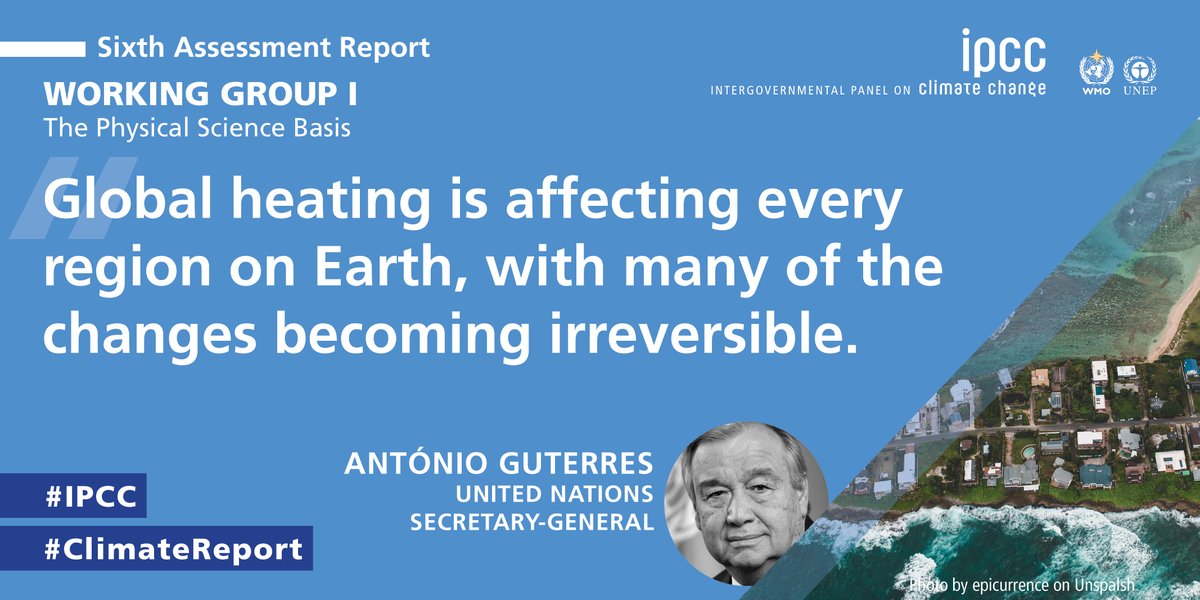
Here we go again: New UN ‘IPCC report is apocalyptic, catastrophic’ – Certain doom unless – we follow UN central planning dictates!

 By  - Climate Depot August 9, 2021

 Image

“Here we go again. The UN will never quit until we cut off their funding and stop enabling it. The UN chief Antonio Guterres, a former president of Socialist International — is touting tipping points and “irreversible” changes unless we are obedient to their demands that we turn over our economic, energy and way of life to their centrally planned vision. Quick! Pay up and empower the UN to take over your life or the climate will get you! Reality-based headline: ‘Former top socialist who runs the UN wants issues yet another worthless anti-scientific extreme scenario report demanding huge centralized changes in society that will empower the UN to further impose restrictions on you.’ And the climate will not notice one whit. How many more climate tipping points do we have to listen to?

[See:Earth ‘serially doomed’: The official history of climate ‘Tipping Points’ began in 1864 – George Perkins Marsh, the father of American ecology warned: Unless men changed their ways it would be reduced ‘to such a condition of impoverished productiveness, of shattered surface, of climatic excess, as to threaten the depravation, barbarism, and perhaps even extinction of the species.’]

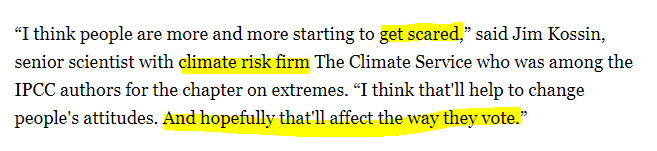
“It is more recycled nonsense. I don’t know how else to say it stronger. I can’t believe they just do this relentlessly every three to five years, and here we are again.”This is essentially the belief that unless we submit to a future where government overlords will control everything, we will face a catastrophe. The UN is literally trying to lobbying you into voting for politicians who want to take ‘climate action.’ Dr. Roger Pielke Jr.: “IPCC author whose company sells RCP8.5 products wants people to ‘get scared’ and for the report to affect how people vote,” Pielke added. 

Image

Morano: “We already know these reports are designed to scare the world into climate action."

 (See: Gore admits UN IPCC report was ‘torqued up’ to promote political action – ‘How [else] do they get the attention of policy-makers around the world?’)The UN is now scaring people to vote the way using the UN’s unscientific extreme model-based scenarios!”

 [Also see the real motivation behind the reports:New UN IPCC report ‘will motivate all nations to deliver urgent emission reductions’ & commit to ‘climate finance’]

Dr. Roger Pielke Jr.: “So this is a BIG problem. The scenarios IPCC admits are unlikely [to] dominate the report w/ 41.5% of all scenario mentions. The scenarios judged most likely under current trends get only 18.4% of mentions. Implausible scenarios (8.5 + 7.0) total 53% of mentions, more than half!” “The literature is heavily biased to extreme scenarios,” “From AR5 WG1 to AR6 WG1 the emphasis on 8.5 scenarios increased dramatically,”  “The IPCC AR6 WG1 is not in fact neutral w/ respect to scenario assumptions because it has an overwhelming emphasis on unlikely (it’s word), implausible (our word) scenarios,”

John Kerry falsely claims: It’s ‘cheaper to deal with the crisis of climate than it is to ignore it’ – Reality check: There is no ‘crisis’ & ‘solutions’ would have no impact

 “The United Nations is a self-interested lobbying organization. If the UN fails to define CO2 as driving a climate crisis, it fails to be in charge of the solution, it fails to have annual conferences all over the globe.” … “It’s like the mafia coming into its neighborhood and saying ‘I’d hate something bad to happen to you with that climate — if you pay us, we can protect you from the climate.’ The UN is saying unless we go Marxist, the climate is gonna get us. It’s time for us to say hell no, to the UN, to the Green New Deal and expose this corrupt science.” Mark Marano

“They’ve turned science into lobbying and there’s nothing to alarm the American public. In fact, the climate death rate over 100 years has declined 95 plus percent. In other words, our fossil fuel use has protected us. It’s taken an unsafe climate and made it safe and the UN claims we need to make ourselves poorer to make us produce a climate better.” Mark Marano

 “This is the Summary for Policymakers (SPM), the result of negotiations between governments. In other words it is a political statement, not a scientific document. The latter won’t be published until much later, probably long after COP26. And as [UN Sec. Gen] Guterres makes clear, the whole object of the SPM is to scare governments into signing up to the UN agenda at COP26.”

Analysis: ‘The reality is that our weather is no worse now than it was 150 years ago’ IPCC report is ‘highly subjective projections of what might happen in the future’...........

Much More Here.............

Saturday, March 20, 2021

Climate Alarmism Reconsidered

Robert L. Bradley Robert L. Bradley Jr.  – March 16, 2021 @ American Institute for Economic Research

 https://www.aier.org/wp-content/uploads/2021/03/deadtree-800x508.jpg

“Global Warming Has Begun” announced the New York Times in mid-1988, predicting a temperature and sea level rise by 2050 of as much as 9 degrees and 4 feet, respectively. 

The majority of East Coast beaches could be gone by 2020, warned the Times in 1995. And just last week at the publication formerly known as the newspaper of record: “Shifts in Atlantic Hint at Danger.”

Don’t let this tsunami of climate-change alarm distract and fool you. Today’s push for government solutions to a global market failure is right out of the Malthusian playbook. Remember the “population bomb” of the 1960s? Resource exhaustion of the 1970s? Soil erosion, water famines, global cooling?

Back then, the consensus tried to demean, isolate, and cancel contrarian Julian Simon. The science was settled that more people equals more problems (the I=PAT equation), and “depletable” resources could not be replenished.

Simon won on the facts and outfoxed the consensus with his famous wager on the future of mineral-resource prices, “The Bet.” Playing offense against climate exaggeration and gloom can win too.

There is a case for climate optimism, not pessimism, whether or not global warming is the result of nature, humankind, or both. Physical change can be good or bad, depending on a variety of factors. Self-interest and entrepreneurship capitalize on the good and ameliorate the bad. The obvious climate policy for government at all levels is do no harm in the anticipation/adaptation process.

In 2004, I published Climate Alarmism Reconsidered with the Institute of Economic Affairs (IEA) in London. Written 16 years after James Hansen’s climate-scare testimony, and 16 years before Joe Biden’s recent “climate day,” the booklet began with this ten-point summary (an IEA tradition):

  • The energy sustainability issues of resource depletion, reliability (security), and pollution have been effectively addressed by market entrepreneurship, technology, and, in the absence of private property rights, measured regulation. Continuing improvement is expected.
  • The remaining carbon energy-related sustainability issue concerns anthropogenic (man-made) climate change. Current levels of atmospheric greenhouse gas (GHG) concentrations are approximately 52 per cent above pre-industrial levels with an associated increase in global warming potential of 66 percent. Emissions released in the mining, transportation and combustion of oil, natural gas, and coal account for most of this accumulation.
  • The balance of evidence points towards a benign temperature “greenhouse signal.” A greenhouse signal has not been identified with weather extremes or “surprises.”
  • Enhanced atmospheric carbon dioxide (CO2) concentrations create tangible benefits to offset any costs associated with anthropogenic climate change.
  • Liberal energy markets foster wealth creation, adaptation and social resilience – a positive strategy to deal with inevitable climate change, natural and anthropogenic. In addition, free-market reforms in the energy sector harness self-interest in energy efficiency, which has historically tended to reduce GHG emissions per unit of energy.
  • Mandatory GHG emission reductions beyond “no regrets” actions produce costs in excess of benefits under realistic assumptions, including discounting future benefits (if discernible) to compare with near-term costs.
  • Serious efforts to equilibrate the carbon cycle will have to employ novel sequestration strategies given increasing energy usage, supply constraints with renewable energies, and political and economic limitations with nuclear power.
  • Activist proposals for GHG reductions such as cap-and-trade programs should be cognizant of the unintended consequences of open-ended regulatory regimes driven by temporary political majorities.
  • The precautionary principle should be applied to government intervention limiting GHG emissions (e.g., the Kyoto Protocol), not just to acts of man on the natural environment. The economic risks of intervention, in other words, must be evaluated along with environmental ones.
  • The major threat to energy sustainability is statism, not depletion, pollution, reliability, or anthropogenic climate change. Major government interventions in energy markets, such as price controls, access restrictions, or carbon suppression, create the energy problems that non-politicised, free-market processes work to prevent.

Today, the atmospheric concentration of CO2 has risen; the Paris Climate Accord has replaced the Kyoto Protocol internationally; carbon taxes and tariffs (“border adjustments”) are on the table, not cap-and-trade; and a doomsday narrative has crowded out the case for global lukewarming and CO2 enrichment. 

Meanwhile, climate science remains unsettled about the what, when, where, and why of climate change. Climate models are too artificial and imprecise for global and particularly regional prediction. Recorded data on extreme events (the center of today’s hyperbole) fail to confirm negative trends in hurricane intensity and landfall, drought and floods, U.S. wildfires, and ocean acidification. And the most important climate statistic of all? As documented by Bjorn Lomborg: “Global death risk from extreme weather has declined 99% over 100 years and global costs have declined 26% over the last 28 years.”

Back in the Malthusian heyday, ecological economist Kenneth Boulding confessed: “Is there any more single-minded, simple pleasure than viewing with alarm? At times it is even better than sex.” Whatever the attraction, today’s climate alarm, now in its 33rd year, shows little sign of abatement within the green establishment or in government. 

The real threat is climate policy, not physical climate change itself. Affordable, reliable energy, free international trade, and lifestyle norms hang in the balance.

Robert L. Bradley Jr.

Robert L. Bradley

Robert L. Bradley Jr., AIER Senior Fellow, is the founder and CEO of the Institute for Energy Research. He is author of eight books on energy history and public policy and blogs at MasterResource.

Bradley received a B.A. in economics from Rollins College, an M.A. in economics from the University of Houston, and a Ph.D. in political economy from International College.

He has been a Schultz Fellow for Economic Research and Liberty Fund Fellow for Economic Research, and in 2002 he received the Julian L. Simon Memorial Award for his work on energy and sustainable development.

Get notified of new articles from Robert L. Bradley Jr. and AIER.

Sunday, January 17, 2021

Americans supposedly just voted for only electric vehicles

The Big Switch will cost trillions and massively change America – not for the better

Duggan Flanakin

The election of Joe Biden, Kamala Harris and their ultra-progressive cabinet will hasten the death of the internal combustion engine in the United States, despite the nearly even party split in the House and Senate. They will just take their narrow victory as a license to implement all manner of decisions in the name of saving the planet. Or so we’re told. And maybe they’re right.

President-elect Biden has promised his $2-trillion “climate change” plan will include “rigorous new fuel economy standards aimed at ensuring that 100% of new sales for light- and medium-duty vehicles will be zero emission vehicles (ZEVs).” VP-elect Harris has called for beginning this ban by 2035, perhaps even sooner, if they can maintain their momentum for fundamentally transforming America.

Once the sale of new gasoline engine vehicles is banned, the only question remaining is, How long before driving such vehicles is also outlawed? Harris has promised that, under “my plan, by 2045 we will have basically zero emission vehicles only. 100% by 2045.”

Of course, that means zero emissions in the USA, assuming all electricity generation is also zero-emission for charging batteries – despite enormous emission increases in places where battery minerals are mined and processed, and batteries are manufactured (which likely won’t be in America). 

To jumpstart the government-mandated transformation of the 99.5% of US vehicles that are not yet ZEVs, Biden ally Sen. Chuck Schumer plans to introduce legislation authorizing $454 billion “cash for clunkers” incentives or rebates, to help people replace gasoline-powered vehicles with super-expensive all-electric vehicles (EVs). Schumer’s plan also includes building a half million new EV battery charging stations, and replacing the entire US government  vehicle fleet with EVs.

That’s almost one-quarter of Biden’s $2-trillion climate plan right there. The rest of the massive Green New Deal (GND) will likely cost at least Bernie Sanders’ $16-trillion scheme, if not far more.

Not since Henry Ford introduced the assembly line for his Model T in 1913 has America faced such a transportation transformation. The Big Switch to an all-EV fleet will bring equally massive changes to American society, create new winners and new losers, make owning any vehicle a near impossibility for poor and even middle class families, and shift the balance of world power away from countries that ensure “the free flow of oil at market prices” to those that mine GND minerals (mostly China and Russia).

The Big Switch has been in the works for years. As early as 2017, many countries had already announced dates for banning internal combustion engines (ICEs). Norway said its 2025 date was just a “suggestion,” but Germany, France and the United Kingdom set “firm” dates of 2040, while the Netherlands pushed the funeral to 2030. Austria, Denmark, Ireland, Japan, Portugal, South Korea and Spain also set dates, as did India – and several American states, such as (naturally) California.

Major automakers also pledged to end ICE vehicle production soon, even though 2017 polls show that only 30% of millennials (and much lower percentages of older drivers) were willing to “invest” in an electric vehicle. That’s even before considering studies by economist Tilak Doshi and others that even after 50,000 miles on the road, the typical EV has effectively emitted some 76% as much carbon dioxide as a gasoline-powered vehicle.

That’s because, as economist Bjorn Lomborg explained, EV batteries are the product of emission-intensive mining, mineral processing and manufacturing operations, and because the electricity for recharging the batteries often involves additional CO2 emissions.

The term “zero emission vehicles” is obviously a deliberate misnomer, since emissions are just transferred from wealthy Western countries to other nations, where they go steadily upward. 

The Big Switch will create jobs in some sectors. But it will also cause major declines in jobs in the oil and gas industry, declining revenues for convenience stores that profit from gasoline sales, and significant manufacturing cost increases for petrochemicals, automobile and truck tires, roof shingles, plastics, pharmaceuticals and a host of other consumer products that rely on oil and gas for raw materials.

All that also means huge decreases in lease bonus, rent, royalty and tax revenues for fossil fuel states.

Electric vehicle mandates will also harm auto repair and insurance industries. An EV drivetrain has around 20 moving parts, compared with up to 2,000 for ICE vehicles. However, these parts tend to be more expensive and (at least in the near term) less readily available. This means EVs needing repairs or new parts will sit longer in garages and repair shops, and delays in parts availability will increase the overall cost of EV maintenance and ownership. Will insurers cover these added costs?

The Big Switch will also mandate major shifts in tax policy for local and state governments and the federal government, all of which rely heavily on gasoline taxes to pay for highway maintenance and repair. The 18.4-cents-per-gallon federal excise tax goes to the Highway Trust Fund that pays for much of this (with a separate small tax covering remediation of leaking underground fuel storage tanks).

As gasoline sales continue to decline, will Washington find a way to replace this lost revenue?

(Related questions: How will driverless vehicles handle all the proliferating, expanding and deepening potholes? And what will happen to family vacations in cars that require hours of charging for every half-hour of driving? to our tourism and hospitality industries and fundamental freedoms?)

Highways maintained by state and local gasoline taxes are already threatened by declining revenues, thanks to EVs, hybrids and higher-mileage ICE vehicles – and to the 2020 pandemic, which cut highway driving by 64% in April 2020 and significantly ever since. Some states are adding or increasing electric vehicle registration fees: Alabama’s is now $200 for EVs and $100 for plug-in hybrids (a quarter of which will fund EV charging stations), while California began imposing a $100 annual EV fee last July.

That’s not all. People today can purchase an older gasoline-powered vehicle that will pass inspection for well under $2,000. Batteries for these vehicles cost under $200, and many really older vehicles can be repaired by amateur mechanics. By contrast, replacing an EV battery can cost up to $6,000 (or much more), making even used electric vehicles unaffordable for tens of millions of Americans in a nation where half of all vehicles are over ten years old.

Meanwhile, China, India and dozens of other countries are building thousands of new coal and gas-fired electrical generating plants – and putting millions of new ICE vehicles on their roads. So there will be no reduction in global emissions, which means all this pain and disruption in the USA will bring absolutely no benefits, even if CO2 does drive climate change.

Moreover, as recently as 2017, industry experts said EVs will likely reach only 25% of all vehicles worldwide by 2050. People in other countries don’t want and cannot afford them, either.

Equally significant, the Biden-Harris plan also includes a total phaseout of fossil fuels for producing electricity – along with the major increase in electricity needed to keep EVs moving. Even if Biden, Harris, Democrats and Greens accept nuclear energy as a “renewable” (or at least zero-emission) fuel, building enough new nuclear power plants will take decades.

But then, when did Moscow or Beijing ever meet all, most or even some objectives of their Five-Year Plans? Does anyone really think centralized government planning will work better here? More critically:

Will We the People be able to raise and discuss these issues in public forums? Will Republican Members of Congress have any meaningful opportunities to do so during committee hearings or floor debates?

Or will we all just be canceled, censored, silenced and browbeaten into submission in the newly progressive, intolerant and Divided States of America, amid more phony calls for unity and comity?

Duggan Flanakin is Director of Policy Research at the Committee For A Constructive Tomorrow (www.CFACT.org)