Chinese Academy of Science physicists find link between solar peaks and strong El Niños

Wen-Juan Huo and Zi-Niu Xiao, Chinese Academy of Science
Abstract
Recent SST and atmospheric circulation anomaly data suggest that the 2015/16 El Niño event is quickly decaying. Some researchers have predicted a forthcoming La Niña event in late summer or early fall 2016. From the perspective of the modulation of tropical SST by solar activity, the authors studied the evolution of the 2015/16 El Niño event, which occurred right after the 2014 solar peak year. Based on statistical and composite analysis, a significant positive correlation was found between sunspot number index and El Niño Modoki index, with a lag of two years. A clear evolution of El Niño Modoki events was found within 1–3 years following each solar peak year during the past 126 years, suggesting that anomalously strong solar activity during solar peak periods favors the triggering of an El Niño Modoki event. The patterns of seasonal mean SST and wind anomalies since 2014 are more like a mixture of two types of El Niño (i.e., eastern Pacific El Niño and El Niño Modoki), which is similar to the pattern modulated by solar activity during the years following a solar peak. Therefore, the El Niño Modoki component in the 2015/16 El Niño event may be a consequence of solar activity, which probably will not decay as quickly as the eastern Pacific El Niño component. The positive SST anomaly will probably sustain in the central equatorial Pacific (around the dateline) and the northeastern Pacific along the coast of North America, with a low-intensity level, during the second half of 2016. [...]
4. Conclusion
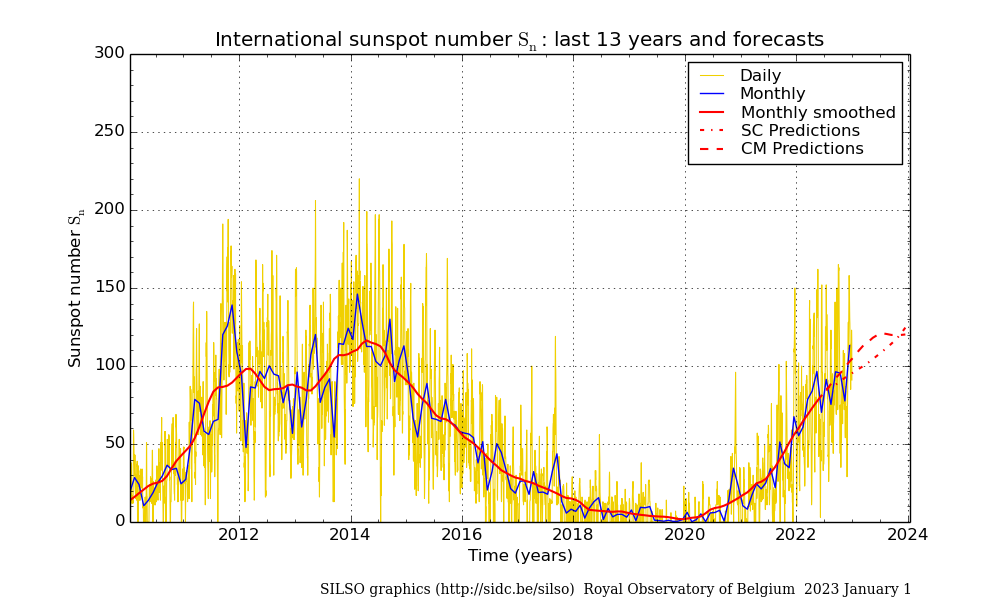
This study investigated the modulation of El Niño Modoki events by solar activity, and analyzed the possible impact of solar activity on the 2015/16 El Niño event. The 2015/16 El Niño event is more like a mixture of two types of El Niño; namely, EP El Niño and El Niño Modoki. The EMI has a clear decadal period, similar to the solar cycle, and demonstrates a significant positive correlation with sunspot numbers. Statistical analysis revealed that an El Niño Modoki event will most likely occur in the one to three years following a solar peak year. The solar cycle reached a peak in 2014—the 24th solar cycle since 1755. The evolution of the SST and wind anomalies are similar to the typical features found from historical data composites in peak years and the following one to three years after a solar peak. Therefore, the El Niño Modoki component of the 2015/16 El Niño event might also have resulted from high solar activity. Considering the impact of high solar activity, the El Niño Modoki component in the 2015/16 El Niño event may not decay as quickly as the EP El Niño event. It will likely sustain in the central Pacific, with a low-intensity level, in the second half of 2016.
Full paper
Brought to you by Benny Peiser's Global Warming Policy Forum

No comments:
Post a Comment