This reveals some glaring inadequacies...
By John Droz, Jr, October 21, 2025 @ Critically Thinking About Select Societal Issues
This is an excerpt from a recent Ballotpedia Daily Brew post.
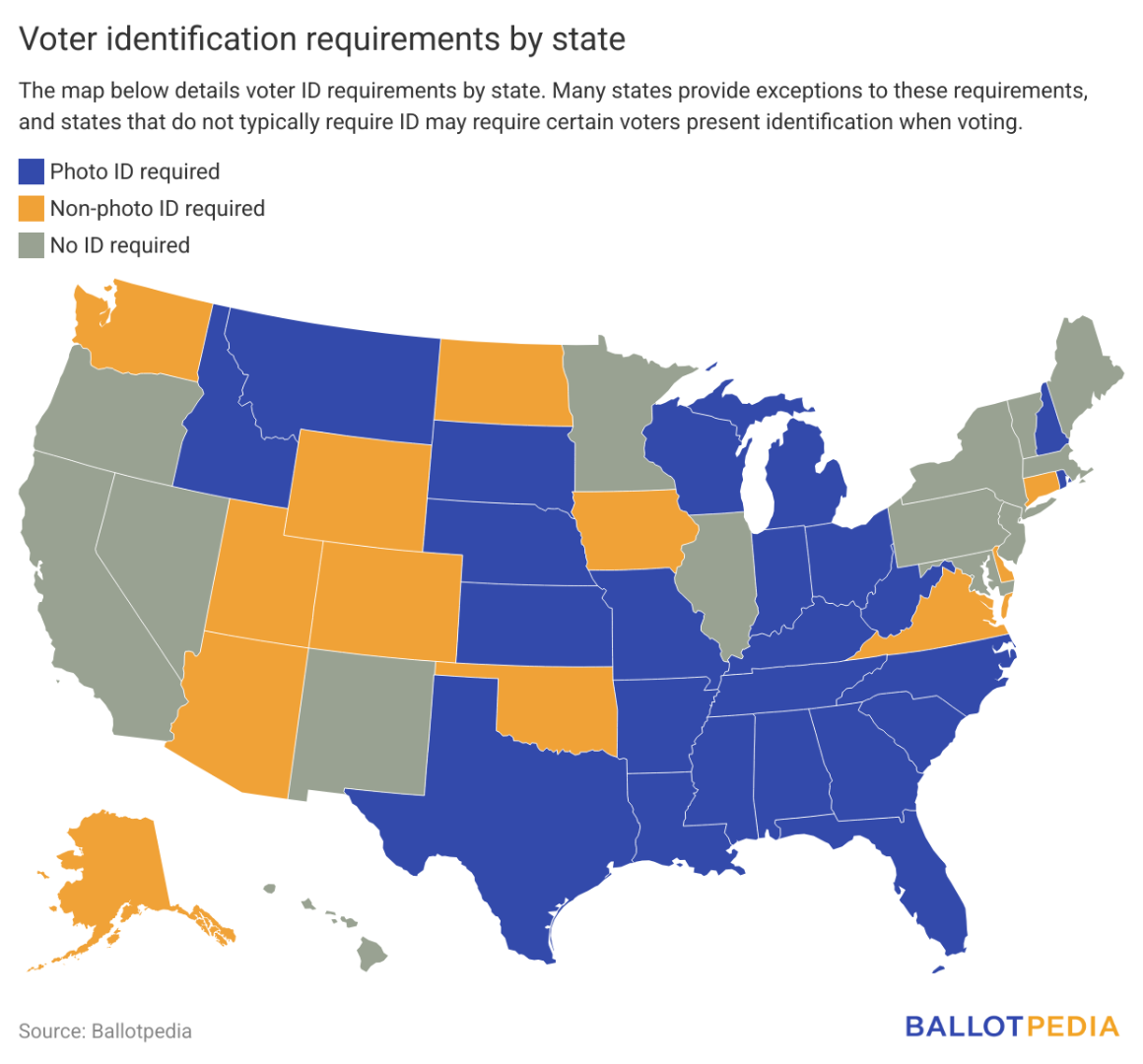
To me, one of the most concerning takeaways is that after 250 years, we still have fourteen (14) States that continue to require zero identification for an individual who wants to vote! What could go wrong with that?
BTW, just like K-12 education matters, this is another example where “leaving things up to the States” is not any assurance of getting quality results.
————————————————————————————————————————
As November nears and voters head to the polls in 36 states,
let’s review which states require voters to present identification when
casting their ballots — and see where voter ID laws have changed in
2025.
Across the U.S., 36 states require voters to present identification to vote at the polls on Election Day. Of those states, 24 require voters to present photo identification, while the other 12 states accept other identification
that does not contain a photograph. The remaining 14 states do not
require voters to present identification to vote at the polls on
Election Day, in most cases.
Ten states have amended
their voter ID laws so far in 2025. One state, West Virginia, moved
from requiring non-photo identification to vote to requiring photo
identification.
Valid
forms of identification differ by state. Commonly accepted forms of ID
include driver’s licenses, state-issued identification cards, and
military identification cards.
Some states requiring
voters to provide identification may have exceptions allowing some
people to cast a ballot without providing an ID. For instance, 15 states
allow some or all voters to sign an affidavit attesting to their
identity at the polls instead of presenting identification. Seven states
allow another voter or an election official to vouch for the person’s
identity in at least some cases. Four states allow voters who live and
vote in state-licensed nursing homes or residential care facilities to
vote without showing identification.
Three states —
Alabama, New Hampshire, and Kentucky — require voters to provide a copy
of their identification when requesting an absentee/mail-in ballot. Two
states, Arkansas and North Carolina, require voters to provide a copy of
their identification when returning an absentee/mail-in ballot.
Across the country, 10 states passed 10 bills
related to voter ID for in-person voting or absentee/mail-in voting
during 2025 legislative sessions. Some noteworthy laws states adopted
this year include:
- Colorado SB 1 expanded the list of eligible forms of non-photo identification to include identification and cards issued by the Bureau of Indian Affairs, the Indian Health Service, or any other federal agency that includes an address in the state. Colorado has a Democratic trifecta.
- Georgia HB 296 required that driver’s licenses used as identification for voting purposes be in a physical format and issued by the Georgia Department of Driver Services. Georgia has a Republican trifecta.
- Montana SB 276 expanded the list of eligible forms of identification to include a student ID card issued by a school in the Montana university system or a Montana school that is a member of the National Association of Intercollegiate Athletics. Montana has a Republican trifecta.
- New Hampshire SB 287 required voters to include a copy of their identification or a notarized signature when requesting an absentee ballot by mail or to present their ID to an election official when requesting an absentee ballot in person. New Hampshire has a Republican trifecta.
- Utah HB 300 required voters to provide the last four digits of their driver’s license, ID card, or Social Security number when returning a mail-in ballot, starting on Nov. 5, 2025. Until Dec. 31, 2028, election officials will attempt to match the voter’s signature on the envelope affidavit to the signature on file for voters who do not provide an identification number. Starting on Jan. 1, 2029, voters must provide the last four digits of an identification number or include a copy of an acceptable ID when returning their mail ballot. Utah has a Republican trifecta.
- West Virginia HB 3016 required photo identification to vote, though driver’s licenses issued without a photograph remain valid for voting. The bill removed documents from the list of eligible forms of identification and allowed voters 65 years of age and older to use an expired ID if the document was valid when they turned 65. West Virginia has a Republican trifecta.
In addition, Wisconsin voters in April approved a constitutional amendment
adding language requiring a photo ID to vote in the Wisconsin
Constitution. The amendment allows the state legislature to define what
qualifies as a valid photo ID and provide exceptions to the requirement.
Wisconsin passed a statutory voter ID law in 2011. On Nov. 4, Maine
voters will decide on a ballot measure that would make multiple changes to the state’s election laws, including changes to photo IDs.
Five states adopted five laws related to voter ID in 2024. Thirteen states adopted 14 such laws in 2023. Nine states adopted 10 such laws in 2022.
To learn more about voter ID legislation, check out Ballotpedia’s Election Administration Legislation Tracker.
Click here to learn about voter ID laws in each state.
Here is other information from this scientist that you might find interesting:
I am now offering incentives for you to sign up new subscribers!
I also consider reader submissions on Critical Thinking on my topics of interest.
My commentaries are my opinion about the material discussed therein, based on the information I have. If any readers have different information, please share it. If it is credible, I will be glad to reconsider my position.
Check out the Archives of this Critical Thinking substack.
C19Science.info is my one-page website that covers the lack of genuine Science behind our COVID-19 policies.
Election-Integrity.info is my one-page website that lists multiple major reports on the election integrity issue.
WiseEnergy.org is my multi-page website that discusses the Science (or lack thereof) behind our energy options.
Media Balance Newsletter: a free, twice-a-month newsletter that covers what the mainstream media does not do, on issues from climate to COVID, elections to education, renewables to religion, etc. Here are the Newsletter’s 2025 Archives. Please send me an email to get your free copy. When emailing me, please make sure to include your full name and the state where you live. (Of course, you can cancel the Media Balance Newsletter at any time - but why would you?
Thanks for reading Critically Thinking About Select Societal Issues! Please pass a link to this article on to other associates who might benefit. They can subscribe for FREE to receive new posts (typically about twice a week).

No comments:
Post a Comment