I have a three-part series (here, here, and here) about a likely fiscal crisis hitting Europe.
As a matter of fact, I don’t actually think it is “likely.”
It’s a given at this point. The only mystery is which domino falls first.
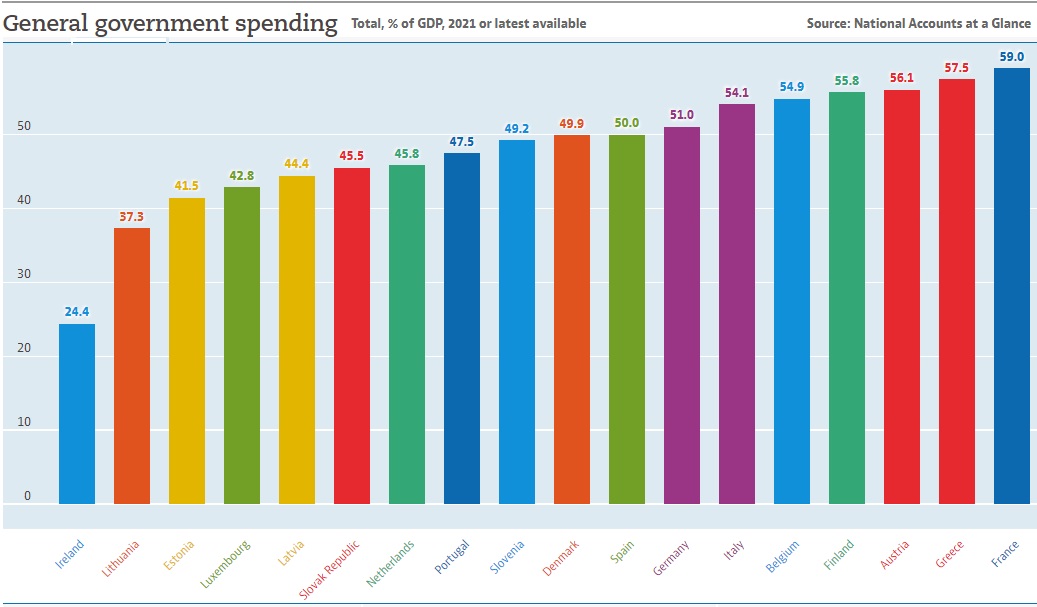
My pessimism is based on the fact that European nations already suffer from staggering fiscal burdens.
And because of aging populations, government spending is projected to consume ever-larger shares of economic output in the future.
It seems more people are now aware of the problem.
Here are some excerpts from a report in the Washington Post by Annabelle Timsit, Anthony Faiola, and Aaron Wiener. They focus on France and Germany and the news is grim.

Across Europe, and especially in France, the bill is coming due. The cost of…the so-called European way of life, offering health care, affordable education and a dignified retirement to all, through high social spending — is becoming unbearably high. …In France, …the nation’s debt soars, its credit rating slips, incomes stagnate, prime ministers fall and the country stumbles into ungovernability…
Related challenges loom in neighboring Germany, where the economy is flat after two consecutive years of decline, companies are shedding jobs, infrastructure has crumbled, and the government is bracing the populace for tumultuous cuts… For France and Germany, long the pillars of the European Union, it is unclear that they can still afford to be the West’s guiding lights of economic justice.
Here are some passages showing the dependency mindset in France.
Anastasia Blay, 31, a camera assistant in Paris, does not believe her generation should…sacrifice benefits. For years, Blay survived with the help of a government subsidy for entertainment workers…which she and others view as an unbreakable social contract… A monthly social welfare payment for low-income workers now supports her during periods of unemployment…
She has joined a string of street protests aimed at paralyzing the country. Even with government aid and a family apartment that allows her to live rent-free, she says it’s hard to make ends meet. “For me, the problem is injustice, the gap between the poor and the rich, and the rich who, in reality, are barely taxed compared to what they earn,” she said. While she said she feels “a bit ashamed” to rely on welfare and fears people’s judgment, the payments help her “keep my dignity and … live decently.” “It’s a right and not a privilege, in my opinion,” she said.
Ms. Blay obviously does not understand economics, as shown by her views that upper-income people are under-taxed.
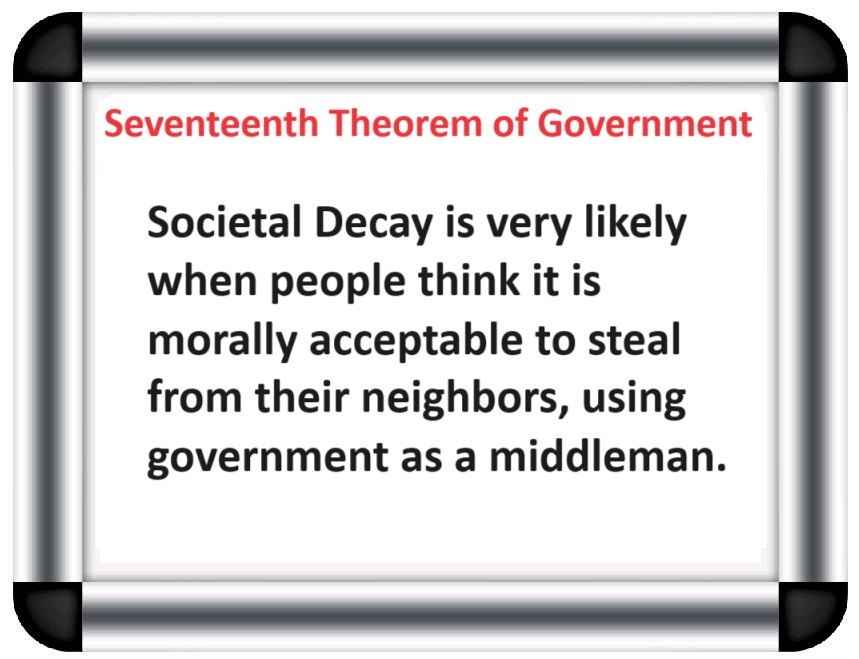
But the biggest problem with the above is that she thinks mooching off taxpayers is “a right and not a privilege.”
She could be the poster child for my 17th Theorem of Government.
Let’s shift to Germany. Here’s an excerpt showing fiscal extravagance – and fiscal delusion – in Germany.
Today, between basic welfare and housing assistance, a German family of four on welfare can receive as much as 5,000 euros a month — roughly $5,873, or $70,476 a year, an unthinkably high amount in the United States. …Labor Minister and co-SPD chief Bärbel Bas responded curtly to Merz’s claim that Germany can’t afford its social programs. “That is bulls—,” Bas said.
At the risk of understatement, Miniser Bas is wrong. And interest rates of long-term German government bonds suggest financial markets agree with me.
I’ll close with a chart, based on IMF data, showing that the problem in much of Europe is excessive government spending. As you can see, both taxes and spending consume much greater shares of economic output in Germany and France than Switzerland.

I also included Italy to show that France and Germany are just as bad – or even worse – on fiscal policy.
Actually, I’ll include one more chart. It’s no coincidence that Switzerland is much richer than its neighbors – more than $22,000 of additional economic output per year compared to the average of Germany, France, and Italy!

Maybe, just maybe, there’s a lesson to be learned about the relationship between the size of government and national prosperity.
P.S. I should have written “Medium-Sized Government Switzerland” since the East Asian tiger economies have significantly smaller spending burdens.

No comments:
Post a Comment