Search This Blog

De Omnibus Dubitandum - Lux Veritas

Showing posts with label Book Review. Show all posts

Tuesday, June 14, 2022

A tale of two great, must read books—Part two

By June 13th, 2022 | Books, Energy | 48 Comments 


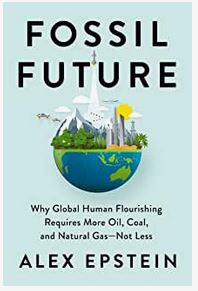
If you have time to read two books in the coming year make them The Cloud Revolution, and the Fossil Future.  The latter is reviewed below and Cloud Revolution appeared last week at CFACT.org.

Fossil Future will arm you for life with the information to discuss human-caused climate change exaggerations with neutral friends who will listen.  The Cloud Revolution will disabuse you of lingering pessimism resulting from the present world takeover of truly communist factions hoping to destroy capitalism. The human caused climate change fraud is a path to the destruction of capitalism and the installation of communism. Yes, you read that correctly. It is time to tell it as it is.

If you think I am being too strident mentioning communism let me quote Alexander Trachtenberg, the head of the American communist party at a rally in Madison Square Garden, New York City in 1944.

When we get ready to take the United States, we will not take you under the label of Communism. We will not take you under the label of Socialism…We will take the United States under labels we have made very lovable, we will take it under Liberalism, under Progressivism, under Democracy. But take it we will.”

In the United States they are doing this under the guidance of Billionaires, Bill Gates, Michael Bloomberg, Jeff Bezos, Mark Zuckerberg and most of the jet setters who just attended the World Economic Forum (WEF) in Davos Switzerland. There they continued their plot to change the world into a system they can rule. You see, many if not most, mega-rich people are sure they can run your life and the world better than you, or us, because they so cleverly made tons of money. Surprisingly, they have nothing, tangibly, to look forward to in the future, having all that money can buy, other than Increased Power. They know that only Communism, by whatever its name they choose, can achieve this for them. Capitalism with all its faults can not readily become a Tyranny though the current US administration is doing its best to make it so.

A tale of two great, must read books -- Part two

These two books I am recommending, if not insisting you read in the coming months, will arm you to be a great warrior on behalf of liberty, both to fight the climate change, anti-fossil fuel fraud, while lifting yourself and your friends out of the pessimism gripping our nation. Both are extremely well written comprehensive texts but both are 400 page books. Few will be able to look forward to a quick read. I strongly recommend my own 10 pages a day reading plan for great books. That way you become energized daily with new information that whets your appetite for the next days read.

Alex Epstein is a trained philosopher and indeed this text is a philosophy book aimed at presenting a complete view of a scientific discipline, rarely fully understood by anyone. He captured the knowledge he sought beginning in 2007, in his initial 2014 book The Moral Case for Fossil Fuel. He hits the high points of that book in this book’s introduction. Thus, those who read that book will know where he is beginning this new project. His goal with every section, paragraph and sentence is to arm the reader with the intent of utilizing fossil fuels to maximize “human flourishing” of the world’s population.

At a time when government, education and financial institutions are attacking fossil fuels, Alex provides the ammunition to fight the myths and presents common sense solutions that advance the cause for reliable sources of energy. He identifies “human flourishing” as the standard by which we should evaluate any climate policy and attitude toward sources of energy.

This term appears in the book’s sub-title and is repeated constantly throughout the text so I will define it here. Human Flourishing is defined as an effort to achieve self actualization and fulfillment within the context of a larger community of individuals. Each then has the right to pursue his or her such efforts. It conjures thoughts in my mind of our Declaration of Independence where Thomas Jefferson said each of us has an inalienable right to the pursuit of happiness. The climate scare has to be considered the biggest obstacle to that pursuit in decades.

In his first book as well as this one he makes the controversial prediction that fossil fuel use would grow, not shrink. The benefits of increasing fossil fuel use far outweigh any conceivable negative impacts. If the book has any weakness in my opinion, it would be his open mind toward the impact of carbon dioxide emissions on the Earth’s temperature though he does convey the fact that if there is any impact, it is completely insignificant.

Epstein’s prediction of increasing fossil fuel is based on his conviction that it will have a unique ability to provide low-cost reliable energy in a world where far more energy will be needed for the billions of people who still use almost no energy. He explains how low-cost reliable energy empowers us to use machines to improve our lives, our environment and our health.

In an interview with conservative billionaire (almost an oxymoron) Peter Thiel, developer of PayPal, during the launch of this book, the author referred to the infamous initials ESG (environment, social and governance) as important to connect with the initials CCP (Chinese Communist Party). Scoring their population on their conduct is really where ESG began. He also made a brilliant comment that threads through this entire book that “technology is trying to make more with less” while everything connected to the fossil fuel fraud is trying to make less with more and thus impoverishing a population.

All through Fossil Future, Epstein successfully takes on the insanity we have been exposed to by calmly replacing it with a philosophic point of view from which all lies fall away. I so admire this approach as my own 60-year history in the energy field has prevented me from going about this debate without losing my cool and walking away.

Understand that Epstein tells us that the countries most avidly embracing fossil fuel elimination are the world’s freest countries. Contrast this with unfree China whose goal is to rule the world, uses 85% fossil fuel and uses it to manufacture most of the solar panels and wind turbines beginning to stifle our ability to maintain our standard of living.

While the world is now universally told how bad carbon dioxide resulting from the burning of fossil fuels is, Epstein explains in details how they result in higher environmental quality and human flourishing. In contrast he details the apocalyptic consequences of eliminating fossil fuels promoted he says by The New York Times, The Washington Post, financial institutions such as Blackrock, corporations such as Apple and of course the United Nations.

As a trained philosopher the author has studied the history of ideas extensively and admits to being haunted by the fact that some of the worst ideas in history such as slavery, racism and eugenics were successfully spread as the consensus of experts. It turns out that it is not that the research experts perform to produce these ideas are so in error but rather it is because the system we rely on to tell us what the experts think is significantly distorting what the experts think. In climate science this is further complicated by the fact in complex sciences there is hardly anyone actually expert in every phase of the discipline.

The fundamental principle of the human flourishing framework is that it should be the primary moral goal of our evaluations. It is a long term and wide ranging goal that thinks generations ahead. The anti-human goal of eliminating fossil fuel is immoral.

There will be a few days in your life when you do not read or hear now some of the many lies about fossil fuels and carbon dioxide, our molecule of life. Don’t even consider sitting down to read this book in a single sitting. It can’t be done. But if you want to do your part in saving our way of life, our standard of living, our capitalist political system AND THE LIVES OF THE LESS FORTUNATE ALL OVER THE WORLD, get a 10-page dose of Alex Epstein’s philosophical approach to this subject each and every day.

Note 1- Human Flourishing is defined as an effort to achieve self actualization and fulfillment within the context of a larger community of individuals, each with the right to pursue his or her such efforts.

Note 2: Portions of this article were excerpted from the book FOSSIL FUTURE: Why Global Human lourishing Requires More Oil, Coal, and Natural Gas-Not Less, with permission of the author Alex Epstein and the publisher Portfolio/Penquin. I strongly recommend this book to everyone fighting for the preservation of life in America which has been made possible by our abundance of fossil fuels before the leftist, liberal, progressives and yes communists have attempted to limit the well being of human-kind.

Author

  • CFACT Senior Science Analyst Jay Lehr has authored more than 1,000 magazine and journal articles and 36 books. Jay’s new book A Hitchhikers Journey Through Climate Change written with Teri Ciccone is now available on Kindle and Amazon.


Wednesday, June 8, 2022

A tale of two great, must read books—Part one

By June 6th, 2022 Books, Technology 35 Comments

If you have time to read two books in the coming year make them THE CLOUD REVOLUTION and FOSSIL FUTURE. The first is reviewed below and the other review will appear next week here at CFACT.org. FOSSIL FUTURE will arm you for life with the information to discuss the human caused climate change FRAUD with neutral friends who will listen. THE CLOUD REVOLUTION will disabuse you of lingering pessimism resulting from the present world takeover of truly communist factions hoping to destroy capitalism. You will become the most popular among your friends as you succeed in raising their hopes for the future.

As a sidebar to my readers who think I am being too strident mentioning Communism, let me quote Alexander Trachtenberg, the head of the American Communist Party at a rally in Madison Square Garden, New York City in 1944.

When we get ready to take the United States, we will not take you under the label of Communism. We will not take you under the label of Socialism…We will take the United States under labels we have made very lovable, we will take it under Liberalism, under Progressivism, under Democracy. But take it we will.”

In the United States they are doing this under the guidance of billionaires, Bill Gates, Michael Bloomberg, Jeff Bezos, Mark Zuckerberg and most of the jet setters who just attended the World Economic Forum (WEF) in Davos, Switzerland. There they continued their plot to change the world into a system they can rule. You see, many if not most, mega-rich people are sure they can run your life and the world better than you, or us, because they so cleverly made tons of money. Surprisingly, they have nothing, tangibly, to look forward to in the future, having all that money can buy, other than Increased Power. They know that only Communism, by whatever its name they choose, can achieve this for them. Capitalism with all its faults can not readily become a Tyranny, though the current US administration is doing its best to make it so. 

These two books I am recommending, if not insisting you read in the coming months, will arm you to be a great warrior on behalf of liberty, both to fight the climate change, anti-fossil fuel fraud, while lifting yourself and your friends out of the pessimism gripping our nation. Both are extremely well written comprehensive texts, but both are 400 page books. Few will be able to look forward to a quick read. I strongly recommend my own 10 pages a day reading plan for great books. That way you you become energized daily with new, often exciting information, that whets your appetite for the next days read.

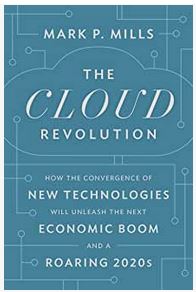
So now on to Mark Mills’ masterpiece, The Cloud Revolution.  

A tale of two great, must read books -- Part one

When I review books, I always calculate the number of references and notes as it is a quick indicator of how comprehensive the author went about his work. Marks Cloud Revolution has 823 of them which puts it in the top 10 of all books I have reviewed over the years (which is about 500). This is a result of my having had a book review column in the journal of Groundwater for 25 years.

I was particularly interested in Mark’s detailed acknowledgements in order to learn of all the folks who helped him. Hillary would not have been a total idiot when she said, it takes a village”, had she been talking about outstanding books.

The conventional wisdom on how technology will change the future is wrong, argues Mark Mills in his book The Cloud Revolution, who lays out a very different and hugely optimistic vision of our future. The mainstream forecasts, which you should try and avoid, fall into three very wrong scenarios, all quite pessimistic: the new normal getting food from a motorcycle driver and buying a car with a Bitcoin is as good as it gets; a dystopian future with jobs destroyed by robots and the digital world leveling business; 3- a technically ignorant world where wind, solar power and electric cars reign.

According to Mills, a convergence of technologies will drive an economic boom over the coming decade (editors note: when we get rid of the power in the hands of this administration, which we surely will). Not a single invention will make this so, but a convergence of new knowledge in three primary domains: microprocessors, materials, and machines.

Microprocessors are increasingly embedded in everything. Materials from which everything is built are emerging with near magical qualities, and machines are undergoing a complimentary transformation. Accelerating and enabling all of this is the Cloud, history’s biggest infrastructure which is itself based on the building.

Blocks of next generation microprocessors and artificial intelligence (AI). On this term (AI) he writes how exaggerated its malevolence is. Happily Mills explains its terminology to have been a big mistake offering false fears.

In doing so he explained the similarities of the technologies that first brought forth the Roaring 20’s where information (telephones), materials (plastics and pharmaceuticals ), and machines (cars and power plants) launched a great century—in spite of the wars that held us back as wokism is doing today.

The world of techno-pessimists leads to demands for more government control, socialized medicine, more mandates to achieve preferred social outcomes and far bigger safety nets. Very different actions are called for if you believe instead that a new boom is imminent, and that unbridled capitalism (there are no true fee markets, only freer ones) is the only mechanism that can unlock the complex and intertwined dynamic of markets that leads to a new mass flourishing. (Editors note: I do not usually write notes in my reviews but both authors Mills and Epstein in their books mentioned the unusual word “flourishing” so you will find the definition below. It is a must for Epstein’s book as it uses it more than 3 dozen times).

The new normalists don’t see anything on the horizon with potential economic or social impacts equivalent to the dawn of electrification or plumbing. To counter these folks who may make up a majority, its not enough to explain that progress has always happened. Its also not enough to just list amazing inventions because inventions and services yet to emerge won’t be on any such list. We need hard evidence to counter the new normal claim. This is clearly the purpose of Mark Mills’ wonderful book in which he succeeds beyond what I thought possible.

This time at the center of the information journey we find not a single tool like the radio or telephone or the smart phone. We instead find the microprocessor, a general purpose information tool whose sizes range from a spec in one’s eye, to a dinner plate, all with capabilities ranging from simple counting to a main-frame of old on a single chip. They are the building blocks of The Cloud.

Less aware to the average citizen is the fact that today instead of relying on a fixed catalogue of available materials or undergoing trial and error attempts to come up with new ones, engineers can turn algorithms running in super computers to design unique materials, based on a “material genome” with properties tailored to a specific need.

This book is, in effect, a survey of the patterns, evidence, and implications of revolutions in technology’s three spheres which are, microprocessors, materials and machines. Mills does not attempt to catalogue every consequential innovation, instead he focuses on key innovations that either instigate or typify foundational changes. He builds on the famous business philosopher Peter Drucker who believed that the future is built on the past. Mills says “Our near future was invented in the recent past.” You may be amazed by how many great inventors were actually building on the work of past folks with less ability to promote their genius.

While in the exploration of the recent past, Mills does mention specific companies and individuals but he makes clear that he does not wish to pick winners or losers. Of course, its the entrepreneurs, investors and business leaders who literally capitalize on and thus socialize the benefits of revolutionary innovations. His purpose, however, is to reveal the overall scope and depth of the epoch-shifting innovations now coming.

Mills divides his book into four parts: explaining how many things can be forecast; describing the nature of the Cloud that so few understand; focusing on the revolutions occurring in information, materials and machines; and speculates on how these things will impact activities, business, work, travel, health, safety and entertainment.

Of course anything that purports to be a forecast faces the familiar aphorism that has been attributed to everyone from Nostradamus and Mark Twain to Niels Bohr and Yogi Berra: “Prediction is very difficult, especially if its about the future.”

Buy The Cloud Revolution, read it a little at a time and you will thank me. You are welcome.

Note 1- Human Flourishing is defined as an effort to achieve self actualization and fulfillment within the context of a larger community of individuals, each with the right to pursue his or her such efforts.

Note 2: Portions of this article were excerpted from the book THE CLOUD REVOLUTION: How The Convergence of NEW TECHNOLOGIES Will Unleash The Next ECONOMIC BOOM and a ROARING 2020s with permission of the author Mark Mills and the publisher Encounter Books. I strongly recommend this book to everyone fighting for the preservation of life in America. It has been made possible by our abundance of fossil fuels. Now the leftist, liberal, progressives and yes communists are attempting to limit the well being of human-kind.


CFACT Senior Science Analyst Jay Lehr has authored more than 1,000 magazine and journal articles and 36 books. Jay’s new book A Hitchhikers Journey Through Climate Change written with Teri Ciccone is now available on Kindle and Amazon.


Monday, May 23, 2022

Book Review With a Warning: Red Notice

By Rich Kozlovich 

I have the privilege of belonging to an eclectic e-mail group that discusses all the world's woes, and this Russo/Ukrainian War is a daily topic.  One of the people in that group  recommended reading Red Notice.  I bought it and found it was even more insightful than I expected.  Also, as I was reading this I thought it read like a movie script, and apparently someone else thought so too, as they might make a TV series on this story. 

It starts out as just another autobiographical business story, and only moderately interesting. But it soon turns into a very real drama that ends up being a dramatically emotional story highlighting and exposing how vile, corrupt and disgusting are the minds of Putin and his murderous, and I highlight murderous, organized criminal band of thugs really are.     

Buy it, read it, and as you do you will recognize the very things Putin has done, and is doing, makes your mind travel down a road showing that same kind of tyranny, crime and corruption is being imposed on America today. 

For years I had said Putin was playing chess while Obama was playing checkers.  I was wrong. They were both playing patty-cake, and both Kerry and Hillary were a party to that, and this book makes it clear just how contemptible Kerry is.  Also, John McCain was part of the problem, not the solution, and it almost makes me break out in hives to say this, I have to give John McCain an attaboy here over his support of the Magnitsky Act.
 
Putin was never playing chess, and the reason why is he never had to play chess, at least until Trump was elected. And as it turned out he was ill equipped.  Reading this book highlights his mind is still the mind of a KGB Lt. Colonel thug who became Russia's President, then it's dictator and now it's Czar, and the head of a massive criminal enterprise known as the government of Russia. And there are no boundaries to the savagery of his mind, or the minds of his myrmidons.  There are no boundaries on the left because there's no moral code on the left. 
 
Reading Red Notice makes clear of what all those years of communist infestation does to the moral values of a culture.  Nothing any Russian leader, and their society in general says, has a moral foundation other than what's expedient.   It's all about money and power.  I know that's a generalization, but generalizations aren't supposed to do anything but demonstrate a general view and approach of a society based on what mostly happens within a society.

The elite in America has gotten away with untold criminal activity while the January 6th attendees, none of whom were charged with a felony, are having their rights to a speedy trial and bail violated, at times not allowed legal representation and kept in conditions that are deplorable.  Then forced to agree to guilty pleas to get out of prison after being illegally held for months, which cost them jobs and created massive hardship on their families.  That's just what happens in Russia.  

Yet as we see Hillarygate unfolding,  something we've known from the beginning, Hillary is guilty as sin, making this question necessary: After spending three years and millions of dollars how is it possible Mueller and Weissmann didn't know Hillary created the Russian hoax?  

How could John Brennan, who was head of the CIA, and James Clapper, who was head of National Intelligence, stayed out of jail in spite of lying to Congress, and many more and much worse violations of American law, when General Flynn was railroaded by a corrupt federal judge and a vile and corrupt FBI, who knew Flynn wasn't guilty of any crime whatsoever?  The entire federal judiciary, along with the legal system is now totally suspect.  Just like Russia. 

Just like Russia, the laws don't apply to the elite.  Buy and read Red Notice, the danger signs are all there.  It's happening here.  That's not just my well documented, well thought out, and totally logical opinion. 

It's History!  And that history is being told by those who fled socialist nations, or I should say escaped from these nations, who see events unfolding and are warning America:  It's happening here. 


Sunday, October 3, 2021

Don’t waste time or money on ‘Silent Earth’

This new book is just another junk-science screed against modern civilization and technology 

Paul Driessen

Book reviews usually tell people, buy this new hardback. This article advises, don’t bother reading Silent Earth, much less purchasing a copy; it’s mostly a junk-science, anti-technology screed.

Dave Goulson’s book expands on Silent Spring, Rachel Carson’s polemic against pesticides that helped rid Europe and the USA of deadly malaria, and now protect crops that require so much land, water, work, fertilizer and energy to grow and harvest that we dare not sacrifice them to hordes of hungry insects.

Carson falsely blamed DDT for her cancer – and launched the practice of using conjecture, poetic prose, hyperbole and even fraud, instead of evidence-based science, to advance environmentalist agendas. The Environmental Defense Fund used her book to drive its campaign to ban DDT and give environmentalists “a level of authority they never had before.”

The EPA ban led to the deaths of millions of Africans and Asians from malaria, which could have been reduced dramatically by using this powerful spatial repellant in conjunction with modern insecticides and anti-malarial drugs. (See here here here and here.)

Relying mostly on inventive speculation, Goulson claims a silent spring devoid of chirping birds could soon become a silent planet devoid of insects that pollinate flowers and crops, and feed birds, amphibians, reptiles, mammals and (if former UN Secretary-General Kofi Annan has his way) billions of us humans.

It would take another book to address all the new book’s errors and problems, but here are a few.

Goulson transforms the supposed “bee-pocalypse” of a few years ago into a global apocalypse for all insects, and potentially all life on Earth. He blames modern agriculture, “greedy corporations,” free-market/personal-choice capitalism, too many humans who eat too much and live too well, urban light pollution and o course manmade climate change. Above all, he blames modern synthetic pesticides, though he does recognize that many “natural” “organic” chemicals are toxic to insects, wildlife and even humans.

Honeybee populations have been on a happy rebound for several years now, after being hit hard by Varroa destructor mites, Nosema, and other bee parasites and diseases. They were also harmed by beekeepers who tried to address these problems, but sometimes misused or overused mitacides. US Department of Agriculture surveys now show there are now over 150,000 more beehives than in 1995.

Studies in actual farmers’ fields have consistently shown no adverse effects on honeybees at the colony level from realistic exposures to neonicotinoid insecticides, one of Goulson’s primary scapegoats. In fact, bees thrive in and around neonic-treated canola, corn and other crops in the United States, Canada, Europe and elsewhere. As to wild bees, 98% don’t even pollinate agricultural crops – and the species that do are thriving, even though they have the greatest contact with neonics. That shouldn’t be surprising.

Neonicotinoids are used primarily to coat seeds. They are systemic pesticides that become part of the plant tissue and target only pests that actually feed on the crops, particularly during early growth stages. Sulfloxaflor is similar in that regard. Both are far safer for general insect populations than older pesticides or organic farming chemicals that are applied by air, hand or truck across entire fields – and often beyond.

Goulson ignores all this and advances his central claim that populations of all insects are in precipitous decline globally. He bases that largely on a 2017 study by him and several colleagues. They assert that insect populations plummeted by over 75% during a 25-year period in several German nature reserves – then extrapolate that and a few other studies to the entire planet.

But their study didn’t track the same areas from year to year and employed traps that capture insects only while they’re flying. That misses non-flying insects and is heavily dependent on rainfall and other weather.

There’s simply no reliable evidence of a general insect decline. Indeed, some 900,000 insect species have been identified around the world, though total estimates range from 2 million to 30 million species. That and extremely limited monitoring programs make it impossible to calculate global insect population trends. Moreover, an extensive insect population study published in 2020 found no overall decline in North America, with declines in some US areas offset by increases elsewhere. The verdict is still out.

Goulson also claims modern pesticides are vastly more toxic than their predecessors. However, an Agriculture Department analysis concluded that, between 1968 and 2008, overall US pesticide toxicity plunged by 98% – while the amount of pesticides (insecticides and herbicides) applied per acre declined by 60% and pesticide persistence in soils and waters was cut in half, as farmers used different, better, more-targeted pesticides more carefully and judiciously, and employed other measures to control pests. He pillories glyphosate, the active ingredient in the herbicide Roundup, claiming the chemical is harmful to bees, has been linked to other insect and even bird declines, and causes cancer in humans. For evidence he cites the International Agency on Research and Cancer. But as I explain in a medical journal paper, IARC has strong ties to American trial lawyers who have filed multiple lawsuits over glyphosate – and the agency’s claims have been roundly contradicted by a decades-long US National Cancer Institute Agricultural Health Study – and by more than 3,300 studies around the world that support glyphosate safety. Reliance on IARC puts Goulson on very thin ice.

He’s against synthetic fertilizers (and more CO2) that help us grow far more food from much less land – because they can allegedly reduce floral diversity, make other plants less palatable for insects, pollute aquatic systems and contribute to climate change. He wants children to learn more about ecology and nature in school (presumably only his lesson plans) – and applauds the UK’s Extinction Rebellion lunatics.

These errors, omissions, exaggerations, falsifications and biases shouldn’t be surprising. A widely published biology professor, Goulson is also a trustee for Pesticide Action Network, an ideologically driven anti-pesticide organization.

Goulson’s proffered solutions to his imagined insect Armageddon are equally fanciful. While acknowledging that organic farming uses nasty chemicals and produces 80-90% lower yields than conventional modern agriculture, he wants still more organic farms – even though plowing billions more acres for the same overall crop yields would have horrific impacts on insects and wildlife.

With millions of jobs disappearing, he says the newly unemployed could work on organic farms, in backyard plots and in urban community gardens (doing stoop labor, pulling weeds and picking bugs off vegetables). Ruling elites wouldn’t do such work, of course, but we commoners should.

Amid his concerns about climate change, the author likewise ignores how industrial-scale wind turbines would splatter birds and insects, solar panels would obliterate habitats, and converting forests into wood pellets for “biofuel” electricity generation would destroy still more habitats. Mining and processing for Green New Deal metals and minerals would drastically harm people, insects and planet.

Ultimately, Goulson concludes, we need fewer people, who eat less and “switch to a predominantly vegetable diet, supplemented by small amounts of sustainably-harvested fish and grass-fed meat” (and bugs). Ruling elites once again likely exempted.

It all looks lie part of the Green warriors’ mission to stamp out prosperity as we know it.

Silent Earth will undoubtedly get rave reviews from environmentalists, leftist journalists, Big Tech, teachers unions, and the rest of the Cancel Culture. The insanity will get foisted on our children. Parents and policymakers should be wary.

Paul Driessen is senior policy advisor for the Committee For A Constructive Tomorrow (www.CFACT.org) and author of many articles on the environment. 


Friday, September 3, 2021

New Book Alert: Fake Invisible Catastrophes and Threats of Doom.


By Dr. Patrick Moore 

There have been dozens of good books written in the past decade telling the true stories countering the incessant lies of alarmists blaming impending environmental disasters on carbon dioxide emissions. None have been better than the newest contribution by Patrick Moore and certainly none as up to date as this just published contribution to real science.

This must read is now on sale in the CFACT Store

If you need further convincing, here is Dr. Lehr's full review.


Friday, May 21, 2021

A Leader Without Followers

Former Speaker of the House John Boehner is unassuming in On the House: A Washington Memoir. He promises that the book will not be “another boring drag through Washington’s ‘halls of power.’” “If you’re looking for Shakespeare, or my 15-point plan to save the world, this isn’t the book for you,” he writes. This will be a book about real politics, filled with interesting personal stories, rather than instruction in public policy or political theory.

On the House, for the most part, delivers on this opening promise. It is a folksy, breezy read that I completed in two or three sittings of a couple hours. And it is engaging, at least until the final three chapters, which consist of trite discussions of Boehner’s relationships with lobbyists and the media and mildly interesting but ultimately forgettable stories of foreign travels. Before then, there are a few perplexing detours (such as an encomium to his high school football coach and Gerald Ford) interspersed with genuinely entertaining stories about what really goes on in Washington.  .............To Read More....


Thursday, September 17, 2020

Book Review: The Myth of America’s Decline: Politics, Economics, and a Half Century of False Prophecies, by Josef Joffe


Reviewed by Jay Lehr (Originally published on December 22, 2013)
I will cut to the chase and tell you that this book is the most brilliant discourse on world economics and its history I have ever read. If you have ever worried about China one day over taking the United States in your life time or that of your grandchildren’s, this book will eliminate those sleep depriving thoughts.
 A sub title for the book could have been The reality of China's declining path to progress. One must care about both history and the realities of economic outcomes to fully enjoy the abundant supporting information that Joffe presents to his readers. But even a speed reader will discover a bounce in their step when the journey through its pages is complete. And if education is your main concern, buy the book just to read the chapter Challengers and Champions to know how well we are doing as a nation in spite of the impediments placed in our way by our government and its teachers unions.
The myth of our decline is mainly homemade by our resident doomsayers, originating in the 1950s, when Sputnick’s launch made Russia look pre-eminent and then reenacted once every decade with the threat from another country. But if history has one certain message, it is the transience of spectacular growth, a fate that may have already overtaken China as it did earlier to Russia, Europe and Japan.
Joffe succinctly summarizes the historic ups and downs of the Kennedy, Johnson, Nixon, Carter, and even Reagan years, where he shows the downs to be exacerbated by journalistic fictions when comparing us to what were, in all cases, inferior competitors. It has been the incessant drum beat of America’s shrinking global power and prestige that surfaced through the decades, that has made our populace constantly concerned that we are sinking slowly, while others were rising with our influence on the wane.
Indeed there have been ample catastrophes on the world’s stage to feed the journalists and doomsayers with smoke where fire did not exist. None offered greater fodder than Jimmy Carter with his famous Malaise speech of 1979 which led Newsweek to print a cover story “Has the U.S. Lost its Clout”.  On the opposite side of the coin, Reagan used these misguided feelings to propel himself into office with his famous campaign speech “It is Morning Again in America”.
When Japan was predicted to overtake us in 1985 their economy was one third of ours, and five years later it was half of ours. Shift to the present and it is again one third of ours; so much for linear projections, “tomorrow will be like yesterday.” Joffe explains to us.
 “Japan’s bureaucratically guided capitalism..demonstrated an increasing propensity to corruption. The banking system that once gushed forth limitless capital was mired in bad debt and cover-up. The school system? An inhuman pressure cooker that was good for rote learning, but flunks on fresh thinking.” Now he tells us that China is following that same scenario.
We were told that America was evolving into a nation of hamburger flippers, pizza makers and big box store clerks, but in fact the opposite was true. The primary indicator of national success is Gross Domestic Product (GDP) per worker, and we have always outranked our nearest competitor by a wide margin over the the past 50 years.
At the turn of this century globalization became the rage and here we were destined to lose our edge. It did not happen.  “The nice thing about prophecy” Joffe tells us is that doom never comes with a date.”
The crash of 2008 gave the doomsayers new hope of our decline, but who among the world’s nations is roaring back? Only the U.S. of A.. Usually “Declinists” just come back, they never repent but Roger Altman the former Deputy Treasury Secretary has done just that with this quote, “the US banking system has recovered faster than anyone could have imagined. Capital and liquidity has been rebuilt to levels unseen in decades.”  Joffe tells us that the United States has made a huge leap in industrial competitiveness and can look forward to bringing back jobs from the rest of the world. Our breath taking increase in energy development from horizontal drilling in shale will increase our GDP a full percentage point within five years, he says.
Joffe traces declinism throughout history beginning with the bible itself. It has always been a mechanism to first scare people and then offer to lead them out of despair. He quotes Matt Ridley’s The Rational Optimist “Arch-pessimists are feted, showered with honors and rarely challenged let alone confronted with their past mistakes.”
For some the book offers more history and statistics than one may desire but these parts can be sped through.
Most readers will recall the recent focus on the BRICs, Brazil, Russia, India and China, said to inherit the earth. Today they all find themselves mired in economic turmoil, and of course the European Unions financial crisis is everyday news. It is not clear how China could soon best a nation like the United States that weighs in with a per person income ten times larger. “A nation becomes neither rich nor powerful by adding 1.3 billion very poor people”, Joffe says.
The authors analysis of our superior military power versus all other nations is inspiring both in terms of hardware, planes, ships, tankers and military bases, all of which dwarf the rest of the world. He surprises us with figures that show that this is actually all very economical.
Joffe traces the economic miracles of Taiwan, South Korea, Japan and China, explaining that none can ever last, as he says “whether it is balloons, airplanes or economies, what goes up must come down. His basic knowledge of economics explains the formula that cannot last” low beginnings, spectacular growth, rising prosperity, authoritarian rule, forced capital accumulation, infant industry protection, a high saving rate and an under valued currency”. His detailed analysis of all the problems China has created including corruption and the wealth accrued by its leaders is a fascinating read. He leaves no question unanswered about their present and future. They are in a double bind that will stifle future economic growth regardless of the political direction they go.
Joffe summarizes a presentation by a Chinese scholar in 2011 presented at Washington’s Woodrow Wilson Center assessing America’s advantages in the global contest.
They include: population, geographic position, natural resources, military muscle, high level technology and education, cultural soft power, cyber power, allies, geopolitical strength, intelligence capabilities, intellectual power and global strategic power.
In the final chapter, America, the West, and the Rest, Joffe explains all elements of world order no longer ruled by one, two or five nations, or even the U.S. Battles win tactical gains, no longer strategic gains, while explaining clearly how world power created their earlier empires over the past 500 years.
This book is difficult to put down both for the strength of its argument and the joy it brings to the formerly pessimistic reader. In the end you will not buy into to the doomsayer’s message again, and the state of our current federal administration will bother you less. I am well aware that my reviews have the feel of high school Cliff Notes, short circuiting the need to buy the book. Trust me here that I can never come close to creating a pale shadow of this great book. Read my review and you will smile for a day, read the book and smile for a decade.


Saturday, August 22, 2020

The Battle for the Indo-Pacific

A book of essays explores Asia’s geopolitics.
 
Guy Sorman August 21, 2020

Asia’s New Geopolitics: Essays on Reshaping the Indo-Pacific, by Michael Auslin (Hoover Institution Press, 263 pp., $29.95)

Michael Auslin, an historian at the Hoover Institution, argues that the United States has no global strategy to contain China’s overwhelming ambitions. Moreover, he believes, the U.S. does not understand the collective destiny of Asia. Local agreements, whether economic or military, with India, the Philippines, or Japan cannot balance the power of Beijing, which aims to control this part of the world. 

In his new collection of essays, Asia’s New Geopolitics: Essays on Reshaping the Indo-Pacific, Auslin argues that China’s economic growth, the foundation of its strategic ambitions, reveals the extent of the Communist regime’s cheating, propaganda, and massive theft of intellectual property. If Chinese stealth fighters look very much like U.S. planes, he observes, the only rationale is copycat and theft.
Auslin reviews the Beijing regime’s incremental advancements: the creation of artificial islands in the South China sea, for instance, illustrates its long-term strategy. Indeed, China acts as a patient chess player. China’s gamesmanship, concurs British historian Niall Ferguson in the foreword, is the greatest strategic challenge of the next generation.........To Read More......

Friday, August 14, 2020

The Woke Supremacy

Evan Sayet’s new book explains it all for you.

Mark Tapson
If you are familiar with the wit and wisdom of conservative philosopher and comedian Evan Sayet from his first book, KinderGarden Of Eden: How the Modern Liberal Thinks, or his lecture to the Heritage Foundation on the same topic – the most-viewed lecture in Heritage history, which the late Andrew Breitbart called “one of the five most important conservative speeches ever given” – or his illustrated faux children’s tale about climate change, Apocali Now, or his standup performances, then you know what an incisive and entertaining perspective Sayet brings to our national political conversation. Now Sayet has authored a brand new, must-read book about the current political landscape: The Woke Supremacy: An Anti-Socialist Manifesto, available now. FrontPage Mag is proud to publish the following exclusive excerpt. Check it out below, and get your copy of Evan Sayet’s The Woke Supremacy:
Not all Globalists are Socialists but all Socialists are Globalists. In fact, Globalism is one of the defining traits of Socialism and is codified in the Socialists’ founding document. This is why Marx made his ultimate call-to-action for the workers not just of Russia but of the entire world to “unite” in what he intended to be a global revolution.

While this “taking over the world” stuff might sound like the dreams of only madmen, sociopaths and megalomaniacs, and not at all what today’s Socialists in America would want to do, it is, in fact, the endgame of every Socialist whether he screeches it with vicious vitriol like Hitler, delivers it in market-tested soundbites like Elizabeth Warren, or sets it to a happy tune like John Lennon.........To Read More....

Monday, May 18, 2020

Bookviews by Alan Caruba

(Editor's Note: Sadly, my friend Alan Caruba passed away some years ago. He played a large part in my development as a blogger, allowing me to publish his work, and even quoted me in his articles on occasion.   Alan was special to the Canada Free Press, because those who started it were also encouraged by Alan. 

I've posted most of his work over the years, and for some reason this site, Book Reviews by Alan Caruba, came up as a source for Paradigms and Demographics.  I didn't know it existed, but I think it's special, and I'm sure you will enjoy it.  Go to the site as it opens up a lot more than appears here. RK)

Alan Caruba
 
My photoI am and have been for a long time a writer by profession. I have several books to my credit and my daily column, "Warning Signs", is disseminated on many Internet news and opinion websites, as well as blogs. In addition, I am a longtime book reviewer and have a blog offering a monthly report on new fiction and non-fiction.

A monthly report on the best in new fiction and non-fiction books. Alan Caruba is a charter member of the National Book Critics Circle and has been reviewing for more than five decades. Bookviews does not review e-books, nor accept galleys, only finished, published books should be sent. To request a review, first email acaruba@aol.com

Wednesday, April 29, 2015


Bookviews - May 2015

By Alan Caruba

My Picks of the Month

It’s still early in the year, but by far one of the best books to have been published in 2015 is Senator Mike Lee’s Our Lost Constitution: The Willful Subversion of America’s Founding Document ($27.95, Sentinel, an imprint of the Penguin Group). Lee (R-Utah) is the chairman of the Senate Steering Committee and an appointed advisor to Senate Majority Leaders Mitch McConnell. A former Supreme Court clerk, he serves on the Senate Judiciary Committee. When you read his book, you will give a silent prayer of thanks that someone so knowledgeable about the Constitution and so dedicated to it has been elected to defend it. Indeed, Senators and other U.S. officials take an oath to defend the Constitution, but it has long been honored more in word than deed. This book is especially important because we are living through a period widely understood to be one of lawlessness in the highest office of the land; a fearful situation in which the President has simply chosen to ignore the vital and stipulated role of the legislative branch in the creation of policy. If you have never read the Constitution or were only briefly taught that its first ten Amendments are our Bill of Rights, this book will provide you with an understand that opens your eyes to the great issue of our time that the way the Constitution has continued to serve all Americans even though it has been under duress since the days of Franklin D. Roosevelt who created a huge federal government with asserted powers not found in the Constitution. Want to really understand what is happening at the highest levels of government in America today? Read Sen. Lee’s extraordinary and very interesting book on the subject.

I have been reading Larry Bell’s commentaries on the Forbes magazine site for a long time. He is a Professor of Architecture at the University of Houston, but he is known to his readers as one of the most perceptive writers about the global warming/climate change hoax with which we have been living since the late 1980s. He brings a host of facts along with his opinion, making him invaluable to those trying to sort out the lies. His latest book is Scared Witless: Prophets and Profits of Climate Doom ($22.95, Stairway Press, softcover) and if you have been promising yourself you want to know the truth about the alleged threats to planet Earth, then this most certainly is the book to read. You will learn how and why billions have been squandered by our government and others on the apocalyptic myths that have been repeated endlessly in the mainstream media. There is no scientific basis to much of what is still being taught in our schools and presented as climate policy by the government and the many environmental groups that profit from keep everyone frightened. Bell’s book is easy to read which is a blessing when you consider the science it addresses and presents.

Everyone is African: How Science Explodes the Myth of Race by Daniel J. Fairbanks ($18.00, Prometheus Books, softcover) examines the research about DNA and the origins of the human race, all of which concludes that we are a single human race, sharing most of our DNA and differing only in terms of mutations that occurred after our ancestors migrated from Africa sixty to seventy thousand years ago. Fairbanks is the dean of the College of Science and Health at Utah Valley University, a research geneticist, and author. What he has to say will upset those who cling to race as an important “difference”, but what they are really addressing are cultural and social differences, not racial ones. The science presented is comprehensible even to someone without a background and the conclusions the book arrives at should be more widely known.

Few criminal acts and events evoke more fear and outrage than shootings at schools that take the lives of students and teachers. Two comes swiftly to mind, Columbine High School in 1999 and Sandy Hook Elementary in 2012. Peter Langman is a psychologist who has made an intensive study of the shooters in these and some 48 our incidents. His book, School Shooters ($31.00, Rowman and Littlefield) provides a wealth of information and insight regarding the gunmen, mostly younger and white, mostly psychotic and psychopathic. In general they lacked the normal constraints on such behavior being either narcissistic, lacking empathy, or seeking to empower themselves to offset feelings of inadequacy. The one thing I concluded from reading this book was that all were what we would call “losers” in some respect, failing in school, unable to hold jobs, in trouble of one sort of another. Langman to his credit says there is probably no way to identify the next school shooter or protect against the next shooting.

Science is one of those topics we hear about all the time, but unless you studied it in school or college, it is also one of those topics about which many of us have a very limited knowledge. You can improve yours by reading The Story of Science: From the Writings of Aristotle to the Big Bang Theory by Susan Wise Bauer ($26.95, W.W. Norton). A best-selling writer and historian, Bauer introduces the reader to the development of great science writing as she walks you through thirty-six seminal scientific texts spanning 2,500 years, making them more approachable in a narrative of the human understanding of our world and beyond. This book connects the dots, positioning important scientific texts in both their historical and scientific contexts.

Over the years I have received many cookbooks and one of the best publishes of them is Pelican Publishing Company of New Orleans. Among their latest is Kit Wohl’s New Orleans Classic Celebrations ($16.95). Anyone who has ever visited New Orleans comes away with memories of the fabulous cuisine that its many restaurants offer. Wohl is an author, photographer, and artist. She works with chefs, restaurants, and hotels around the nation and this book is her tenth. It features a hundred color photos to illustrate its many fabulous recipes such as Le Petite Grocery’s blue crab beignets, onion soup from Arnaud’s, and Mosca’s Chicken Grande. They have easy-to-follow instructions for the home cook and the photos alone would make one want to head to the kitchen to prepare and share any one of the wonderful dishes. Pelican has a series devoted to classic recipes for desserts, brunches, seafood and appetizers, among others. A great gift for oneself or the “foodie” you know will love it.

I love a book that exists just to be fun. That is a perfect description of Find Momo Coast to Coast ($14.95, Quirk Books, softcover) by photographer Andrew Knapp and his border collie Momo who came to fame in 2012 when Knapp began sharing photos of him on Instragram. Together they made their literary debut in 2013 with “Find Momo” as that enjoyed playing hide-and-seek around the world. This new book chronicles a 15,000 miles tail-waggingly fun adventure across the U.S. and Canada. The photos are a splendid way for anyone old or young to get acquainted with both nations as both famed sites and those little known are visited and Momo peeks out at you after you finally find him in the setting. It never ceases to be entertaining.

Memoirs and Biographies

I have been a fan of Dana Perino from her days as the press secretary to George W. Bush and now as one of the Fox News show, The Five. It doesn’t hurt that she is simply quite beautiful, but I have always been impressed by, first, her ability to deal with the White House press during the Bush years and, now, for the unfailingly wise interpretation of events and personalities about which she is asked to comment. Her new book is And the Good News Is… ($26.00, Twelve) is a memoir as well as a sharing of lessons she has learned in her life. It would make especially good reading for any young woman who likewise admires her, but the book will surely please any reader because it is filled with good humor plus behind-the-scenes stories from her days in the White House and now at Fox News. We learn for example that her father expected her to pick out two news stories from the Denver Post or Rocky Mountain News and be prepared to discuss them a dinner. She credits that will learning how to articulate her thoughts and present her views persuasively. There is no doubt that she was hired for some very challenging jobs in her government career because others saw she had significant skills. She has had a full life to this point and one about which you will enjoy reading.

We all look at actors and actresses, especially during award shows, and think what fabulous lives they have. Lisa Jakub tells a very different story in You Look Like That Girl: A Child Actor Stops Pretending and Finally Grows Up ($24.95, Beaufort Books). From the age of four, she had a very successful career, appearing in forty movies and television shows over the course of 18-years in which she had appeared in blockbusters like “Mrs. Doubtfire” and “Independence Day.”  Her was indeed a life of red carpets, luxury, celebrity filled dinner parties, and all the things people think are fabulous. “However, like many actors I knew, I failed miserably at feeling successful. When we signed autographs we worried we would be failures if we never signed another one. When we were auditioning, we worried we would never work again. When we were working, we worried that the film might be terrible and could ruin our careers.” Sounds like fun? Hardly. In a chapter titled “Professional Pretender”, Jakub says “I think that there should be Oscars given for coal mining. There should be a red carpet night for 011 operators and orphanage employees.” These were real jobs that real people were living. Here is a completely candid, honest look at the life of a child actor and ultimately how and why Jakub walked away from it to have a life based in the pursuit of reality.

The Nazi Holocaust is fading into history except for those who survived it, their loved ones, and for the nation of Israel that rose from its ashes. It also produced many memoirs and each reminds us of the horrors of the 1930s and 40s. It also reminds us of the personal courage of people to survive a hatred we are seeing mirrored in today’s headlines of a comparable Islamic campaign to kill the Middle East’s Christians. An Improbable Journey: A True Story of Courage and Survival During World War II by Susan Schenkel, Ph.D. ($12.95, Brightfield Books, softcover) is based the lives of her parents, Leon and Siddi Schenkel. Siddi was only 16 when she was left on her own in Nazi Germany and, like Leon, she had found her way to Samarkand, Uzbekistan to escape the fate that before six million European Jews. That is where they met and fell in love. Together they faced starvation, homelessness, epidemics, and harassment from the Soviet police. Despite this, they had a baby. After the war they returned to Germany and a displaced persons camp from which they eventually made their way to America. This memoir is a small piece of history, but reading it will provide a unique window in those times and insights toward our present times.

Reading History

We think of it as the mansion that overlooks Arlington National Cemetery, but for a very long time before it was known as the George Washington Parke Custis Mansion and it was one of the most recognized buildings in the region, visible from almost anywhere in Washington, D.C. It was built by the step-grandson of Washington. It would become the home of his daughter, Mary Anna Custis Lee and her husband, General Robert E. Lee who had lived there for thirty years. Mrs. Lee’s Rose Garden: The True Story of the Founding of Arlington by Carlo Devito ($17.95, Cider Mill Press) tells of its transition from a treasured Lee family home, to hallowed ground. Lee was already an acclaimed general at the time the Civil War broke out. Choosing the lead the South, it would also cause him the loss of the mansion. Its vast grounds were chosen as a national cemetery not just for their location, but as a rebuke to Lee. This is a short book, but it is filled with the drama of the lives most intimately involved with the mansion and provides a wonderful look at the pre-and-post Civil War era. They come alive as real people faced with their personal and the national dramas.

Wars are the punctuation marks of history and they generate much telling of it. Whole libraries could be filled with those about World War II and you can add Hell from the Heavens: The Epic Story of the USS Laffey and World War II’s Greatest Kamikaze Attack by John Wukovits ($25.99, Da Capo Press). In our times we have the Muslim suicide bombers, but during WWII the Japanese had their own suicide killers who flew aircraft loaded with explosives into war ships. The Laffey gain fame as “The ship that refused to die”, but not until thirty-two of its crew had died, over seventy were wounded, and the ship was gravely damaged. On April 16, 1945 he was attacked by twenty-two kamikaze aircraft, marking the largest single-ship attack of the war. Nine of the aircraft were shot down in the 80-minute battle and, despite the damage, the ship managed to return home. This year marks the 70th anniversary of the attack. The hero of the story is the Laffey’s commander, F. Julian Becton, who took an inexperienced crew—many just barely out of high school—and prepared them for battle with rigorous training drills. The whole crew were, of course, heroes and testimony to “the greatest generation” that faced a fanatical, determined enemy and defeated it.

Although they were on the wrong side of the law, we still have a strange sweet spot for the bad boys, the criminals who made history in their own way. That is why the Mafia became part of U.S. history after some of its members migrated from Italy. The era of Prohibition became a unique opportunity to make a lot of money providing the booze that a Constitutional Amendment had banned. Bill Friedman has written a massive tome, 30 Illegal Years to the Strip ($19.99, available from Internet book outlets, ebook $9.99. It looks at the careers of the most powerful gangsters in American history; men whose names like Al Capone, Charlie Luciano, and Meyer Lansky are well known thanks to the popular culture of films and television. The criminals of that era would go on to build 80% of the early Las Vegas Strip gambling resorts from the Flamingo in 1946 to Caesars Palace in 1966. This is an intensely researched book about three decades of organized crime starting with Prohibition and how these hoodlums changed course to set in motion the most famed gaming capital in America. Under different circumstances they might have been regarded as business leaders, but they also occasionally ordered the murder of those that threatened their lives and livelihood. During WWII, Luciano and Lansky would have been regarded as heroes for ordering dock workers to cooperation with U.S. Naval intelligence to thwart the German U-boat attacks on allied ships. Chapter by chapter this is fascinating history.

Getting Down to Business (Books)

If and when the nation encounters a financial meltdown, it won’t be because lots of well- informed people did not issue warnings. The latest is Michael D. Tanner’s Going for Broke: Deficits, Debt, and the Entitlement Crisis ($18.95, Cato Institute). Tanner is a senior fellow with the libertarian Cato Institute, an expert on health care reform, social welfare policy, and Social Security. His latest book points to a federal government that continues to grow and the overspending for which it has become famous. At this writing, we have an $18 trillion debt.  In sum, Tanner warms could end up a financial basket case like Greece. The entitlement programs represent 47% of federal spending today. The addition of the Affordable Care Act only adds to deficit to the tune of a trillion a year. This book will be read by those who take such matters seriously, but its predictions will affect everyone. If Tanner’s book doesn’t keep you up at night, Philip Kotler’s Confronting Capitalism will ($26.00, Amacom). Kotler is a professor of International marketing at the Kellogg School of Management, Northwestern University, but trained initially as an economist, being taught by the University of Chicago’s famed free-market evangelist, Milton Friedman, and later under Paul Samuelson at MIT. Suffice to say, he has terrific credentials, but he also has a host of reservations about the capitalist system that has made the USA the wealthiest nation on planet Earth and which has survived depressions and recessions once the government got out of the way and let it work. Kotler serves up a book filled with reasons, trends and predictions that suggests trouble ahead, but I have to say I have been reviewing books for over fifty years at this point and have seen this kind of thing before. Is he right? Maybe. Your move!

People love to read books by people who have achieved great success and that is a good description of John Sculley, the former CEO of Pepsi and Apple. If you would like to join that multi-millionaire club, you might want to read his book Moonshot! Game-Changing Strategies to Build Billion-Dollar Businesses ($27.95, Rosette Books). The book’s target audience are entrepreneurs, investors and young business leaders. Sculley, unlike the academics noted above, has been there first hand and his book says that all those high tech industries are going to disrupt virtually every industry in some fashion. Moreover, the traditional business plan has been irrelevant and is being replaced by the customer plant. Indeed, the best way in the future to success is to provide superb customer service and, best of all, this is the best time in history to build a billion-dollar business. Now this is the kind of book I like reading!

There is no end to books offering advice on leadership skills and for anyone in the world of business or any other activity they can often be very helpful. A Higher Standard was written by General Ann Dunwoody (U.S. Army, Ret.) and is subtitled “Leadership skills from America’s first female four-star general” ($25.99, Da Capo Press) and it is just that. She relates her 37 years with the military and what she learned along the way, sharing her view they men and women must pursue excellence, demonstrate integrity, and cultivate endurance. Best of all it is filled with practical business advice such as never ignoring a mistake and holding those who make them accountable. She says leaders aren’t invincible and should try to be, while at the same time learning to recognize your advocates, patronizers, and detractors. She advises on the best ways to form a winning team. And much more. She was the first woman to become a four-star general so she knows whereof she speaks. For those in the management ranks, you might consider reading Laurie Sudbrink’s Leading With GRIT: Inspiring Action and Accountability with Generosity, Respect, Integrity, and Truth ($35.00 Wiley).  How do you know this is worth reading? Consider the publisher, Wiley, one of the top business book publishers. Then consider the author who brings twenty years of corporate experience in human relations, management, sales, marketing and training to this book. This is a practical leadership guide and, at the same time, will show you how to approach your job and life with a positive feeling about who you are and where you’re going. Those who master leadership skills and attitudes go onto to become leaders and this book is a good place to start.

When those big bucks begin to come in, you might want to read Paul Sullivan’s The Thin Green Line: The Money Secrets of the Super Wealthy ($27.00, Simon & Schuster). I will hold onto this one in case I hit the Lotto Power Ball. Sullivan is the “Wealth Matters” columnist at The New York Times and draws on his experience writing about today’s One Percent to show others how to make better financial decisions. Indeed, he makes a distinction between being wealthy and being rich, the former being having more money than you need to do all the things you want. Being rich, on the other hand, says Sullivan means being financial secure even in hard times. His book looks at how we think about money and wealth, and being honest with our fears and insecurities, as a way to arrive at rational decisions. He discusses both spending and saving money which is something to which we often do not give much thought. If you intend to get rich or already closing in on that level of security, this is a book worth reading.

Increasingly, people and industries here in the West are looking at doing business in Asia. Mark L. Clifford has lived in Asia for twenty-five years as a journalist, author, and policy advisor, witnessing and chronicling the ups and downs of Asia’s spectacular economic rise. His new book is The Greening of Asia: The Business Case for Solving Asia’s Environmental Emergency ($29.95, Columbia University Press) and it looks at the way, for example, China’s environment, its air and water, has suffered in the quest to embrace a free market economy and join the rest of the world in the pursuit of a growing, successful economy. Clifford is an advocate for “green” solutions to issues such as energy use and pollution, so his book, while celebrating the success Asian business is enjoying, also is filled with warnings about the price it will pay for it. The problem with that is that wind and solar energy cannot even begin to meet the needs of Asia or anywhere else for that matter. Europe is already divesting itself of these power sources and returning to coal and considering nuclear power to meet its growing needs.

There will never be an end to books on investing and that is because changes in the business community, new technologies that generate new investment options, and other factors all need to be addressed. Ken Fisher, a billionaire, best-selling author, and Forbes “Portfolio Strategy” columnist is well worth reading for his insights and advice. His new book, Beat the Crowd: How You Can Out-Invest the Herd by Thinking Differently ($29.95, Wiley) is the book anyone contemplating investing or already doing so should read because he explores our contrarianism as an investment strategy rather than following the herd is worth understanding. Wall Street’s definition of contrarian investing is simplistic and wrong, says Fisher, one of the most successful money managers in history. His firm controls nearly $65 billion in assets. He defines it as being smarter than the crowd by finding and leveraging valuable information that isn’t already priced into a stock.  His book reveals how to train your brain to battle the media, the crowd, your friends, and your neighbors. Independent thought is the key to successful investing says Fisher. There’s nothing magical about this and he says that you just have to be right more often than wrong. “A 60% success rate keeps you well ahead of most.” It is filled with the most basic knowledge of the market to know whether you are a novice or serious investor. “Stocks are your long-term way to own” the benefits of the changes occurring thanks in large part to new and developing technologies shaping the economy. This is definitely the book to read on this subject.

Novels, Novels, Novels

David Ignatius is a prize-winning columnist for the Washington Post who has more than twenty-five year’s experience covering the Middle East and the CIA. He is also the author of several novels that have put him in the ranks of our best. He cements that reputation with The Director ($16.95, W.W. Norton, softcover) that begins when a disheveled youth walks into the American consulate in Hamburg and demands a private interview with the new CIA director. The consulate is dismissive until he tells them the agency has been hacked and that he has a list of undercover agents’ names as proof. At this point you will be reading a fast-paced thriller that feels like it was ripped from the headlines as we read about such hacks. The new Director has only been in office for a week when he receives word that the agency has been hacked and that no one is safe. What the young hacker wants is an exchange of the information he has for protection from the people trying to kill him. A young, tech-savvy agent is assigned to the case, but the Director begins to have suspicions of him. This is a cyber-espionage novel that guarantees a story you will not want to put down until the last page.

Another action-packed novel is Scott McEwen’s The Sniper and the Wolf ($24.99, Touchstone, an imprint of Simon and Schuster). McEwen is the coauthor with Chris Kyle of the huge bestseller of “American Sniper” which went on to become an Oscar-winning blockbuster film. This novel was co-written with Thomas Kolonair. Together they have created a heart-pounding military thriller, the third inspired by Special Ops missions. In this story, hero Gil Shannon joins up with an unlikely Russian ally in order to stop a terrorist plot bent on destruction across Europe. Shannon is hot on the trail of a Chechen terrorist when his mission is exposed by a traitor high up in the U.S. government and he must turn to a Russian counterpart. Together they discover his goal is to upend the U.S. economy and the stability of the Western world. The hunt takes Shannon from Sicily to the Ukraine to Russia and you get to go along as he must get to the one sniper who might be his equal and who wants to kill him. The fact that the story is based on events from real life makes it a page-turner. Thrillers abound and Charlie Newton’s Traitor’s Gate ($14.95, Thomas & Mercer, softcover) takes the reader to the days just before the first shots of World War II. A survivor of a brutal massacre that left her family dead, Saba Hassouneh becomes The Raven, a freedom fighter hunted throughout the Middle East by the British colonial powers and religious mullahs alike. When she meets Eddie Owen, a petroleum engineer, their attraction is immediate, but their goals are diametrically opposed because she is eyeing British refineries as a point of attack. The must resolve their personal issues and, in doing so, determine who will own the skies of World War II.

Victoria Shorr intended to write a non-fiction account of the life of a beloved Brazillian legend, the one-eyed bandit Lampiao and his lover, Maria Bonita, but instead she opted to tell their story In Backlands ($25.95, W.W. Norton), bring to life the story of this Robin Hood hero whose gang avoided capture for a long time by living in the Sertao, the name which translated into the title of this story. They did indeed steal from the rich and give to the poor in the early decades of the 20th century, outwitting the authorities for twenty years. They were regarded as heroes by poor farmers and struggling merchants. The author devoted ten years to researching the story, concluding that the lives of Lampiao and Bonita lent themselves better to a fictional format. The facts remain true, but her lyrical telling of them makes this a story well worth reading.

Mystery and murder combine in The Fatal Sin of Love ($11.50, Back Bay Press, softcover). Somebody’s killing chocolate lovers in Boston and China. When a wealthy Back Bay widow dies in her sleep, nobody suspects that it’s just the beginning of a carefully laid out plot to hijack the multimillion dollar inheritance that the Chinese American dowager left to members of her far-flung family. Well, nobody but amateur detectives Ann Lee and Fang Chen. Written by G.X. Chen, who was born in Shanghai and raised in Hong Kong. A trip back to the mainland China in 1965 trapped her there for decades under Communist rule. After the Cultural Revolution, she became a best-selling author. These days she has a master’s degree from the University of New Mexico, having left China in 1989. She is now an American citizen, this is her fourth American novel. The good news is that there are more to come. This is a great way to learn about another culture while enjoying a great mystery as well.

That’s it for May! Come back next month for more news of books you may not hear or read about elsewhere. Tell your book-loving family members, friends and co-workers about Bookviews.com so they too can benefit from its eclectic news about the latest in non-fiction and fiction.

Tuesday, March 31, 2015


Bookviews - April 2015

By Alan Caruba

My Picks of the Month

Does it seem like all we hear about these days is how fat Americans are? Most surely that accounts for the dozens of diet books I receive. Imagine then how pleased I was to read Harriet Brown’s Body of Truth: How Science, History, and Culture Drive Our Obsession with Weight and What We Can Do About it ($25.99, Da Capo Press). In its introduction she says, “We’re in the midst of an epidemic, one that’s destroying both the quality and the longevity of our lives. I’m not talking about overweight or obesity. I’m talking about our obsession with weight, our never-ending quest for thinness, our relentless angst about our bodies.”  Her book tackles the myths and realities of the “obesity epidemic” and exposes the biggest lies driving the rhetoric of obesity. How nice it would be to have a day in which we are not constantly warned about eating sugar or wheat when candy and freshly baked items are among life’s greatest pleasures. Her book offers ways to think about weight and health with more common sense, accuracy, and respect.  You are not likely to read or hear about this excellent book in the mainstream press because of the billions that the diet craze represents in advertising and revenue for physicians, pharmaceutical companies, and diet programs. All the more reason to read it and learn the truth.

A CNN poll whose results were released in March showed that nearly half of Americans believe race relations have worsened over the course of the presidency of Barack Obama, the first half-black man elected to the White House. The poll found that 39% believe relations between blacks and whites have gotten worse, not better, since Mr. Obama took office in January 2009. Just 15% say relations have improved. It found that 45% of whites think relations have worsened while just 26% of blacks think so. If race relations in America is a subject of interest and concern to you, then you will want to read Colin Flaherty’s new book, ‘Don’t Make the Black Kids Angry’ (available from Amazon.Com and other Internet book outlets, $19.72, softcover, $6.99 Kindle.)  I reviewed Flaherty’s first book, “White Girl Bleed A Lot: The return of racial violence in America”  which caused a sensation became a bestseller as it documented and revealed how the nation’s press consistently failed to report a trend in attacks on whites by blacks that were based entirely on racial bias. His new book looks how Americans are being led to believe that it is “white racism” that is causing comparable attacks, but not being told about the attacks such as a thousand Asian immigrants were brutalized for five years before the local newspaper took notice or the 40,000 blacks that rampaged through a Virginia beach town with little media coverage. A thousand such events are reported in his new book by this award winning reporter. At a time when all we read and hear about are black youths being shot by local police, barely being told they attacked the officers who acted in self-defense, this book has much to say and explain the state of race relations in America today.

The global warming hoax is finally beginning to give up the ghost thanks to 19 years in which the Earth has been in a cooling cycle based on the Sun’s reduced radiation, also a natural cycle. Al Gore got the hoax going bigtime with his book, “An Inconvenient Truth”, that was filled with absurd claims that the north and south poles would be melted by now, that polar bears would be extinct and all manner of weather-related events would produce chaos. Philip M. Fishman has written A Really Inconvenient Truth: The Case Against the Theory of Anthropogenic Global Warming ($19.95, MPS Publishing, softcover) that is intended to be read by those who may not have the scientific background or knowledge to make sense of all the claims. Fishman explains all the basics you need to know from the way the scientific method works to the aspects of climatology, the study of long-term trends that confirms that, yes, there were warm cycles, just as there were cold ones. These are the facts the “Warmists” who are still making claims about global warming don’t want you to know. The surprising thing about this highly readable book is the breadth of knowledge it covers without requiring you to read hundreds of pages. At 114 pages it is a breeze to read. Fishman makes no predictions, the common trait of the “Warmists.” Instead, he lays out the science-based information you need to know to refute “the convoluted logic that Theorists have used to spread their ‘Gospel.’”

If all the headlines these days have you concerned about the future of America, you are not alone. Fortunately, James Langston has taken a careful look at what is occurring in his new book, America In Crisis ($11.46 at Amazon.com, softcover). “Lumbering through a moral wilderness of incivility and unreason we are losing the best of ourselves to fear and uncertainty,” says Langston as he asks if we have lost our sense of right and wrong, but notes that, as a nation, “we have gone from fear to faith countless times.”  Langston offers some inspirational analysis of the issues and challenges of our times. Younger readers in particular would benefit from reading Langston’s book that cites our nation’s history throughout, providing a sense of clarity and insight regarding our present problems.

Our headlines are filled with news of barbaric acts perpetrated by the Islamic State (ISIS) in its quest to create a new caliphate from which to conquer and dominate the world. Beheadings, crucifixions, kidnappings and slavery are its stock-in-track. A genocidal attack on Christians throughout the Middle East makes one ask why are they doing this and Hector A. Garcia, PhD provides an answer in Alpha God: The Psychology of Religious Violence and Oppression ($19.00, Prometheus Books, softcover).  The author, a clinical psychologist, examines religious scriptures, rituals, and canon law, highlighting the many ways in which our evolutionary legacy has shaped the development of religion and continues to profoundly influence its expression. The author focuses on the image of God as the dominant male in Judaism, Christianity, and Islam. This is not light reading, nor does it provide much comfort, but it does provide an interesting look at the way religions reflect early human societies and affect our present ones.

Bookviews is generally a boost-don’t-knock report on new books. I am going to make an exception to that regarding Coal Wars: The Future of Energy and the Fate of the Planet by Richard Martin ($28.00, Palgrave Macmillan) because, while it acknowledges that coal provides 45% of the world’s electrical power, it also embraces the totally debunked environmental claims that it is causing or will cause “global warming” by putting too much carbon dioxide (CO2) into the atmosphere. The fact is that CO2 levels have been increasing but the Earth has, at the same time, been in a cooling cycle of some 19 years. It is not warming and, more importantly, the amount of CO2 in the atmosphere was far higher centuries ago and its vegetation and animal life thrived. At present it represents a miniscule 0.04% of the atmosphere. We could use more, not less CO2 for healthier forests and increased crops. The fact that Martin is the editorial director of Navigant Research, “the premier clean energy (solar and wind) and analysis firm” reveals his bias and the flawed theme of this book. My suggestion is that you ignore it and all the other claims of so-called climate change. The Earth’s climate has been changing for 4.5 billion years and coal has nothing to do with it. What does? The Sun!

Only received one children’s book this past month, but it is well worth recommending. Wild Ideas: Let Nature Inspire Your Thinking ($18.95, Owlkids Books) by Elin Kelsey is, says the publisher, aimed at youngsters age 4 and up, but the earlier ages will need a parent to read it aloud to them because its vocabulary is for older readers at least 7 and up. A picture book, it is illustrated in ways to stimulate the imagination while its text features examples of how various animals from birds to whales solve problems. It generates respect for other species at the same time it teaches the young reader how to solve their problems. Its artwork makes it fun and its text is imaginative and inspiring.

On the subject of teaching, if you are a teacher or know one, Caroline Alexander Lewis has penned a short, pithy book, Just Back Off and Let Us Teach ($16.99, Dog Ear Publishing, softcover) asserting that if America wants to reform public education and regain its status in the world if must begin to value the good teachers and find ways to remove the poor ones from the classroom. Or as she puts it, unions should not provide job security for bad teachers. Both descriptive and motivational, her book defines five skills effective teachers must either have or acquire. For 22 years she was a teacher and a school principal before moving on to develop new programs in other fields. I would call this book “must reading” for any teacher.

A collection of quotations by Russ Kick is aptly named Flash Wisdom ($14.95, Disinformation Books, softcover) as his selection from poets, philosophers, scientists, and others provides pages of instant insight regarding all aspects of life. This is one of those books you keep handy to energize your mind with quotes that open doors on the best way to live one’s life. Keep it bedside or on your desk.

Memoirs and Memories

We live in a culture that thrives on celebrity news of their lives. This has been true throughout history when the royalty were fair game for discussion. In the Company of Legends by Joan Kramer and David Heely, with a foreword by Richard Dreyfus ($24.95, Beaufort Books) who together have won five Emmy Awards in addition to the twenty Emmy nominations they received, as the producers of many television programs. Their book focuses on the famous folk about whom they produced TV profiles. They included Katherine Hepburn, Johnny Carson, Frank Sinatra, Ronald and Nancy Reagan, Jane Fonda, Elizabeth Taylor, Audrey Hepburn, Jimmy Stewart and Bette Davis, among others. Noted film history, Robert Osborne, said of their book that it is “a king’s ransom of fascinating stories about colorful, bigger than life people we know, but didn’t know…told by people who actually knew the celebrities they write about…” If you love Hollywood and its legendary actors and actresses, you will love this book.

If you’re a fan of Cindy Williams, one half of the comedic duo, Laverne & Shirley, you will have to wait one month to pick up a copy of Shirley, I Jest! A Storied Life ($22.95, Taylor Trade Publishing, an imprint of Rowman & Littlefield) by Cindy with Dave Smitherman, relating her life from her blue collar roots to unexpected stardom. She went from waiting tables at Whisky a Go Go to starring in one of the most iconic shows on television. This is an almost quintessential American story of success and she earned it. Like many bitten by the acting bug, she loves it and still loves her theatre roots, performing in many shows across the nation in addition to starring on Broadway in The Drowsy Chaperon. What makes her book so delightful is that she never took herself or her fame that seriously, demonstrating throughout her wonderful sense of humor while sharing amusing anecdotes about some of the most famous actors in Hollywood.

Not everyone is famous, but that doesn’t mean they have interesting stories to tell. Binoculars: Masquerading as a Sighted Person by Philip F. DiMeo ($24.95, New Horizon Press) is an example. For more than 17 years he pretended to be a fully-sighted person and, despite his growing loss of sight, he drove a car, went to college, became a social worker, a cartoonist, and a coach for two sports teams. As he vision grew worse, a physician diagnosed him as having retinitis pigmentosa, an eye disease with no known cure. This is his first person account of what it was like to finally come to deal with that harsh reality, but he had the help of a loving wife and, with his guide dog, Ladonna, a yellow Labrador, became what he calls “a perfect match.” His blindness closed some doors in his life, but opened others. This is a truly inspirational book.

Missing Persons: A Life of Unexpected Influences by Bruce Piasecki is self-described as “a memoir of past, present, and future” ($17.95, Square One Publishers, softcover). Piasecki says “This book is a product of memory and creativity, not of chronology and fact.” He regards memory as an “art form that is accessible to us all. It is through memory that we triumph over loss, and it is memory that renders the impossible probable—and the dead merely missing.” Piasecki takes us from his impoverished childhood to his success as an internationally renowned businessman, as well as a husband, father, friend, and writer. It’s been an interesting life for him and you can read along for an interesting journey through it.

Reading History

If there is one thing I love to read it is history. I never come away without having gained a new or renewed insight to the state of humanity.  Understanding the present is impossible without know the past.

Thomas Fleming is already regarded as one of our nation’s preeminent historians and with good reason. In his latest book, The Great Divide: The Conflict between Washington and Jefferson that Defined a Nation ($27.99, Da Capo Press) he grabs your attention by pointing out that that Washington and Jefferson had dramatically different backgrounds and differing opinions that left their imprint on the presidency. As Fleming notes, Jefferson was an avid bibliophile who attended the College of William and Mary, and went onto study law in his twenties as America inched toward rebellion against British rule. Washington, by contrast, was Jefferson’s senior by eleven years and had spent his youth as a land surveyor and began his military career in the French and Indian War. While Jefferson avoided military service in the Revolution, Washington relentlessly led America to victory. Suffice to say there was much disagreement between the two. Washington came to see him as an enemy and with good reason. Jefferson was all about his love for the French revolution—a bloodbath—and his own ambitions. Suffice to say this is a totally fascinating insight into the two men and their colleagues who brought about a new nation.

Knowing the past of Afghanistan as well as its present is the subject of Abdullah Sharif’s book, Sardar: From Afghanistan’s Golden Age to Carnage ($12.95 @ Amazon.com and other Internet book outlets, softcover), a personal account of his return to his former home after joining the U.S. State Department in 2009. He had been back in 2007 and was horrified by what he saw. In his absence of thirty years, his birth nation was in ruins, the result of invasion by the Soviet Union and the struggles with the Taliban after it withdrew. This is his memoir of his memories of the nation he left in 1976, the golden age to which he makes reference, to its present times. As he notes, his book is not that of an “expert”, but rather of a U.S. diplomat speaking for himself, unofficially of the devastation and corruption he found and an effort to explain the nation’s culture so that the U.S. can take steps to help Afghanistan became an independent nation. For his efforts, he was awarded an Expeditionary Service Award and Meritorious Civilian Service Award. The Governor of Kandahar Province, Tooryalai Wesa, Ph.D, described his book as filled with priceless observations and you will come away with a far better understanding of the nation than from reading official or academic writings on this subject.

America may be a young nation by comparison with others, but it has a long, rich history and The Lost World of the Old Ones: Discoveries in the Ancient Southwest by David Roberts ($27.95, W.W. Norton) begins with his discovery in 2005 with two of his mountaineering friends of what turned out to be a settlement beneath an overhanging cliff a thousand feet above a Utah ranch. It was an enormous granary and, given its location, raised the question of how the ancient natives could have lugged a ton and a half of corn up a sheer cliff. The region around the Four Corners is filled with such mysteries, including why the natives abandoned their homeland in the 14th century. In 1996, Roberts authored “In Search of the Old Ones”, which became an instant classic and this one is likely to be regarding in the same way. Here’s a way to enjoy the mountain climbing and exploration without having to do more than turn the pages of this interesting and entertaining book.

Douglas & McIntyre is a Canadian publisher that quite naturally publishes books about Canada. I suspect most Americans know very little about Canada other than it forms our northern border and that its hockey team is one of the most valuable franchises in the NHL. You can repair that gap in your knowledge, for example, with Allan Levine’s Toronto: Biography of a City ($36.95). It starts on the packed streets of today, whose 2.79 million residents makes it North America’s fourth largest city and a far cry from its earliest days as ”Little York”, comprised of the lieutenant governor’s muddy tent which he shared with his wife and six children. For anyone who is interested in the development of a dynamic city this book will prove very entertaining. I’ll bet most Americans are unaware that there have been three Canadian astronauts. In Canadian Spacewalkers ($29.95) Bob McDonald tells us the story of Chris Hadfield, Steve MacLean and Dave Williams, all of whom stepped outside to confront the universe in zero gravity. A science journalist and commentator on CBC News Network, he has received many honors for his work and when you read his book you will understand why as he takes you along on a trip that explains what it takes to be a spacewalker. The book is greatly enhanced by a hundred color photos. If space and science is your interest, this book is ideal.

University of Oklahoma Press

University presses are often overlooked as sources of interesting books that you might not find in a bookstore or on the site of one of the Internet book outlets. The University of Oklahoma Press is a good example.

We usually think about the “wild West” in terms of the many movies and television shows filled with cowboys and villains, bank robbers and sheriffs, but that period in our history, from between 1800 and 1920 also represents one of extraordinary invention, innovation, entrepreneurship and business. The names of many of the men who shaped our history are well known, from Buffalo Bill Cody to Levi Straus, famed for the slacks we loved to wear. There’s the banker J.P. Morgan, the brewmaster Adolf Coors, religious leader Brigham Young, and inventor Cyrus McCormick whose reaper transformed the task of harvesting crops.  Out Where the West Begins: Profiles, Visions & Strategies of Early Western Business Leaders by Philip F. Anschutz ($34.95) brings together a montage of men who believed they could enrich themselves at the same time they contributed to a still young nation. Many, once they made their fortunes, helped build libraries, parks, and other cultural institutions. You will read of fifty men whose lives opened up the nation to growth and wealth.

There could hardly be a more timely book, Religious Freedom in America: Constitutional Roots and Contemporary Challenges ($45.00, hardcover, $24.95 softcover) as edited by Allen D. Hertzke, a professor of political science and a faculty fellow in religious freedom with the Institute for the American Constitutional Heritage at the University. Nine writers contributed to this examination of an issue that is being argued in the courts over issues of same-sex marriage and contraception mandates in ObamaCare, as well as other aspects of the practice of religion. The many perspectives of the issues are well served in this book written from the point of view of historians, social scientists, and jurists who examine the laws, often described as “messy” and you will understand why and learn about the tug of war between the free exercise of religion and the government’s need to apply the Constitution and laws equally and fairly.  I thought that Do Facts Matter? Information and Misinformation in America Politics by Jennifer L. Hochschild and Katherine Levine Einstein ($29.95) would provide some answers to the nation’s current state of politics, but what I found, unfortunately, was an academically dense examination of what occurs and why when voters are uninformed or misinformed. Both are professors specializing in government and politics, Hochschild at Harvard University, and Einstein at Boston University. This could have been a far more lively examination of the issues to which it is devoted, but it is so concentrated on its own facts that it never provides a larger, more comprehensive presentation or maybe the topic just defies that?

Novels, Novels, Novels

Allan Topol has penned yet another bestselling novel, The Washington Lawyer, ($16.95, Select Books, softcover). A lawyer by profession, it is a wonder he still found the time to pen eleven novels of international intrigue, plus a two-volume legal treatise on the Superfund law. This novel, unlike many written by lawyers, is not about some courtroom drama. It’s about a lawyer, Andrew Martin, who is a long-time friend with Senator William Jasper who needs help. A sex tryst at Martin’s beach house in Anguilla has gone awry and a congressional staffer and former model, Vanessa Boyd, is dead. Martin must decide how best to protect his reputation and the Senator’s. What unfolds are hairpin plot turns as human vice and political power collide and race toward catastrophe for both men. Here’s is an intriguing and entertaining look inside the circles of power with which the author is familiar and includes the element of Chinese spying because that is as critical today as Soviet spying was during the Cold War. If you’re looking for a great read, you will find it in this novel.

I think the ladies will like Chasing Sunsets ($22.99, Howard Books, an imprint of Simon and Schuster) more than the guys. Karen Kingsbury has more than 25 million copies of her books in print. This one features Mary Catherine, the only child of married parents but generally neglected by them. She brings meaning to her life through charity work in Los Angeles and finds herself attracted to one of her co-workers and begins to think of their life together until she gets devastating news about her health. I won’t give much away except to say that she is faced with serious decisions and she ops for an inspirational one. William Hazelgrove is the author of ten best-selling novels, Jack Pine is his latest. It has strong environmental themes. When the sixteen year old daughter of a prominent attorney is raped in a woodshed and a logger found shot the next morning, Deputy Sheriff Reuger London becomes embroiled in a war between environmentalists, the Ojibwa Indians fighting for their timber rights, and the ruthless son of a powerful logger. Needless to say the logger is the villain in this story, but it has plenty of plot twists and turns to hold your attention. It is officially due out next month.

There are two new novels from Thomas & Mercer. David Corbett’s talents as a crime writer have earned him award nominations and The Mercy of the Night ($15.95, softcover) is likely to do the same with its story of Jacquelina “Jacqi” Garza who was one of two nearly identical girls abducted at age eight by a child predator in the northern California town of Rio Mirada. After escaping and enduring a very public trial, he life spiraled out of control until, a decade later, she vanishes once again, determined to cross the border and start over. Phalan Tierney, a former lawyer and part-time investigator is recovering from trauma in his life and is determined to find Jacqi and help her get back on track. Just as he has located her, he is drawn into a case that threatens to tear the town apart. Suffice to say there are circles within circles in this densely plotted story that is sure to please those who love crime fiction. Threshold by G.M. Ford ($14.95, softcover) is a police thriller that will add to a reputation based on his previous novels. Still smarting from the very public breakup of his marriage and facing conduct complaints, Detective Mickey Dolan catches a case that might turn things around for him. It involved the disappearance of the wife and daughters of a powerful city councilman. Assisted by a young woman who may know the terrible truth about the missing family, Dolan soon finds that he must choose between helping his career and protecting innocent lives. It’s a page-turner.

Lawyers and cops seem to dominate the novels arriving of late. Gun Street Girl: A Detective Sean Duffy Novel by Adrian McKinty ($15.95, Seventh Street Books, softcover) and it will take you to Belfast, Ireland in 1985 where Detective Duffy is a Catholic cop in the Protestant Royal Ulster Constabulary is struggling with burn-out as he investigates a brutal double murder and suicide. Did Michael Kelly really shoot his parents at point blank range and then jump off a nearby cliff? A suicide note seems to confirm this, but Duffy has his doubts and he soon discovers that Kelly was present at a decadent Oxford party where a cabinet minister’s daughter died of a heroin overdose. The story explodes with gun runners, arms dealers, the British government and a rogue American agent with a fake identity. Sound interesting? It is!  McKinty has authored sixteen novels and has been called the best of the new generation of Irish crime novelists.  Adam Mitzner is an attorney and a novelist and his latest is Losing Faith ($26.00, Gallery Books) in which Aaron Littman, the chairman of one of the country’s most prestigious law firms has just been contacted by a high-profile defense attorney whose client is Nikolai Garkov, a Russian businessman widely believed to have pulled the financial strings behind a recent terrorist bombing. Gorkov is a thorough evil villain and he has evidence of a torrid affair Littman had with the presiding judge, Faith Nichols, in the case against him. He threatens to ruin Littman’s career if he doesn’t influence Faith. Legal thriller fans will love this one.

Finally, what if William Shakespeare had written the Star Wars stories? Well, now you can find out what it would have been to read The Phantom of Menace: Star Wars ® Part the First as rendered by Ian Doescher ($14.95, Quirk Books). It is an ideal Shakespearean drama filled with sword fights, soliloquies and doomed romance. The School Library Journal said “Doescher’s pseudo-Shakespearean language is dead-on; this is one of the best-written Shakespeare parodies create for this audience and it is absolutely laugh-out-loud funny for those familiar with both the Bard and Star Wars.” I can’t add anything to that.

That’s it for April! Come back in May and don’t forget to let your book-loving friends, family, and co-workers know about Bookviews.com and its wide selection of the latest non-fiction and fiction books.  
  

My Favorite Sites