Search This Blog

De Omnibus Dubitandum - Lux Veritas

Showing posts with label Unrealized Capital Gains. Show all posts

Wednesday, October 30, 2024

The Vice President’s Radical Plan to Tax Unrealized Capital Gains

October 29, 2024 by Dan Mitchell @ International Liberty

What’s the most radical part of Kamala Harris’ agenda?
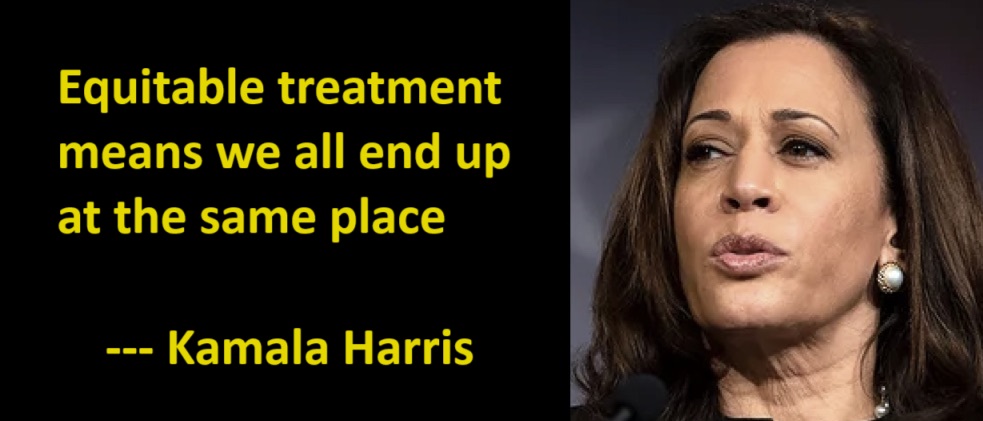
I’m tempted to say it’s what she has said about wanting the Marxist notion of “equality of outcomes.”  But I suspect (or hope!) that’s just empty campaign rhetoric. If we look at the specific ideas she has proposed, she was definitely radical when she rain in 2020, embracing crazy ideas like the Green New Deal and Medicare for All.

For the most part, she has been more cautious this year. She has a leftist agenda, but it’s mostly focused on incremental statism, such as partial price controls, more redistribution, and higher corporate tax rates.

But she has one idea that is breathtakingly bad. She wants the IRS to tax unrealized capital gains, which means that if you own an asset that increases in value from one year to the next, the government would tax that difference.

I opined about the Harris proposal for the U.K.-based Telegraph newspaper. I started by warning that both presidential candidates have been furiously trying to buy votes (last month, I wrote that this is America’s “Santa Claus election”).


Election years can be dangerous because politicians have extra incentive to push bad policies. Donald Trump has floated all sorts of gimmicky tax cuts, such as ending taxes on tips, Social Security, and overtime pay. …Needless to say, Trump has not proposed a single penny of savings on the spending side of the budget. To the contrary, he actually wants to further expand the burden of government. …What about Kamala Harris? She’s also playing Santa Claus, having proposed several trillion dollars of additional redistribution spending. She intends to finance some of that new spending with various class-warfare taxes such as higher personal tax rates and higher business tax rates.

I then explain that one of her tax increases is the radical scheme to tax gains that exist only on paper.

…Harris is also proposing to impose a 25 per cent tax on unrealised capital gains. If an affected taxpayer owns an asset that increases in value from Year 1 to Year 2, that “gain” would be subject to the 25 per cent tax even though nothing has been sold and the taxpayer doesn’t have any additional money.

I give five reasons why her proposal is absurd.

First, it will reduce investment, which will reduce productivity, which will reduce wages.

…it is bad for workers to impose higher taxes on investment and entrepreneurship. The Veep’s proposed tax on unrealised gains would exacerbate the US tax code’s bias against saving and investment… This means less money being set aside to finance productivity-enhancing inventions, innovations, and industry.

Second, the plan would dramatically increase the complexity of a tax code that already is a convoluted nightmare:

…the tax would be an administrative nightmare. Taxpayers and the Internal Revenue Service would have to squabble every year over the value of a taxpayer’s assets. …Tax lawyers and accountants are probably salivating at the thought of this plan becoming law.

Third, it is disturbingly close to a punitive wealth tax:

…a tax on unrealised capital gains could be viewed as a backdoor wealth tax. …The only difference is that it would be a tax on changes in wealth rather than a tax on the stock of wealth.

Fourth, it is so radical that no other country has made this mistake:

…no nation in the world has ever tried to impose a tax on unrealised gains. Even hard-core Leftist governments such as Venezuela have never contemplated such an intrusive and destructive levy.

Fifth, Harris says only rich taxpayers will be affected, but experience teaches us that it will merely be a matter of time before others are hit as well.

…supporters of the tax claim that it would only apply to…less than 1 per cent of the population. That may sound reassuring to ordinary voters … until they realise that the first income tax back in 1913 also applied to less than 1 per cent of households. Yet that “tax on the rich” eventually morphed into the monstrous internal revenue code.

The bottom line is that there should not be any capital gains tax. It’s a very destructive form of double taxation. As such, the Harris plan to expand this destructive levy is a “nutty idea.”

P.S. A lot of my lefty friends are upset that the Washington Post is not endorsing Harris. My personal theory is that the owner, Jeff Bezos, is very aware that the Vice President’s plan would be very bad for his personal finances and (since we already know he seeks to protect his money) he has rationally responded.

P.P.S. One of the worst features of the capital gains tax is that there’s no protection against inflation, so politicians win from bad monetary policy. That unfair policy will be exacerbated by the Harris proposal.

Saturday, August 31, 2024

The Cold Hard Truth of Kamala's Unrealized Capital Gains Tax

The classic left-wing proposal comes with unintended consequences. 

By Aug 30, 2024 @ Liberty Nation News, Tags: Articles, Business News, Opinion

Vice President Kamala Harris and her surrogates are pulling out an oldie but goodie in public policy: a tax on unrealized capital gains. Bharat Ramamurti, her campaign economic advisor, defended the proposal on CNBC, telling hosts it is comparable to property taxes and that revenues will be dedicated to proffering “more opportunities” to the American people. While it will not directly impact most Americans, it will potentially trigger a series of unintended consequences for average folks, businesses, and even the US government.

Primer: Unrealized Capital Gains Tax

According to The New York Times and The Wall Street Journal, the vice president has endorsed a 25% tax on unrealized capital gains for individuals with more than $100 million in wealth. This would work by mandating affluent households remit taxes on unrealized gains from stocks, bonds, and privately held companies. The average net worth in America is around $1.06 million, and the median net worth is about $193,000 – so most Americans will not be directly affected. However, that doesn’t mean it wouldn’t hit them eventually.

The current administration has floated this idea on Capitol Hill during the budget season over the last few years to help plug the gaping fiscal hole and “address substantial inequities in our tax system.” Each time, it has been panned by a chorus of moderate Democrats, Republican lawmakers, social media personalities, and financial media pundits. A May 2021 study also found that most Americans, including 76% of independent voters, reject this concept.

Red Ink

Revenue forecasts vary, but the consensus is that the wealth tax may generate $50 billion per year for the US government. This would be insufficient to help balance the books and pay the $35 trillion national debt, as it would only make about 60 days’ worth of interest payments. In August alone, the Treasury Department borrowed another $64 billion.

Additionally, according to the National Health Care Anti-Fraud Association, taxpayers yearly lose more than $100 billion to Medicaid and Medicare fraud. Senior Medicare Patrol estimates it at approximately $60 billion. Either way, $50 billion would not even pay for the fraudulent payments that occur. Last year, the US Small Business Administration inspector general estimated $64 billion in fraud from the pandemic-era Paycheck Protection Program (PPP) loan program.

Put simply, an unrealized capital gains tax would be a drop in the bucket of Washington’s drunken sailor mentality.

Financial Markets

No, Uncle Sam will not target the Robinhood investing accounts of an armchair trader who owns half a share of Nvidia or Tesla Motors. However, experts warn that if this tax policy is implemented, the crusade will manufacture a ripple effect on the financial markets, impacting many Americans’ 401(k) accounts. The chief reason is that wealthy individuals and hedge funds would likely employ one of three measures: refrain from holding stocks long-term, sell on the first sign of trouble, or avoid deploying capital to help businesses expand and allocate the money to safe-haven instruments.

Let’s say investors choose to keep their positions intact. Paying a tax on unrealized gains made while the money is still tied up in the investment being taxed means taking funds from somewhere else to pay the IRS. What’s worse, a long-term investment could then drop in value in later years, resulting in taxes paid on gains that never materialized.

The Wider Public

When the US government introduced the income tax, it only affected 2% of the population. Today, however, two-thirds of US households pay the government a share of their income. More than a century later, why does this matter? It demonstrates how US officials constantly expand their confiscatory pursuits to the broader public. Even if Washington gets its way like a spoiled toddler at the supermarket screeching for candy and imposes the unrealized capital gains tax, revenues will inevitably fall short of rosy outlooks. This would likely prompt politicians and bureaucrats to extend the levy to those making $50 million, then $10 million, 

The Tax Policy, a think tank created by the Urban Institute and the Brookings Institution, has calculated that the Democratic nominee will back approximately $5 trillion in tax hikes on corporations and the wealthy over a decade. If Congress receives that much in revenues and bypasses constitutional challenges, the cash injection would be enough to pay for 39% of the cumulative net interest payments accrued by 2034, based on the recent rosy Congressional Budget Office (CBO) outlook.

Eminent economist Milton Friedman famously wrote, “Governments never learn. Only people learn.” Politicians might fail to understand that America’s fiscal problems emanate from too much spending – discretionary and non-discretionary – and not shrinking tax receipts.

Liberty Nation does not endorse candidates, campaigns, or legislation, and this presentation is no endorsement.

 
Read More From Andrew Moran

Wednesday, March 30, 2022

The Worst Part of Biden’s New Budget?

March 29, 2022 by Dan Mitchell @ International Liberty

Since the economy suffers when tax rates go up and the burden of government spending increases, there obviously are plenty of awful features in President Biden’s newly released budget.

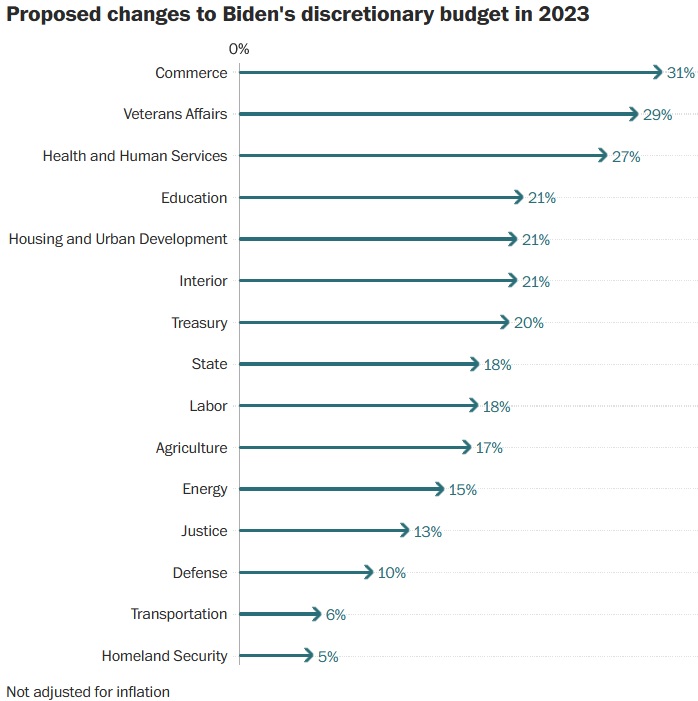
If I had to select a worst feature, though, I’d be tempted to pick the proposed spending hikes that Biden is seeking for some of Washington’s most-wasteful bureaucracies.

Here’s a chart from a story in today’s Washington Post (based on Table S-8 in the budget), which summarizes how much additional “discretionary spending” Biden is seeking.

Why am I upset about these proposed spending increases?

From a big-picture economic perspective, it’s bad fiscal policy to allow the burden of government spending to grow faster than the private sector.

And since Biden is projecting that real GDP will grown by 2.8 percent next year and inflation will be 2.1 percent during the same period (see Table S-9 of the budget), he obviously wants all these bureaucracies to enjoy big increases (unlike families, who are losing ground compared to inflation).

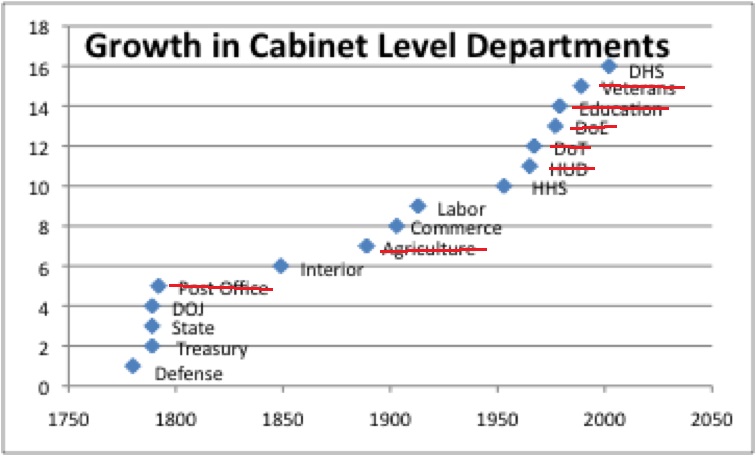
But I’m also irked from a targeted fiscal perspective. That’s because Biden wants giant spending increases for bureaucracies that should not even exist.

Here’s what I’ve written about some of them.


By the way, “worst feature” is not the same as most economically damaging feature.

There are two other parts of Biden’s budget that definitely will cause more harm.

These tax increases and entitlement expansions will do considerably more damage than the discretionary spending increases excerpted above.

But it’s still an outrage that Biden is shoveling more money at some of Washington’s most wasteful and counterproductive bureaucracies.

Wednesday, October 6, 2021

They’re Coming for You

Antony DaviesAntony Davies – October 4, 2021


For years, politicians have claimed that the rich weren’t paying their “fair share.” While it’s taken a decade or more for voters to catch wind of the truth, people are finally beginning to realize that the rich actually pay far more than the rest of us. According to Congressional Budget Office figures, the average household in the top one percent earns 120 times what the average poor household earns, but pays 2,000 times the taxes. Even after deductions, exemptions, write-offs, income deferrals, and whatever other accounting and legal arcana the rich throw at their tax returns, in the end, the typical one-percenter paid 32% of his income (all sources combined) in 2018 versus 13% for the typical middle class household and almost 0% for the typical poor household.

It’s clear that Americans have figured out the truth about who pays, because politicians are shifting the goalposts. Elizabeth Warren shifted the conversation from what fraction of income the rich paid to what fraction of wealth they paid. President Biden has upped the ante by talking about taxing unrealized capital gains.

This is unprecedented. The federal government has no constitutional authority to tax wealth, and never have unrealized gains been considered income – either in the realm of accounting or economics. An unrealized gain is simply an investment “in process.” What shows up as a gain today can easily turn into a loss tomorrow. Ask anyone who invested in Bitcoin in March 2021, or gold in August 2011, or housing in 2007. An investment’s tale isn’t told until the investor cashes out. Unrealized gains aren’t gains. They are hypotheticals.

What politicians want is to foment class warfare. If they can get the middle class and poor to resent the rich, those same politicians can expand the scope of federal taxation into areas it has never before touched.

But watch out. Politicians are only partially interested in the rich. They are very interested in the middle class. In 2018, middle and upper middle class households, combined, earned double what the top one percent earned. And the federal government currently taxes the middle classes at rates less than half of what it taxes the one percent. Politicians see the middle class as a largely untapped revenue source.

While President Biden says that a tax on unrealized gains would apply only to billionaires, once instituted, there is nothing stopping the government from applying it to everyone else. If it did so, the middle class would find itself awash in taxation. Most middle class wealth is tied up in home values. The median sale price of existing homes shot up 14 percent just in the past year. If the government applied an unrealized capital gains tax to all homeowners, the median homeowner would get socked with a $7,000 tax bill. And that’s for just one year. The value of the median home rises more than 3.5 percent per year. At current capital gains tax rates, the median worker would get hit with an additional $1,500 federal tax each year simply because his home was, on paper, worth more than the year before. The average 401K or IRA account is worth $135,000. Given stock market gains last year, the average saver would have seen around $13,000 in unrealized capital gains – and a $2,000 tax bill if those unrealized gains were taxed.

And what of higher education? The typical four-year college graduate earns over 60 percent more than the typical worker with only a high school education. Currently, the median difference is over $500 per week. Over a 40 year career, that wage difference adds up to more than $1 million. Should that be taxed?

The college graduate has made an investment in his education that has increased his expected future earnings by $1 million. Of course, the graduate hasn’t earned that money yet. But that simply makes it an unrealized gain. If the government can tax other investments before their gains materialize, why can’t it tax the graduate’s increased income before it materializes? The tax bill there, by the way, would be around $150,000.

What’s really going on is that politicians see a coming fiscal storm, and they are desperate to find new sources of revenue before it hits. The Congressional Budget Office estimates that by 2031 the federal debt will have reached almost $36 trillion. Historically, the CBO’s ten-year debt projections have underestimated future debt by more than a factor of two. If the CBO’s current estimate is off by that same factor, the debt will actually be over $80 trillion by 2031. That’s equivalent to running a $5 trillion deficit each year over the next decade. While that sounds unbelievable, it’s consistent with what we’ve seen in the past. Since the late 1960s, the federal debt has grown at an average annual rate of almost 9 percent. If the debt continues to grow at that historical average, by the end of the decade, it will be more than $65 trillion. That’s equivalent to running a $3.5 trillion deficit each over the next decade. For comparison, the federal government collected $3.4 trillion in taxes in 2020.

Federal spending is out of control. Politicians know it and they know that they can’t stop it.

Those same politicians have realized that raising taxes isn’t enough. They need new sources of tax revenue that haven’t existed before. Their first step is to institute new taxes on wealth and unrealized capital gains. Once established, their next step will be to expand those taxes to the middle class.

A day of reckoning is coming. Politicians hope that we’ll keep pointing fingers at the rich so we don’t notice who the real culprits are.

Antony Davies

Antony Davies

Antony Davies is the Milton Friedman Distinguished Fellow at the Foundation for Economic Education, and associate professor of economics at Duquesne University.

He has authored Principles of Microeconomics (Cognella), Understanding Statistics (Cato Institute), and Cooperation and Coercion (ISI Books). He has written hundreds of op-eds appearing in, among others, the Wall Street Journal, Los Angeles Times, USA Today, New York Post, Washington Post, New York Daily News, Newsday, US News, and the Houston Chronicle.

He also co-hosts the weekly podcast Words & Numbers. Davies was Chief Financial Officer at Parabon Computation, and founded several technology companies.

Get notified of new articles from Antony Davies and AIER.