Search This Blog

De Omnibus Dubitandum - Lux Veritas

Showing posts with label AIER. Show all posts

Thursday, September 19, 2024

Welfare is a Jealous Polygamist

A young mother prepares a meal for her child.

Nearly ten years ago, I wrote what I thought was a provocative essay about polygamy and the state. Specifically, I claimed that the state acts like a polygamist, enforcing a cruel and explicitly patriarchal regime on single mothers. Perversely, the justification for this repressive regime is compassion, even “social justice.”  

One of the most corrosive aspects of patriarchy is that it treats women as objects, rather than active moral agents in their own right. It is certainly true that, given the weak bargaining position women are often placed in, in traditional societies, women appear to accept inferior roles. But as Gerry Mackie famously argued, even the worst institutions — footbinding and infibulation, for example — have a “rational element” from the perspective of women trapped in these systems. Lisa Tessman has a theory of contingency and virtue, about the struggle of women to preserve a space for virtue in lives circumscribed by sexist rules.

In the years since I wrote the first version, the performance and repression of our welfare system has, if anything, gotten worse. The “privilege” of being raised in a two-parent household is being denied to more and more children. We can’t ignore the truth: the state is a small-minded polygamist, outlawing marriage to anyone except the welfare system and — worse — insisting that the women stay at home rather than finding jobs.

About eight million US families are headed by single mothers, and of those nearly three million live below the poverty line defined by the government. Many sustain this tenuous existence with “assistance,” ranging from subsidies on housing and food to childcare and education grants. The state is no Puritan, and does not enforce a rule of exclusivity on the sex lives of these women. But it has an iron-clad rule that if a woman gets married, or gets a job, she loses her benefits. 

This so-called “benefits trap” has been commented on by both the left and right as an odd policy. Brittany Birken, director of community and economic development at the Federal Reserve Bank of Atlanta, testified before a joint oversight committee here in North Carolina about a proposed consolidation of welfare programs known as the “One Door” policy.

Birken used an anecdote to illustrate the problem: she had talked to a single mother in Florida who had been offered a 10-cent per hour raise, and more hours, in her part-time job. The woman said (according to her calculations) if she accepted the promotion she would lose her benefits through the childcare subsidy program.

“We confirmed her math. For that $200 a year increase, she was going to lose access to $9,000 in childcare subsidies,” Birken said. “The real dilemma that families can face is advancing in their career or making financial ends meet.”  Women who find themselves in this no-win situation are not lazy; they are rational, because they have to accept the situation as it is.

Of course, that’s not how the architects of the welfare system think about it. These program heads no doubt see the system protecting women who are otherwise defenseless, with no other means of raising their children. The problem is that these “benefits” are contingent, and the contingencies — no jobs, no marriage — are detrimental to women long term, and disturbingly similar to the restrictions a polygamist would impose.

Some people in the US are poor. They aren’t poor by world standards, perhaps — a minimum wage job in the US puts you in the top 30 percent of the world income distribution — but by US standards, they are poor. Welfare state logic insists that if you are a good person, you care about people who are (especially through no fault of their own) poor. Therefore, we (the state) should do something. 

Passing those programs requires some political compromises, and intentionally creating obstacles to access, or means testing. Contingencies and guard rails are erected to limit fraud, and direct money only to those “who really need it.”  But those conditions trap recipients in a cycle of poverty from which escape is very difficult. Get a job, lose your benefits. Get married, lose your benefits. 

Astonishingly, the effective marginal tax rates for poor people with children can approach, or in some cases exceed, 100 percent. As the Center for Hunger Free Communities put it:

Families that successfully increase their earnings should not find themselves worse off due to the consequent loss of benefits…. While a higher income can be an important step in a family’s progress towards self-sufficiency, the increased child food insecurity in this group suggests they may be experiencing the ‘cliff effect.’ This occurs when an increase in income causes an overall reduction in total resources due to a loss of benefits or increased tax liability.

Welfare policies are, for the most part, well-intentioned. But their perverse effect is real. Our welfare system traps women in hopeless lives, depending on a state that — like a small-minded polygamist — doesn’t really want them, but is too jealous to let them go.

Michael Munger  
 
Michael Munger is a Professor of Political Science, Economics, and Public Policy at Duke University and Senior Fellow of the American Institute for Economic Research. His degrees are from Davidson College, Washingon University in St. Louis, and Washington University. Munger’s research interests include regulation, political institutions, and political economy.

Books by Michael Munger

 Is Capitalism Sustainable?

Get notified of new articles from Michael Munger and AIER. SUBSCRIBE

Wednesday, July 31, 2024

Why the ‘Green Economy’ Is Suddenly in Retreat—in EU, US, and on Wall Street

Jon Miltimore July 30, 2024 @ American Institute for Economic Research 

 
Near The Hague, Dutch farmers protest against government’s forced shrinking of livestock herds. 2019.

In February, a stream of tractors driven by Italian farmers arrived at the outskirts of Rome, horns blaring. The scene, which was captured by the Agence France-Presse, was just one of dozens of protests across Europe against EU regulations that farmers said threatened to put them out of work.

“They’re drowning us with all these regulations,” one farmer at a protest in Pamplona, Spain, told The Guardian. “They need to ease up on all the directives and bureaucracy.”

The protests were nothing new. They began in 2019 when Dutch farmers, for the first time, drove some 2,000 tractors to The Hague to protest radical legislation designed to reduce carbon emissions, which disproportionately impacted farmers.

Dutch lawmakers responded in 2022 by passing legislation that required farms near nature reserves to slash nitrogen emissions by 70 percent.

“About 30 percent of the country’s cows and pigs will have to go,” The Economist noted.

The policy was part of the government’s plan to sharply reduce livestock farming in Europe. The thinking was that since the livestock sector contributes to about a third of all nitrogen emissions globally, the government would have to target farmers to meet its goal to cut nitrogen emissions in half by 2030.

So Dutch farmers were given a bleak choice: give a portion of their land to the government or have it taken away. By 2023, some 750 Dutch farmers had reportedly sold their land as part of the state’s buy-out scheme. Others were still trying to find a way to preserve their livelihoods.

When asked by a reporter in 2023 whether he thought he would be able to pass his farm on to his children, one Dutch farmer struggled to speak.

“No,” he said tearfully. “No.”

The ‘Great Green Retreat’?

Farmers are not the only ones unhappy with Brussels’s aggressive war on climate change.

The European Union’s effort to reach “net zero” CO2 emissions by 2050 has rankled voters across the continent, something political leaders seem to have realized. Earlier this year, The Guardian lamented the EU’s “great green retreat,” which included a pullback on a bevy of “Green New Deal” regulations, including:

  • Plans to put sharp new restrictions on the use of pesticides.
  • Bans on PFAS (per- and polyfluoroalkyl substances), man-made chemicals that are used in countless everyday products.
  • Rules restricting new industrial emission, which were relaxed on industries and tweaked to exclude cattle farms altogether.
  • Calls to relax a pending anti-deforestation law, which, according to Reuters, officials believe could hurt European farmers.

Whether this retreat stemmed from concerns that these environmental regulations would cause serious harm to the economy (and European farmers), or from concern that the Green agenda would lead to a bloodbath at the ballot box, is unclear.

Whatever the case, the reversal didn’t prevent a historic defeat for Green parties in June’s European Parliament elections, which saw them lose a third of their seats.

“There is no sugarcoating it,” the New York Times lamented following the June elections, “the Greens tanked.”

Political scientist Ruy Teixeira described the event as a “Greenlash.”

“In Germany, the core country of the European green movement, support for the Greens plunged from 20.5 percent in 2019 to 12 percent,” Teixeira, a scholar at the American Enterprise Institute, noted.

He continued:

Shockingly, among voters under 25, the German Greens actually did worse than the hard right Alternative for Germany (AfD). That contrasts with the 2019 elections, when the Greens did seven times better than the AfD among these young voters.

And in France, Green support crashed from 13.5 percent to 5.5 percent. The latter figure is barely above the required threshold for party representation in the French delegation.

Bans Against Hot Showers and Swimming Pools?

Pundits across the world are still trying to figure out why Green parties crashed so hard, which leads one to wonder if they were paying attention.

It wasn’t just crackdowns on farming. Facing an energy crisis, governments across Europe began to roll out regulations forcing Europeans to adopt, shall we say, more spartan lifestyles.

“Cold swimming pools, chillier offices, and shorter showers are the new normal for Europeans,” Business Insider reported, “as governments crack down on energy use ahead of winter to prevent shortages.”

In other words, instead of producing or purchasing more energy, governments began to crack down on energy consumption.

It didn’t stop there.

In May 2023, months after Germany shut down its last three remaining nuclear power plants, the Financial Times reported that many Germans were “outraged and furious” at a law that forced them to install heating systems that run on renewable fuels, which are far more expensive than gas-powered boilers.

The action was even more invasive than the European Union’s sprawling ban on gas-powered vehicles that was finalized just months before.

“[The EU] has taken an important step towards zero-emission mobility,” EU environment commissioner Frans Timmermans said on Twitter. “The direction is clear: in 2035 new cars and vans must have zero emissions.”

Wall Street’s $14 Trillion Exit

The Green policies emerging from Europe did little to alleviate Americans’ concerns that the climate policies of central planners are not driven by sound economics. Yet many similar policies have taken root in the US.

As of March 2024, no fewer than nine US states had passed laws to ban the sale of gas-powered cars by 2035. Meanwhile, the Biden administration recently doubled down on an EPA policy to begin a coerced phase-out of gas-powered vehicles — even though the federal effort to build out the charging stations to support EVs has flopped spectacularly (despite $7.5 billion in funding).

Despite federal subsidies for EVs, a majority of Americans remain unsold on them, and the sputtering EV market has left a wake of carnage. In June, the EV automaker Fisker Inc., which in 2011 received half a billion dollars in guaranteed loans from the US Department of Energy, filed for Chapter 11 bankruptcy in Delaware. (Fisker had long drawn comparisons to Solyndra, the solar panel company that went belly up in 2011 just two years after receiving $535 million from the US government.)

Fisker’s bankruptcy came just months after the New York Times reported on a massive exodus of capital from Climate Action 100+, the world’s largest investor initiative on climate change. JPMorgan Chase and State Street pulled all funds, while BlackRock, the world’s largest asset manager, reduced its holdings and “scaled back its ties to the group.”

“All told, the moves amount to a nearly $14 trillion exit from an organization meant to marshal Wall Street’s clout to expand the climate agenda,” the Times reported.

Days after the Times report, PIMCO also announced it was leaving Climate Action 100+. Invesco, which manages $1.6 trillion in assets, made its exit just two weeks later.

‘You Cannot Avoid the Consequences of Avoiding Reality’

There’s no doubt that the Green economy is in retreat, but the question is, Why?

First, it’s becoming apparent — especially in Europe where energy is more scarce and expensive — that people are souring on Green policies.

As Teixera noted, voters don’t actually like being told what car they must drive and how to cook their food and heat their homes. If you own a swimming pool, you probably want to be able to heat it.

Policymakers talk about “quitting” fossil fuels, but in recent years Europeans got to experience an actual fossil-fuel shortage following Russia’s invasion of Ukraine, which disrupted fossil fuel imports. The result was energy rationing, something Europeans don’t seem to care for.

This brings me to my second point. Green parties and environmentalists have had success largely by getting people to focus on the desired effect of their policies (saving people from climate change) and to ignore the costs of their policies.

Politicians seem to grasp that their policies come with trade-offs, which is why their bans and climate targets tend to be 10, 15, or 30 years into the future. This allows them to bask in the glow of their climate altruism without dealing with the economic consequences of their policies.

This is one of the most salient differences between economics and politics. Economics is all about understanding the reality of trade-offs, but politics is primarily about ignoring or concealing these realities.

Few understood this better than the economist Henry Hazlitt, the author of Economics in One Lesson, who wrote time and again about the tendency of politicians to overlook the secondary consequences of their policies, which were responsible for “nine-tenths of the economic fallacies that are working such dreadful harm in the world today.”

For a time, politicians were able to ignore the secondary consequences of their policies. But voters are finally getting a taste of the costs of Green policies, and they don’t like it.

“You can avoid reality,” Ayn Rand once noted, “but you cannot avoid the consequences of avoiding reality.”

An ‘Iron’ Law

Fear of climate change has helped progressives and Greens gain more economic control in recent decades, but even fear has its limits.

Teixera points to Roger Pielke, Jr., a University of Colorado Boulder professor who in 2009 wrote about the “iron law of climate policy.”

“Climate policy, they say, requires sacrifice, as economic growth and environmental progress are necessarily incompatible with one another,” he wrote. “This perspective has even been built into the scenarios of the IPCC.”

Whether one accepts this premise — that economic growth and environmental progress are necessarily incompatible — doesn’t matter. What matters is that when economic growth policies collide with emission reduction targets, economics wins.

It’s one thing to say that gas prices should be $9 a gallon, as physicist Steven Chu once did, because climate change is a dire threat. It’s another thing to say this while trying to become Energy Secretary, as Chu was while testifying before the Senate in 2012:

Sen. Mike Lee: “So are you saying you no longer share the view that we need to figure out how to boost gasoline prices in America?”

Chu: “I no longer share that view… Of course we don’t want the price of gasoline to go up; we want it to go down.”

You can call this the “iron law of climate policy,” or you can call it common sense. (Who wants gas to go to $9 a gallon?)  Essentially, it’s lofty environmental goals colliding with economic and political reality.

This phenomenon is also conspicuous in Joe Biden’s presidency. On day one, the president nixed the Keystone XL Pipeline (for inexplicable reasons), and would go on to declare global warming a greater existential threat than a nuclear war.

Yet he would later boast that his policies were lowering gasoline prices, and that he oversaw record-high US oil production.

This is the iron law of climate policy, and it explains why the Green economy is suddenly in retreat all over the world.

Not-So-‘Green’ Policies

The reality is that the Green agenda comes with steep trade-offs, something Europeans, Americans, and Wall Street are finally beginning to admit.  But Europe’s energy policies haven’t just been unpopular; many of them haven’t even been “Green.”

For starters, electrical vehicles are hardly the environmental panacea many claim them to be. In fact, EVs require much more energy to produce on average than gas-powered vehicles, and also often run on electricity generated by fossil fuels. This means that EVs come with their own carbon footprints, and they tend to be much larger than most realize. 

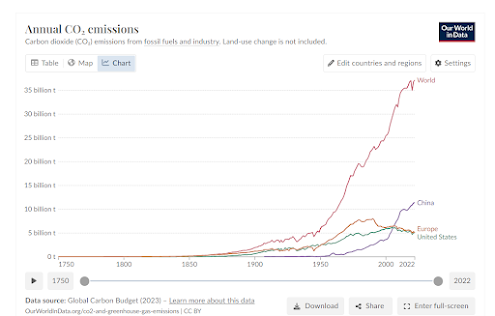
An analysis by the Wall Street Journal found that shifting all personal vehicles in the U.S to EVs would reduce global CO2 emissions by only 0.18 percent. This would do virtually nothing to change global CO2 emission trends, which data show are rising not because of European or US personal vehicles, but from emerging economies like China. 

And then there’s Germany’s bizarre decision to abandon nuclear power. Despite an eleventh-hour plea from a group of scientists (including two Nobel laureates) who urged lawmakers not to do so because it would exacerbate climate change, Germany closed its last three nuclear power plants — Emsland in Lower Saxony, Neckarwestheim 2 in Baden-Württemberg, and Isar 2 in Bavaria — in the middle of an energy crisis

The move puzzled many around the world. After all, nuclear energy is cleaner and safer than any other energy source with the exception of solar, according to estimates from Our World in Data. Even more bizarre, Germany’s phaseout of nuclear power, which began in 2011, coincided with a return to coal

Germany’s decision to ramp up coal production and shutter its last nuclear plants is hardly consistent with the EU’s view that climate change is a dire threat to human kind, many noted.

“No less a climate-change evangelist than Greta Thunberg has argued publicly that, for the planet’s sake, Germany should prioritize the use of its existing nuclear facilities over burning coal,” journalist Markham Heid pointed out at Vox.

Meanwhile, in the US, where nuclear power has been steadily attacked for decades by politicians and environmentalists, the Senate quietly passed (by a vote of 80–2!) a bill to support the deployment of nuclear facilities.

These anecdotes illustrate an important point: Green policies are not just unpopular and uneconomical; they are often senseless.

Few understand this better than Dutch farmers, who are being forced to sell off their farms by politicians who have little understanding of economics trade offs.

Jon Miltimore

Jonathan Miltimore is the Managing Editor of FEE.org and a Senior Writer at AIER. His writing/reporting has been the subject of articles in TIME magazine, The Wall Street Journal, CNN, Forbes, Fox News, and the Star Tribune.

Get notified of new articles from Jon Miltimore and AIER.

Saturday, July 20, 2024

Milei’s New Monetary Regime for Argentina

By Nicolás Cachanosky, July 19, 2024 @ American Institute for Economic Research Tags: Daily Economy, Sound Money Project, Monetary Policy, International Inflation

President of Argentina Javier Milei speaks during 
CPAC Conference in Maryland. 2024 

In a significant legislative move, Argentine President Javier Milei has successfully passed his omnibus law, known as “Ley Bases.” This marks a crucial milestone in his administration as he transitions into the second phase of his government. Central to this phase is a new monetary regime, which was a major promise of his presidential campaign. Given that dollarization has been taken off the table, at least in the short run, what exactly does this new monetary regime entail?

The government has introduced the concept of “currency competition,” although this term might not fully capture their true intentions. In a genuine currency competition scenario, various currencies compete on equal footing. In the case of Argentina, where the US dollar and the peso would compete with each other, currency competition would necessitate granting the US dollar legal tender status alongside the national currency. This would require a law passed by Congress, ensuring that the US dollar could be used for all transactions, including tax payments and debt cancellation. However, the government’s plan deviates from this ideal. Instead, it looks more like a bi-monetary regime.

In a bi-monetary regime, it is legal to transact in multiple currencies, but only the national currency holds legal tender status. This inherently creates an uneven playing field, and makes it a stretch to label it as genuine currency competition. The recent IMF Staff Report underscores this, indicating that the US dollar will not be granted legal tender status and taxes will continue to be paid in pesos.

While bi-monetary regimes can function in countries with credible institutions like Peru, Chile, Colombia, or Uruguay, Argentina’s volatile economic and political environment poses significant challenges. A congressman who safeguards private bank deposits today might vote for their expropriation tomorrow, undermining any sense of stability and trust in the system. Argentina needs a monetary regime whose survival depends as little as possible on domestic politics.

Milei’s strategy includes freezing the base money supply and prohibiting the central bank from directly financing the Treasury. Additionally, he aims to implement a version of a 100-percent reserve requirement for the banking sector. The ultimate goal of this monetary regime is to facilitate an endogenous and spontaneous dollarization. By freezing the supply of pesos, Milei argues that any increase in the demand for money will have to be met with US dollars, gradually reducing the peso’s market share. This forced currency shift is envisioned as a way to stabilize the economy by aligning it more closely with a stable and globally recognized currency.

However, the sustainability of Milei’s version of currency competition is questionable. While it may hold during his presidential tenure, Argentina’s economic history suggests it is unlikely to be a lasting solution. Arguably, Argentina’s current economic troubles can be traced back to its experience with a non-robust bi-monetary regime in the 1990s, highlighting the need for a more durable and credible monetary framework.

A truly lasting solution requires a regime that can withstand the political changes and economic shocks in the years following Milei’s presidency. Despite its controversial nature, full dollarization remains the monetary regime with the most potential for long-term stability in Argentina. It offers a credible pathway to restore confidence and put the country back on a sustainable economic trajectory. By fully adopting the US dollar, Argentina could anchor its monetary policy to a stable currency, reducing the risks of inflation and currency devaluation that have plagued its economy for decades.

The bi-monetary approach, with its inherent weaknesses, may not provide the stability needed to ensure lasting economic health in Argentina. Despite its challenges, full-scale dollarization offers a more robust solution that could help Argentina achieve the economic stability it desperately needs.

Nicolás Cachanosky:  Get notified of new articles from Nicolás Cachanosky and AIER.

Monday, July 15, 2024

Coolidge’s Silent Recipe for Success: Less Federal Government

Luis Carlos Araujo Quintero July 12, 2024 @ American Institute for Economic Research 

A century ago, the American marketplace of ideas provided the people with very different options in terms of public policy. The formal institutions looked similar. The same two political parties dominated the electoral system, benefiting from entrenched regional support. The Electoral College filtered the popular vote, which reflected the people’s will through decentralized and fraud-resistant elections. 

Politicians, however, subscribed to different ideas. Limited government was the consensus among the political elites, who called for restrictions on government’s scope and scale. President Calvin Coolidge embodied this zeitgeist, given his reluctance to step into affairs beyond the constitutionally mandated functions of the federal government. Americans confidently elected him in 1924 by one of the biggest margins in American electoral history, after he had served for one year after President Harding’s sudden death. Silent Cal, a nickname that reflected his quiet demeanor and political restraint, empowered the American people in the interwar period.

The Roaring Twenties was a period of particular prosperity and modernization in the United States. The Coolidge Administration, whose respect of limited government created fertile soil for people to prosper in a free market, is partly responsible for the nation’s success prior to the Great Depression. This President delivered reforms that enhanced the life of Americans in many ways. He reduced taxes across the board, incentivizing productive economic activities that allowed free and enriching exchange. 

Coolidge challenged a tax system designed to finance America’s intervention in World War I, fostering private American entrepreneurship and saving instead. This new economic boom did not have to navigate a complex federal regulatory regime, given that this president kept the federal government largely away from free enterprise. In fact, he reduced the federal budget consistently between 1923 and 1929.

The 1924 elections also demonstrate how relevant Coolidge’s philosophy of limited government was to the positions of other parties. The president ran as a Republican, when that party embodied the demands for greater federal government in the Progressive Era after the Civil War. Simultaneously, the Democratic Party pushed for greater power to the states as a means to enforce heavy regulations, some of which had racist and segregationist undertones. 

Coolidge’s approach, which called for less federal government and better state and local government, dominated the Republican Party under his leadership. Radicals within his own party, led by Robert M. La Follette, left and ran a third candidacy with the Progressive Party. Americans deemed this party’s higher progressive taxes and state-owned companies as too radical to fit into the traditional two-party system,which tends to promotes moderation. On their side, Democrats reluctantly decided to run a moderate candidate in the form of John W. Davis to compete with Coolidge’s centrist and classical liberal platform. 

His support for policies similar to the President’s proposals meant many southerners did not even vote, yielding the worst presidential election result for this party in history. Limited government was the political consensus of 1924, playing an important role in deciding who was to become president.

A century later, the political market offers very different policies. The institutions are still the same: electoral college, decentralized election mechanics, and a two-party system where the same parties dominate, even if they have switched positions ideologically. Politicians in 2024, however, embrace a very different principle: the necessity of government intervention in private affairs. 

Regardless of the party or the candidates, the automatic answer seems to be bigger and, most worryingly, more invasive government. Issues like migration, labor, abortion, environmentalism, urban development, healthcare, education, transportation, safety, security, crime, investment, housing, voting rights and even citizenship are billed as having a single solution: tougher and more numerous governmental regulation, both federal and state.

The last hundred years have seen a remarkable change in political attitudes. Coolidge’s hands-off administration ended roughly three months before the Great Depression, the economic downturn that motivated the rise of the New Deal under President Franklin Delano Roosevelt. In his 14-year tenure, the longest of any American President, the federal government grew in scope and scale to manage the alleged issues generated by free markets. 

The response to anything that doesn’t function optimally has too often been more government, regardless of level and, overwhelmingly since the New Deal, to the benefit of politicians’ electoral prospects. Many Americans seem to approve of this development, voting for the politicians willing to “do something,” even if they make things worse. As both parties prepare to officially select their candidates at conventions this summer, the centennial of Calvin Coolidge’s only presidential election in 1924 should serve to remind Americans that less federal government and better state and local government is the governance formula behind this country’s political success. When it means restraining big and bad government, silence really can be golden.

Luis Carlos Araujo Quintero

Luis Carlos Araujo Quintero holds an International Relations and Political Science double major from Universidad Francisco Marroquín in Guatemala. He is a teaching assistant at UFM, as well as a junior analyst of international affairs in a Guatemalan consultancy firm.He authors Public Choice research articles for the Centro para el Análisis de las Decisiones Públicas (CADEP) and takes part of his school’s research team on the Guatemalan Civil War. He is currently a research intern in the American Institute for Economic Research.

Get notified of new articles from Luis Carlos Araujo Quintero and AIER. SUBSCRIBE

Tuesday, January 23, 2024

Meet the Economist NPR Interviewed to Explain Why America’s $34 Trillion Debt Is Definitely Not a Problem

 
In late December, after US Treasury Secretary Janet Yellen borrowed $90 billion in just one day, the federal government’s public debt eclipsed $34 trillion for the first time in history.

The steady accumulation of public debt has become a mainstay in modern America, seemingly as inevitable as death and taxes. But something strange happened when the US passed yet another trillion-dollar debt milestone. 

There appeared to be concern. 

“The federal debt starts the new year at a level that is hard to grasp: $34 trillion,” the New York Times declared in a piece titled “The Debt Matters Again,” and even “…federal deficits now look scarier.”

CNN, the Associated Press, and other legacy media outlets also reported on the debt situation, offering bleak soundbites.

“Unsustainable,” Marc Goldwein, senior vice president at the Committee for a Responsible Federal Budget, told the Washington Post while describing the situation. 

“Dangerous… a truly depressing ‘achievement,’” said Maya MacGuineas, president of the Committee for a Responsible Federal Budget, in a CNN interview

“Pretty grim,” Loyola Marymount University economics professor Sung Won Sohn told the Associated Press. 

That legacy media are no longer shrugging off concerns about the federal debt is encouraging, if long overdue.  

After all, it doesn’t take a PhD in economics to realize that racking up $34 trillion in debt — an amount 20 percent higher than the nation’s GDP, with a debt-to-GDP ratio higher than during World War II — is a serious problem.

Nothing to Fear?

Yet one media crown jewel informed listeners they had little to fear. NPR’s Leila Fadel asked Stephanie Kelton, a professor of economics at Stony Brook University, if Americans should “be afraid” of this mountain of red ink. 

“No. They shouldn’t,” Kelton responded. “It’s the word debt that makes people afraid. And so when I think about this, you know, I look at this number, and I think, well, it’s just keeping track of our savings.”

The idea that debt is just “keeping track of our savings” is peculiar. But Kelton is a peddler of strange ideas.

For those who don’t know, Kelton, an advisor to Bernie Sanders during his 2016 presidential run, is a disciple of Modern Monetary Theory (MMT), a school of economics typically rejected (and often laughed at) by other economists

MMT is distinguished from other economic schools of thought in that it posits that governments that issue fiat money don’t actually need to collect taxes to pay for their goods and services. As the New York Times stated in a 2022 profile of Kelton, “How will you pay for it?” is considered “a vapid policy question” in the MMT world. Things like budgeting are for cavemen. 

In case you think I’m exaggerating, I’ll quote Kelton directly.

“[T]he idea that taxes pay for what the government spends is pure fantasy,” she writes in The Deficit Myth. “[I]t is the currency issuer — the federal government itself — not the taxpayer, that finances all government expenditures.”

Since the state can simply print money, its only real financial constraint is inflation, MMT proponents argue. This is, of course, true in a sense. Governments can print as much money as they want, but there is nothing profound or “modern” about this revelation.

‘The Carpenter Can’t Run Out of Inches’

China’s Song dynasty introduced paper money way back in the 10th century. Paper notes were convenient, and all went well initially because the notes were at first backed by coins made of precious metals. Things went south, however, when Chinese officials began printing notes that weren’t backed by coins. Hyperinflation ensued, and Song China was soon swallowed by the Mongol Empire

History is replete with similar examples, most recently in Argentina, where Peronists for years tried to solve its social problems by printing money

Inflation is a curse. And MMT is a recipe for hyperinflation, as Harvard economist and former Clinton Treasury Secretary Lawrence Summers has noted, along with countless other economists. 

The economics of this are not complex. Every economist knows there’s no such thing as a free lunch. Printing mass amounts of money cannot solve the problem of scarcity. This fundamental economic reality, that we have limited resources and limitless wants, seems lost on Kelton.  

“The carpenter can’t run out of inches,” she tweeted in 2019. “The stadium can’t run out of points. The airline can’t run out of [frequent flier] miles. And the USA can’t run out of dollars.”

Kelton’s tweet reflects a fundamental misunderstanding of scarcity. 

A carpenter might not be able to run out of inches, but he can run out of lumber and nails. Airlines might not be able to run out of frequent flier miles, but they can run out of seats and fuel, something better economists than Kelton have pointed out

The ‘Court Intellectuals’ 

This brings me back to NPR.  

It’s unclear why the media network chose to interview an economist with such discredited views to explain away the country’s mountain of debt. Whatever some may think, public debt is no laughing matter. Thomas Jefferson once described it as “the greatest of the dangers to be feared” for any country. 

It seems unlikely that NPR wouldn’t know Kelton’s views on debt, which is to say they would know exactly how she’d answer their questions as to whether $34 trillion in federal debt is a problem. But then why have her on? A cynic might suggest that it stems from the fact that NPR receives 10 percent of its funding from government entities, all of which benefit from the government’s inflationary policies.  

NPR would no doubt bristle at such an accusation. After all, the media network quit Twitter after Elon Musk branded the company “state-affiliated media.”

Many took issue with Musk’s label, but there is indeed something deeply troubling about government-funded media. Americans laugh at the clumsy propaganda organs of other countries, but many grow indignant at the suggestion that the government shoveling tens of millions of dollars to NPR could influence its media coverage.

Perhaps NPR’s government largesse is indeed the product of altruism. But there’s another possibility. 

The economist Murray Rothbard, who spent a better part of a lifetime analyzing the state, had a dark theory on why the state takes interest in intellectuals like Kelton and media organizations like NPR. 

Rothbard understood that the source of political power (“might,” as the economist Ludwig von Mises said) is ideology. Therefore, those who seek to maintain power have an incentive to shape ideas, opinions, and thoughts. And Rothbard argued that a primary purpose of the modern nation-state involved opinion-molding — essentially convincing the masses that its existence was valid, necessary, moral, and useful.

This is where Kelton comes in.

Rothbard wrote:

Since its rule is exploitative and parasitic, the State must purchase the alliance of a group of ‘Court Intellectuals,’ whose task is to bamboozle the public into accepting and celebrating the rule of its particular State. In exchange for their continuing work of apologetics and bamboozlement, the Court Intellectuals win their place as junior partners in the power, prestige, and loot extracted by the State apparatus from the deluded public.

Kelton (and to a lesser extent Fadel) are what Rothbard would describe as Court Intellectuals, tools of the state’s opinion-making machine.

This is not to say that NPR doesn’t do any good journalism. I believe it often does. But it helps explain why NPR tapped Kelton, an economist with bankrupt ideas, for its piece on America’s $34 trillion debt, instead of any number of credible economists.

Kelton was all but certain to say the $34 trillion debt was no problem. Don Boudreaux, Peter St. Onge, David Henderson, Bob Murphy, Antony Davies, or any number of other free-market economists would have given a very different answer, one that no doubt would have been far more grounded in economic reality. But as a media entity receiving tax dollars, NPR has little incentive to promote a free-market economist or free-market views. Indeed, they have an incentive to do precisely the opposite.

Regardless of what NPR told its viewers, the $34 trillion national debt is a serious problem, not a mark of government “savings.” 

And we know the primary cause of the problem. 

“Washington has been spending money as if we had unlimited resources,” Sung Won Sohn told the Associated Press.

Our leaders in Washington, it seems, suffer from the same delusion as Kelton.

Monday, September 18, 2023

Orwell Exposed the Cowardice of Journalists and Intellectuals

Barry Brownstein Barry Brownstein

George Orwell had little hope that the lies of totalitarians would be exposed by a free press. His essay “The Freedom of the Press” was intended as the preface to Animal Farm, but was not published until 1972. Orwell revealed that the United Kingdom’s Ministry of Information (MOI) (created during the Second World War) advised Orwell’s publisher not to publish Animal Farm since it would be offensive to “Russian Soviets.”

Orwell’s thesis was that journalists, not the government, are the biggest censors:

[T]he chief danger to freedom of thought and speech at this moment is not the direct interference of the MOI or any official body. If publishers and editors exert themselves to keep certain topics out of print, it is not because they are frightened of prosecution but because they are frightened of public opinion. In this country intellectual cowardice is the worst enemy a writer or journalist has to face.

Today’s cowardly journalists have suppressed stories of Hunter Biden’s laptop, doubts about the efficiency of masks and lockdowns, questionable safety profiles of vaccines, concerns that vaccines didn’t prevent transmission, questions about U.S. policy in Ukraine, and challenges to the global warming orthodoxy. 

While the Biden administration did twist the arms of social media companies to censor ordinary people, it didn’t have to censor journalists. Orwell wrote: “Unpopular ideas can be silenced, and inconvenient facts kept dark, without the need for any official ban.” He explained, 

At any given moment there is an orthodoxy, a body of ideas which it is assumed that all right-thinking people will accept without question. It is not exactly forbidden to say this, that or the other, but it is ‘not done’ to say it… Anyone who challenges the prevailing orthodoxy finds himself silenced with surprising effectiveness. A genuinely unfashionable opinion is almost never given a fair hearing, either in the popular press or in the highbrow periodicals.

In the following paragraph, Orwell painted a portrait of our time. As you read, substitute vaccines, gender reassignment surgery for teens, green energy, etc., for “Soviet Russia”: 

At this moment what is demanded by the prevailing orthodoxy is an uncritical admiration of Soviet Russia. Everyone knows this, nearly everyone acts on it. Any serious criticism of the Soviet régime, any disclosure of facts which the Soviet government would prefer to keep hidden, is next door to unprintable. And this nation-wide conspiracy to flatter our ally takes place, curiously enough, against a background of genuine intellectual tolerance. For though you are not allowed to criticise the Soviet government, at least you are reasonably free to criticise our own.

Orwell was not surprised by “the servility with which the greater part of the English intelligentsia have swallowed and repeated Russian propaganda,” even though they had “no direct pressure to falsify their opinions.”

Big Pharma’s power was already an issue almost eighty years ago. Orwell observed, “Notoriously, certain topics cannot be discussed because of ‘vested interests’. The best-known case is the patent medicine racket.”

Unfortunately, despite raising the alarm, Orwell adds a qualifier to his support for freedom of speech:

If the intellectual liberty which without a doubt has been one of the distinguishing marks of western civilisation means anything at all, it means that everyone shall have the right to say and to print what he believes to be the truth, provided only that it does not harm the rest of the community in some quite unmistakable way.

Today, of course, the harm to the community qualifier is used by Google and others to censor legitimate differences of opinion. 

Just as Hayek warned in The Road to Serfdom, Orwell warned, “It is only, or at any rate it is chiefly, the literary and scientific intelligentsia, the very people who ought to be the guardians of liberty, who are beginning to despise it, in theory as well as in practice.”

Today, authoritarians claim they are defending democracy yet do so by illiberal means. Orwell observed these tactics and reported “a widespread tendency to argue that one can only defend democracy by totalitarian methods. If one loves democracy, the argument runs, one must crush its enemies by no matter what means.” 

The enemies to be crushed included “those who ‘objectively’ endanger it by spreading mistaken doctrines.” Today’s censors also use this misinformation argument. 

Worse, Orwell explains intellectuals justified Stalin’s purges by claiming the victims’ “heretical opinions … ‘objectively’ harmed the régime, and therefore it was quite right not only to massacre them but to discredit them by false accusations.” 

This is not an essay to consider the cancellation of health professionals, authors, and academics. But if you believe intellectuals oppose “false accusations” in service of their perceived good cause, Orwell would say you are wrong.

Orwell observed great enthusiasm for Stalinist Russia was “only a symptom of the general weakening of the western liberal tradition.” He warned, “If you encourage totalitarian methods, the time may come when they will be used against you instead of for you.” 

Any tribal adoption of an “orthodoxy” is problematic. Orwell observed, “The enemy is the gramophone mind, whether or not one agrees with the record that is being played at the moment.”

Can Western civilization survive the illiberalism Orwell observed? Orwell had his doubts:

[I]intellectual freedom is a deep-rooted tradition without which our characteristic western culture could only doubtfully exist. From that tradition many of our intellectuals are visibly turning away. They have accepted the principle that a book should be published or suppressed, praised or damned, not on its merits but according to political expediency. And others who do not actually hold this view assent to it from sheer cowardice. 

Orwell wrote, “If liberty means anything at all it means the right to tell people what they do not want to hear.” Today,  journalists and intellectuals tell us that freedom of expression is not essential; rather than being a condition by which civilization progresses, freedom of expression is a menace to “democracy.” With such beliefs, Orwell would warn, we are creating our own dystopia.

Barry Brownstein

Barry Brownstein

Barry Brownstein is professor emeritus of economics and leadership at the University of Baltimore.  He is the author of The Inner-Work of Leadership, and his essays have appeared in publications such as the Foundation for Economic Education and Intellectual Takeout.  To receive Barry’s essays in your inbox, visit mindsetshifts.com  

Get notified of new articles from Barry Brownstein and AIER. SUBSCRIBE

Thursday, September 7, 2023

The Three-Headed Monster Giving Us Lousy Public Policy

Art CardenArt Carden  August 24, 2023 @ American Institute for Economic Research

We have made fantastic strides in our understanding of how the physical and social worlds work. While the Great Enrichment of the last three centuries or so that happened because we adopted the Bourgeois Deal of “Leave Me Alone and I’ll Make You Rich” has lifted us to standards of living our ancestors could not have imagined. However, the prosperity we enjoy is constantly under attack by a political monster that never stops putting obstacles along the road to riches. The monster is a powerful beast with three heads: ignorance, avarice, and arrogance. Together, they help us understand why public policy is not much better.

Ignorance 

First, we don’t know what to do. It is a revelation to many economics students that policies like minimum wages, rent controls, laws against “price gouging,” and tariffs on goods made in foreign countries hurt the people they are intended to help. People don’t appreciate how well markets work, they don’t know how poorly communism has fared, and they don’t understand just how much better off we are than our ancestors were. We try to correct this with education, but economics is not easy–and for the individual citizen, learning the ins and outs of supply and demand analysis is not likely to do much to change public policy.

Second, we don’t know what is being done. This isn’t because we’re lazy or failing in our civic duty; rather, it’s because public policies generate concentrated benefits but dispersed costs. Sugar tariffs, for example, are worth many millions to U.S. sugar producers, but they probably don’t cost an individual family enough for it to be worthwhile to even measure the burden. A quick glance at the Federal Register on Friday, August 4 contained a front-page link to this request for 

comment on a proposal to update the National Highway Traffic Safety Administration’s New Car Assessment Program (NCAP) to provide consumers with information about crashworthiness pedestrian protection of new vehicles. The proposed updates to NCAP would provide valuable safety information to consumers about the ability of vehicles to protect pedestrians and could incentivize vehicle manufacturers to produce vehicles that provide better protection for vulnerable road users such as pedestrians. In addition, this proposal addresses several mandates set forth in section 24213 of the November 2021 Bipartisan Infrastructure Law, enacted as the Infrastructure Investment and Jobs Act.

How many people know section 24213 of the November 2021 Bipartisan Infrastructure Law? How many people had a reminder in their task manager that they needed to submit a public comment (the deadline was July 25, by the way)? Few and fewer, I suspect, because it’s exceedingly unlikely that taking the time and energy to concentrate on this is going to change the course of public policy. Of course, auto manufacturers probably have someone whose job is to know because there might be millions of dollars at stake.

Avarice

Why live at your own expense when you can live at someone else’s? This, incidentally, is precisely how Frederic Bastiat defined government, as “the great fiction through which everybody endeavors to live at the expense of everybody else.” A lot of us may not realize we’re doing this. People would recoil in horror at the idea of breaking into a neighbor’s house and stealing the cash in his wallet. They vote enthusiastically, however, for policies that take a slice out of his paycheck. Reining in avarice requires constitutional checks that oblige us to respect others’ rights. It also requires a cultural change whereby we reject the ancient notion that other people exist to serve us and recognize that they have their own prerogatives we may not know or approve of but that are literally none of our business.

Even when rules, regulations, and spending programs look like they are there to protect the innocent, they usually have support from a special interest that stands to make a lot of money from it. Consider the New Car Assessment Program mentioned above. Incumbent automakers can make it harder to compete by mandating new safety equipment that is there to protect pedestrians. We get more expensive cars and automakers get higher profits because they have fewer competitors. And due to the Peltzman effect, pedestrians might not end up being much safer.

Arrogance

Arrogance is our political beast’s third head. Arrogance comes with thinking the world is a simple place that would be easy to fix if we only had the political will to put the right people in power or make the right policies. Experts in international economic development tend toward arrogance: It is easy to see the cures for all that plagues Southeast Asia, Africa, and Latin America from a comfortable office at an American or European university.

Modern noblesse oblige demands that those of us who know better boss around the benighted fools who do not share our enlightened worldview. Maybe it is for their own good. Maybe it is because we among what Thomas Sowell called “The Anointed” are burdened with glorious purpose like Loki in the Marvel Cinematic Universe. Doesn’t everyone know that we are going to change the world? Historically, it might have been because someone was chosen by the local deity. Nowadays it might be because we are experts in The Science™, which is settled. Regardless, the world has not yet realized that we should be in charge, and they would gladly hand us our rightful scepters and crowns if they knew what was good for them.

Can we slay this three-headed monster? Doubtful, but there is reason to be optimistic. The last three centuries of rhetorical, institutional, and cultural change have clapped it in irons to the benefit of a world that is rapidly making poverty history. Even with these handicaps, it still does a lot of damage; however, if we can bind the monster even faster by eschewing political relations and embracing commercial relations, we can reduce its threat to our freedom and flourishing.

Art Carden

Art Carden

Art Carden is a Senior Fellow at the American Institute for Economic Research. He is also an Associate Professor of Economics at Samford University in Birmingham, Alabama and a Research Fellow at the Independent Institute.

Get notified of new articles from Art Carden and AIER.

Wednesday, August 9, 2023

Caught-Red-Handed’: Scientists Call for Full Retraction of Nature’s Proximal Origin Paper, as Fraud Accusations Mount

“‘Our analyses clearly show that SARS-CoV-2 is not a laboratory construct or a purposefully manipulated virus,’ the authors wrote in February. Yet a trove of recently published documents reveal that Andersen and his co-authors believed that the lab leak scenario was not just possible, but likely.” ~ Jon Miltimore

  Jon Miltimore – July 31, 2023 @ American Institute for Economic Research

A growing number of people, including prominent scientists, are calling for a full retraction of a high-profile study published in the journal Nature in March 2020 that explored the origins of SARS-CoV-2. The paper, whose authors included immunology and microbiology professor Kristian G. Andersen, declared that evidence clearly showed that SARS-CoV-2 did not originate from a laboratory. “Our analyses clearly show that SARS-CoV-2 is not a laboratory construct or a purposefully manipulated virus,” the authors wrote in February. 

Yet a trove of recently published documents reveal that Andersen and his co-authors believed that the lab leak scenario was not just possible, but likely. 

“[The] main thing still in my mind is that the lab escape version of this is so friggin’ likely to have happened because they were already doing this type of work and the molecular data is fully consistent with that scenario,” Andersen said to his colleagues, according to a report from Public, which published a series of Slack messages between the authors. 

Anderson was not the only author who privately expressed doubts that the virus had natural origins. Public cataloged dozens of statements from Andersen and his co-authors—Andrew Rambaut, W. Ian Lipkin, Edward C. Holmes, and Robert F. Garry—between the dates January 31 and February 28, 2020 suggesting that SARS-CoV-2 may have been engineered.

” …the fact that we are discussing this shows how plausible it is,” Garry said of the lab-leak hypothesis. “We unfortunately can’t refute the lab leak hypothesis,” Andersen said on Feb. 20, several days after the authors published their pre-print.  To complicate matters further, new reporting from The Intercept reveals that Anderson had an $8.9 million grant with NIH pending final approval from Dr. Anthony Fauci when the Proximal Origin paper was submitted. 

‘Fraud and Scientific Misconduct’?

The findings have led several prominent figures to accuse the authors of outright deception. Richard H. Ebright, the Board of Governors Professor of Chemistry and Chemical Biology at Rutgers University, called the paper “scientific fraud.”  “The 2020 ‘Proximal Origin’ paper falsely claimed science showed COVID-19 did not have a lab origin,” tweeted Ebright. “Newly released messages from the authors show they did not believe the conclusions of the paper and show the paper is the product of scientific fraud and scientific misconduct.” Ebright and Silver are among those pushing a petition urging Nature to retract the article in light of these findings. Among those to sign the petition was Neil Harrison, a professor of anesthesiology and molecular pharmacology at Columbia University. 

“Virologists and their allies have produced a number of papers that purport to show that the virus was of natural origin and that the pandemic began at the Huanan seafood market,” Harrison told The Telegraph. “In fact there is no evidence for either of these conclusions, and the email and Slack messages among the authors show that they knew at the time that this was the case.”

Only ‘Expressing Opinions’?

Dr. Joao Monteiro, chief editor of Nature, has rebuffed calls for a retraction, The Telegraph notes, saying the authors were merely “expressing opinions.”

This claim is dubious at best. From the beginning, the Proximal Origin study was presented as authoritative and scientific. Jeremy Farrar, a British medical researcher and now the chief scientist at the World Health Organization (WHO), told USA Today that Proximal Origin was the “most important research on the genomic epidemiology of the origins of this virus to date.”

Dr. Anthony Fauci, speaking from the White House podium in April 2020, cited the study as evidence that the mutations of the virus were “totally consistent with a jump from a species of an animal to a human.” Fact-check organizations were soon citing the study as proof that COVID-19 “could not have been manipulated.” 

Far from being presented as a handful of scientists “expressing opinions,” the Proximal Origin study was treated as gospel, a dogma that could not even be questioned. This allowed social media companies (working hand-in-hand with government agencies) to censor people who publicly stated what Andersen and his colleagues were saying privately—that it seemed plausible that SARS-CoV-2 came from the laboratory in Wuhan that experimented on coronaviruses and had a checkered safety record.

Indeed, even as media and government officials used the Proximal Origin study to smear people as conspiracy theorists for speculating that COVID-19 might have emerged from the Wuhan lab, a Defense Intelligence Agency study commissioned by the government questioned the study’s scientific rigor.  

“The arguments that Andersen et al. use to support a natural-origin scenario for SARS CoV-2 are based not on scientific analysis, but on unwarranted assumptions,” the now-declassified paper concluded. “In fact, the features of SARS-CoV-2 noted by Andersen et al. are consistent with another scenario: that SARS-CoV-2 was developed in a laboratory…” 

Despite the many problems with the study’s findings, Monteiro continues to resist calls for retraction—perhaps because Monteiro himself publicly inferred that the lab leak hypothesis was a conspiracy theory in March, 2020.  Whatever the case, it remains unclear how long Monteiro can resist calls for a retraction in face of overwhelming evidence of scientific misconduct.    “There can be no doubt the Proximal Origin authors consciously and inappropriately downplayed the #COVID19 research-related origin hypothesis and coordinated efforts manipulating media coverage,” said Jamie Metzl, a former Clinton administration official and a WHO expert advisory committee on human genome editing appointee. 

Power, Accountability, and Impunity 

Why there was such intense pressure to declare that SARS-CoV-2 was of natural origin is obvious today.  The federal government was funding risky coronavirus research at Wuhan Institute of Virology, which would make officials complicit to some degree in a leak of a deadly virus. This is no doubt why the government had an interest in funding the study, which gave them a measure of control over its results. “Jeremy Farrar and Francis Collins [then director of the National Institutes of Health] are very happy. Works for me,” Holmes Slacked his colleagues after the pre-print was submitted.   The Proximal Origin paper increasingly looks like a whitewashing job, and some influential people have noticed. 

“This is a huge scandal,” said statistician and FiveThirtyEight founder Nate Silver. “Scientists like @K_G_Andersen believed a lab leak was extremely plausible, if not likely, they concocted a plan to deceive the public about it, and they’ve been caught red-handed.”   Silver is not wrong; yet so far, no one has been held accountable. 

This lack of accountability is concerning, and to understand why it’s worth consulting age-old concepts of power and justice. As FEE’s Dan Sanchez has observed, power is not the mere exertion of unjust force. True power lies in the use of force and the absence of any accountability.   “Systematically getting away with it—or impunity—is where power truly lies,” wrote Sanchez.

In his famous work Republic, Plato showed what raw power looked like. The legendary “Ring of Gyges” did not make one strong. It made one invisible. This did not mean the wearer could do anything he wanted, but it did mean he would never be held accountable for his acts of injustice. 

This is the most frightening part of raw state power. The greatest danger is not that people will act unethically. It’s not even that state actors will commit crimes to serve “a greater good.” The real danger begins when people are not held accountable—even when they are caught “red-handed.”

Jon Miltimore

Jonathan Miltimore is the Managing Editor of FEE.org. His writing/reporting has been the subject of articles in TIME magazine, The Wall Street Journal, CNN, Forbes, Fox News, and the Star Tribune.  Get notified of new articles from Jon Miltimore and AIER. SUBSCRIBE