Search This Blog

De Omnibus Dubitandum - Lux Veritas

Showing posts with label Mussolini. Show all posts

Friday, October 10, 2025

George Orwell, Joy Reid, and the Economics of Fascism

October 9, 2025 by Dan Mitchell @ International Liberty

From a wonky economic perspective, fascism is a system based on nominal private ownership but de facto government control.


For most people, however, I think George Orwell had the best description.

Fascism is simply something you don’t like, especially if it can be mixed with accusations of authoritarianism or racism.

With this in mind, Joy Reid was recently interviewed by BET. As a former host on MSNBC, she’s definitely a leftist, so almost nothing she said was surprising (read this Fox report on her interview if you want criticism from a right-of-center perspective).

I also was not surprised that she channeled Orwell and described the Trump agenda as being fascist.

But here’s the part that made me laugh.

I have two reactions.

  • First, I wish Trump had a serious plan to shrink government, end regulations, and get rid of the income tax.
  • Second, that agenda is the opposite of fascism, which is very much a big-government ideology.

Here’s an article from Econlib. Written by Sheldon Richman, it explains the economic component of fascism. Here are some excerpts.


As an economic system, fascism is socialism with a capitalist veneer. …Fascism substituted the particularity of nationalism and racialism—“blood and soil”—for the internationalism of both classical liberalism and Marxism. Where socialism sought totalitarian control of a society’s economic processes through direct state operation of the means of production, fascism sought that control indirectly, through domination of nominally private owners. 

Where socialism nationalized property explicitly, fascism did so implicitly, by requiring owners to use their property in the “national interest”—that is, as the autocratic authority conceived it. …fascism left the appearance of market relations while planning all economic activities. Where socialism abolished money and prices, fascism controlled the monetary system and set all prices and wages politically. …As with communism, under fascism, every citizen was regarded as an employee and tenant of the totalitarian, party-dominated state.

Sheldon then points out that interventionism is basically a halfway step on the road to fascism.

Fascism is to be distinguished from interventionism, or the mixed economy. …Under fascism, the state, through official cartels, controlled all aspects of manufacturing, commerce, finance, and agriculture. Planning boards set product lines, production levels, prices, wages, working conditions, and the size of firms. Licensing was ubiquitous; no economic activity could be undertaken without government permission. Levels of consumption were dictated by the state, and “excess” incomes had to be surrendered as taxes or “loans.”

My two cents can be summed up by this adaptation of my philosophy triangle.

I’ve augmented it to make fun of Joy Reid.

I don’t include “interventionism” as a category, but if I did, it would be probably be right beneath “technocratic governance.” So my analysis would be consistent with the Econlib analysis.

P.S. Here’s one final excerpt from Sheldon’s article.

In the United States, beginning in 1933, the constellation of government interventions known as the New Deal had features suggestive of the corporate state. …It is a matter of controversy whether President Franklin Roosevelt’s New Deal was directly influenced by fascist economic policies. Mussolini praised the New Deal as “boldly . . . interventionist in the field of economics,” and Roosevelt complimented Mussolini.

For what it’s worth, there are ample similarities between Mussolini and FDR.

Tuesday, December 13, 2022

America's Facing a Downward Spiral of Values

https://blogger.googleusercontent.com/img/b/R29vZ2xl/AVvXsEgDdJXy3OAHLJn_MpiNbbpiEfmKMk5o52EaM_ErYTz_AQiD3zo-sQWOUuwWSVBiV4IJ3FlQV6T-I03A9NYvk-Cw_z_XUAGBaqiTjOITYXOGIJAACqAjGX9XDktXKqx-gc3w6FR9l1Ki6Us/w41-h54/My+Picture+2.jpg By Rich Kozlovich

Here are three articles I think are pertinent to questions over the downward spiral of the American culture, the America economy, the American identity and America's values.   

First, the very idea Americans would elect a communist to high office isn't totally unique, FDR's Vice President before Truman, Henry A. Wallace (1941–1945), was a communist was a communist, although he wasn't a party member and tried to claim he was anti-communist when running for President, but he was a communist, and everyone in the Democrat hierarchy knew it.  

That's why they told FDR he had to make Truman his running mate during his last election.  They knew he was not going to last much longer and didn't want an out and out communist becoming President.  Furthermore, the communist infiltration of the federal government under  was considered the greatest enemy infiltration of a government in the history of the world, and it was absolutely treasonous, and FDR was a party to it.  He even had a secret Stalinist agent, living in the White House for two years, Harry Hopkins. 

We're now seeing the philosophical progeny of these Stalinists openly taking power, and destroying everything they touch.  All of which is nothing more than an extension of FDR's New Deal insanity, with the goal of destroying America forever.

Newest congressional communist takes after Marx in more ways than one, By Olivia Murray, December 9, 2022

There’s a reason that disciples of Marxism earned a reputation of being basement dwellers: they’re losers. From Marx himself to his modern protégés, they always have excuses for why they can’t work, why the real world isn’t fair, and why everything is always someone else’s fault.

Marxism, and its logical conclusion in a communist form of government, is a scourge to humanity’s prosperity for many reasons — about 100 million over the last 100 years to be quite accurate. On a less murderous note though, the philosophy fosters an environment of avoiding personal responsibility, and debilitating laziness (back to the ‘loser’ stereotype) — traits which completely undermine the productivity and welfare of an entire society.  Is it any surprise that communists love big government? An ever-growing bureaucracy is their perfect cover — no accountability and no demand to actually produce anything.

Enter: Maxwell Alejandro Frost...........To Read More....

 Reimagining the Secular Fairytale, By Deana Chadwell -We are frequently harangued about “reimagining” whatever it is the left wants to destroy -- reimagine sexuality, policing, education, elections. For me, “imagining” is for fairytales, for Tolkeinish worlds of orcs, hobbits, and magic rings, for Narnia and Cair Paravel. It’s not for public policy, not for laws and regulations that can adversely affect millions of real, flesh-and-blood people. Our nation is suffering mightily under fantastical decisions made by people who either don’t know what they’re doing, or do know and don’t care; they’re too busy imagining their own wealth and power.

I’d like to turn the tables on this make-believe, pie-in-the-sky rip-off and do a different kind of “imagining.” I’d like to explore a different tack -- one that hasn’t been in effect for quite a while -- in fact, has rarely in human history been tried. Let’s imagine…. More

A Look at America's Crossroads Moment, By John Dale Dunn - Roger Kimball is editor and publisher of The New Criterion, a periodical devoted to literature and the arts.  He is also publisher of Encounter Books and author of many books.  The latest is Where Next? Western Civilization at the Crossroads, which appeared for the 40th anniversary of The New Criterion.  It includes essays by many prominent writers like Victor Davis Hanson and Anthony Daniels.  The essay I summarize and comment on below is Mr. Kimball's essay from that book, with the same title.

"Every "Age of Enlightenment" proceeds from an unlimited optimism of the reason . . . to an equally unqualified skepticism."—Oswald Spengler, The Decline of the West 

Mr. Kimball, an erudite essayist if there is one, opens with some rumination on cultures and men at a crossroads, pondering the choices available.  Kimball asserts that a "dark and bloody crossroads" also stands before us, "posing different and perhaps even more ultimate questions." 

Kimball says it is inevitable that there is a decline in the West, but he points out that, in fact, the decline is of "Christendom."  This decline "results in the decaying moral vocabulary of Christendom but also the values of words like 'virtue,' 'manliness,' 'womanly,' or 'respectable. ... Christendom names a dispensation in which the individual possesses intrinsic moral worth ... predominantly classical and Judaic, which flowed into and helped nurture and define that baggy creation we call 'the West.'".......... More

Wednesday, September 28, 2022

Fascism, Socialism, and Mussolini

September 27, 2022 by Dan Mitchell @ International Liberty

Based on Sunday’s election in Italy, the nation’s next Prime Minister almost certainly will be Giorgia Meloni, which has some worried that Italy is returning to the “far right” fascism of Benito Mussolini.


From an economic perspective, though, it would be more accurate to say that Mussolini is “far left.”

Or to say that he is a collectivist, which puts him in the same camp as socialists and communists.

In an article for the Independent Institute, Angelo Codevilla discussed how Mussolini began his career as a socialist activist, but ultimately was forced out of the party because of his nationalist views..


He was active in socialist circles, both Italian and international, giving speeches to workers and helping to organize strikes… He got to know Vladimir Lenin… Benito became a full-time socialist activist…as editor of its socialist newspaper. …he supported himself writing essays and editing a journal called Lotta di classe—class struggle… In 1911 the party entrusted the 28-year-old with editorship of its flagship publication, Avanti!. …He had become Italian socialism’s brightest star. …In…1914…he committed socialist heresy by writing that class struggle is a bad idea because the nation is more important than social class. He called his few scattered followers fasci, bundles, of individuals. …Hence he labeled the movement “Fasci Rivoluzionari d’Azione Internazionalista” and its members “Fascisti.” …the party expelled him.

In other words, Mussolini was part of the conflict between “national socialism” and “international socialism.”

Both versions of socialism favored big government, but they differed in how they viewed the nation state.

And this conflict, driven in part by the events of World War I, led Mussolini to develop fascism as a distinct strain of statism.

…continuing to call himself a socialist and propagandizing his evolving blend of nationalism and socialism…Mussolini shifted to building fascism into a party. …Hegel, following Napoleon, had made patriotic worship of the scientifically administered, progressive state the political essence of modernity. Mussolini’s vision of Italy followed from that. “The bureaucracy is the state,” he said. …Mussolini explained, …The state personifies the country, and disciplines its several elements to its service. “Soon, we will be the state.”

And he was right, at least in the sense that he and his fascists soon took over the government.

In the 1921 elections, Mussolini’s Fascists had gained only .04% of the vote. But chaos reigned in the streets because of socialist, Communist, and anarchist mobs, as well as because of the perhaps 40,000 fascist squadristi (the Blackshirts) who fought them.

…Mussolini organized the descent of some 30,000 squadristi on Rome to demand he be named prime minister. …the king appointed Mussolini to head a government with almost no fascists. But…Mussolini gradually dispossessed the rest. …Fascist Italy was the first country in which the elected legislature gave up its essential powers to the executive…thus establishing the modern administrative state. …

Socioeconomic organization was fascism’s defining feature. Only employers’ and employees’ organizations approved by the government were allowed. …No longer would corporations be responsible to owners.

Mussolini’s fascism was different than traditional socialism in that the goal was to have the government control the economy, but not to have government take over “the means of production.”

Both approaches were very hostile to free markets, of course.

I’ll close with some excerpts about Italian fascism and FDR’s failed New Deal.

After Franklin Roosevelt’s inauguration in 1933, Mussolini’s enthusiasm for likening the New Deal to fascism’s political-economic order… he made clear that “the spirit of [FDR’s program] resembles fascism’s since, having recognized that the state is responsible for the people’s economic well-being, it no longer allows economic forces to run according to their own nature.”

…Fascists rejoiced that FDR had forsaken liberal for corporativist principles… It could hardly have been otherwise since the essence of the National Industrial Recovery Act—the involuntary inclusion of all participants in categories of economic activity and their subjection to government-dictated prices, wages, and working conditions—was at least as detailed as those in fascism’s corporate law. 

Since I’ve written about how the New Deal (and much of modern leftism) is based on fascist economics, I obviously agree.

But I’ve also explained that it’s better to refer to such policies as corporatist or interventionist since fascism nowadays also implies support for some of Hitler’s lunatic ideas about race and conquest.

P.S. The main message of today’s column is that it’s silly to label Mussolini (and his political heirs) as being on the far right. But it’s also true that Mussolini’s nationalist approach to statism is different than the ideas advocated by Marx (and his political heirs).

Dissecting and explaining these differences is why I think the left-right ideological spectrum should be replaced by this triangle.

By the way, the top of the triangle could say “Classical Liberalism,” but I used “Libertarian” so American readers would easily understand.

P.P.S. There’s a “Political Compass Test” that does a good job of determining one’s philosophical orientation, but it completely botches where Mussolini belongs.


Tuesday, July 6, 2021

How the Democrats fell for Mussolini

America's elite has adopted the fascist dream of a corporate oligarchy 

By

There’s a tendency today to see Benito Mussolini as a pathetic sideshow, an incompetent blusterer who went from Adolf Hitler’s idol to his lapdog. Yet in many ways, Mussolini’s notion of fascism has become increasingly dominant in much of the world, albeit in an unexpected form: in the worldview of those progressives who typically see “proto-fascism” lurking on the Right.

Mussolini, a one-time radical socialist, viewed himself as a “revolutionary” transforming society by turning the state into “the moving centre of economic life”. In Italy and, to a greater extent, Germany, fascism also brought with it, at least initially, an expanded highly populist welfare state much as we see today.

Indeed, Mussolini’s idea of a an economy controlled from above, with generous benefits but dominated by large business interests, is gradually supplanting the old liberal capitalist model. In the West, for example, the “Great Reset,” introduced by the World Economic Forum’s Klaus Schwab, proposes an expanded welfare state and an economy that transcends the market for the greater goal of serving racial and gender “equity”, as well as saving the planet............To Read More.....


Tuesday, June 8, 2021

Il Duce’s Overreach

Nathan Pinkoski 

War is a case study in how a lesser power ought not to wage war. In June 1940, a country with only two working battleships, almost no modern artillery, a mere seventy tanks, and a paltry 152 anti-aircraft guns declared war on the Allies. Economically underpowered and militarily overstretched from the beginning, Italy was utterly routed in three years. The real question is why Mussolini fought the war the way he did. If Mussolini’s decision to go to war in June 1940 was risky, then his decision to fight on nearly half a dozen fronts—so that by autumn 1942 Italians were in Yugoslavia, Greece, Libya, Russia, and even occupying parts of France—was lunacy.............To Read More....


Thursday, August 23, 2018

Hitler, Mussolini and FDR: The Secret History of a Mutual Admiration Society

Dinesh D'Souza  Aug 22, 2018

We hear a lot today from progressives about how neo-Nazis support President Trump.  In reality this is questionable; no one has actually surveyed or queried neo-Nazis to find out if this is actually true.  Moreover, several leading neo-Nazis like Andrew Anglin, co-editor of the Daily Stormer, have leftist backgrounds.Even so, gullible people go along with the progressive allegation, because they have been taught that fascism and Nazism are “on the right.”

But are they?

We can throw light on this question by examining the mutual admiration society between the FDR administration and Mussolini’s Italian fascists, and also the praise that the Nazis heaped upon FDR’s New Deal in the early 1930s.  Hitler, Mussolini and FDR seem to have regarded each other as ideological kindred spirits.  This is a subject hardly mentioned in progressive textbooks or progressive historiography...............

FDR regarded his National Recovery Act (NRA) as the most important of his New Deal programs.  It was directly modeled on Italian fascism.  The NRA empowered the federal government to establish coalitions of labor and management in every industry to set production targets, wages, prices, and even maximum and minimum working hours.  According to Tugwell, the NRA was designed to “eliminate the anarchy of the competitive system.”.............To Read More.....

Saturday, June 23, 2012

It Really is About the Basics!

By Rich Kozlovich

As those who work in highly regulated industries can tell you....the bureaucrats are all about the process....not the outcome....and that process is maddening.  The higher you go with any bureaucratic structure; the more maddening it becomes. Why? Because those at the very top are completely unaware about how the businesses they are regulating work.  They have never worked in those businesses; they have never run those businesses; they have never asked what those who actuallly know about those businesses think about their rules and whether they are worthwhile or not.

In the pest control industry we have state regulators that are far more intimate about the details of our work than those at EPA making the rules.  They make rules seem almost irrational.  For example; recently the EPA changed the rules regarding the use of pyrethroids in structural pest control. They are limiting the amount of material and how it is to be applied to a structure in order to make sure there is as little run off as possible.

On the surface that may seem reasonable, except those same regulations allow me to treat a home two feet up and ten feet out from the foundation in a continuous band. And they are worried some small amount of material that will come off the house when it rains! Where is it going to go? Right into the area treated around the house......where I was already allowed to treat up to ten feet away and two feet up from the foundation...in a continuous band.

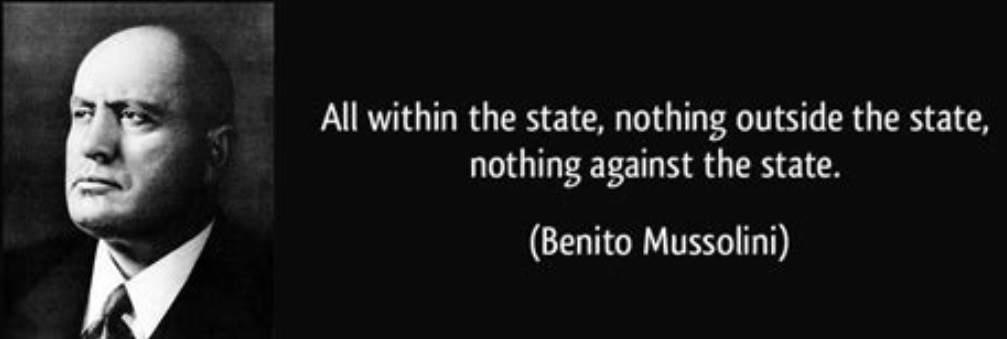
We have to understand....we have now turned over all authority and power to the Fourth Branch of Government.....the bureaucracy. An unaccountable absolute authority that is filled the people who went to college and into government and believe that government is the be all and end all.   Mussolini stated that "Everything in the State, nothing outside the State, nothing against the State", and the world ultimately went to war because of it. Mussolini won! Below are some examples of the folly of big government, big budgets, big taxes and stupid political leaders and their lackeys.
  • French Taxing, Italian Regulating, Greek Mooching, and IMF Economic Illiteracy - Daniel J. Mitchell - Every day brings more and more evidence that Obamanomics is failing in Europe. I wrote some “Observations on the European Farce” last week, but the news this morning is even more surreal. Compared to his foolishness on tax policy, Hollande is a genius when it comes to determining what time it is. Let’s start with France, where I endorsed the explicit socialist over the implicit socialist precisely because of a morbid desire to see a nation commit faster economic suicide. Well, Monsieur Hollande isn’t disappointing me. Let’s look at some of his new initiatives, as reported by Tax-News.com.
  • Supposedly Bankrupt Greek Government to Reward Pedophiles with Disability Payments (January 2010) - By Dan Mitchell - I don’t know whether to laugh or cry when I write about insanely stupid government policies. But I know I get more motivated to fight big government. How can anyone want to give more money and power to politicians, for instance, after reading these comparisons of dumb government policy in the United States and United Kingdom? Or how can anyone think it’s a good idea to expand the public sector after reading these examples of bureaucratic incompetence?
  • I Always Suspected Greek Bureaucrats Were Useless Pieces of S**t, but even I’m Surprised to Learn that They’re Actually Collecting the Stuff - February 24, 2012 by Dan Mitchell - I’ve been having fun in recent months by comparing some of the foolish decisions of politicians and bureaucrats in the United States and United Kingdom. Here’s part of what I wrote in early January………But I think I understated the problem. Brainless policy choices are probably the inevitable result of having so many bureaucrats that they resort to asking for stool samples to justify their pointless and empty lives.