 Sophia Spinazze
– July 19, 2021 @ American Institute for Economic Research
I spent most of the 15-week Classical Political Philosophy course I took last spring parsing through Plato’s Republic (528 pages). This was in conjunction with other literature, classes, and activities, but even if I were to focus solely on the Republic
I would expect it to take me many days to read, let alone understand.
At the end of 2020, though, Congressmen only had a matter of hours to
familiarize themselves with the Consolidated Appropriations Act of 2021 (5,593 pages, more than 10.5 times the number of pages in the Republic) before voting on it—absurd and impossible!
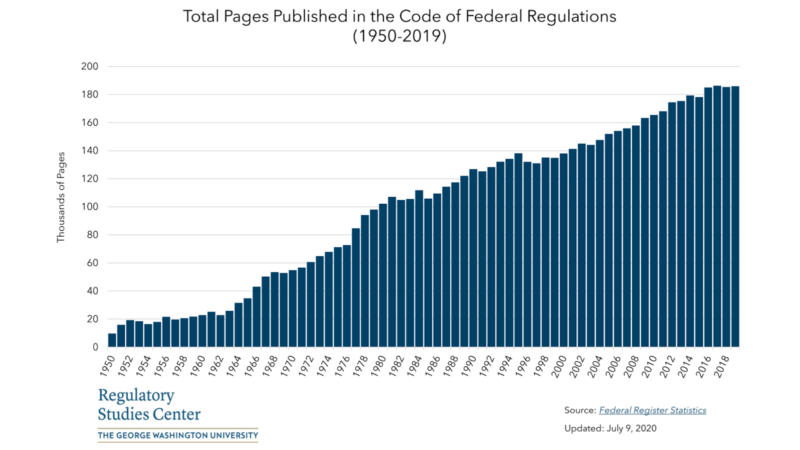
This is more than just one lengthy law. It illustrates a trend of the
United States’ law—the set of formal, written rules the country
recognizes—transitioning from prompting economic and human flourishing
to hindering them.
Expansion
Between 1846 and 1850 the federal government enacted an average of 63
public laws per year, and the average length of each was approximately
823 words (based on data from the Library of Congress).
Between 2015 and 2020, though, Congress passed an average of 179 per
year and the average length was approximately 13,940 (based on data from
GovTrack). Over 2.5 times more and 16 times longer. Regulations with the force of law make this change even more impactful.
Consequences
In his 1850 pamphlet The Law, French economist Frédéric
Bastiat commended the United States for having a law that, “most
faithfully fulfills its role to uphold the freedom and property of each
person.” A telling example is the 1850 General Appropriation Bill that similarly appropriated funds for the civil and diplomatic expenses of the government, but was only 21 pages long.
Bastiat warned us that as the law expands it foresakes its purpose.
It takes from many to benefit a few and becomes unlimited, unequal, and
unclear. This law is unjust and has ruinous consequences.
The current scope of U.S. law offers the government an unrestrained
role in organizing society. The law permeates healthcare, educational
plans in schools, and numerous social programs. Every facet of people’s
lives becomes a product of government action. These laws do not come
from voluntary exchanges between individuals but from forced
redistribution by government. Government’s perverse incentives and lack
of local knowledge make it impossible for legislation to succeed, and
its overreach crowds out individual and community responsibility and
initiative in society.
This increasingly expansive law applies unequally, inviting
rent-seeking, which benefits a relatively small, specific group and
disperses the costs of such policies across many people. As Mancur Olson
explained,
rent seekers usually defeat the unorganized, diverse victims in
legislative contests. Through dishonest means, the well-connected
supplant productive entrepreneurs in reaping rewards.
The law has not just expanded and intensified, but also increased in
complexity. As the law becomes more complex and less accessible to the
citizenry as it grows in length, its aims are obfuscated. In Three Felonies a Day: How the Feds Target the Innocent,
Harvey Silvergate argues that ordinary citizens and even federal judges
disagree about the meaning of America’s many “hopelessly ambiguous”
laws. As in the former Soviet Union, Silvergate claims, U.S. federal
prosecutors today can choose victims and “then [search] the law books…to
pin some offense” on them.
The mere possibility that a nation is ruled arbitrarily by people
instead of by the Rule of Law disincentivizes productive activity. As James Madison
noted, “Where an excess of power prevails, property of no sort is duly
respected. No man is safe in his opinions, his person, his faculties, or
his possessions,” and therefore has little incentive to do anything
more than what is strictly necessary to live through the day, a recipe
for poverty.
The Solution
Luckily, Bastiat also proposed a solution to these problems in his 1850 pamphlet. He believed that The Law,
properly understood, is rooted in individual rights, and its sole
purpose is to secure the free and inoffensive use of each individual’s
faculties. This Law is justice, and it avoids the consequences discussed above and generates practical success.
Since The Law’s well-defined purpose constrains it, it
provides a framework where individuals and communities thrive. Free from
government overreach, people are well-equipped to develop a society
that best encompasses individual preferences. As Bastiat observed,
“What countries have the happiest, most moral, and most peaceful
peoples? Those countries in which the law intervenes the least in
private activity; in which the government is the least felt.”
When The Law applies equally and recognizes that everyone
has an equal right to life, freedom, and property, rent-seeking cannot
bear fruit. It no longer detracts resources from more productive
activities. The winners are those who add value to others’ lives.
Finally, since, “justice is a given quantity that is unmovable and inalterable and does not allow any ifs or buts,” The Law
is clear and precise. Everyone can know and understand the rules by
which they compete to produce and procure goods, which creates an
institutional setting conducive to development and flourishing.
The U.S. can return to the law Bastiat once praised us for
by, as he suggests, purging our laws of the legal plunder that has
corroded incentives to create and work harder and smarter:
“It is under the law of justice, under the regime of right, under the
influence of freedom, security, stability, and responsibility that each
person will attain his full value, the full dignity of his being, and
that humanity will accomplish with order and calmness, doubtless with
slowness but certainty, the progress which is its destiny.”

Sophia Spinazze is a Research Intern
for AIER. She is a Toledo, OH native and currently a senior at Hillsdale
College pursuing a B.A. in Economics and Politics. She plans to use her
education to make the proper understanding of economic principles more
widespread, better understood by individuals, and to help influence
public policy.
At Hillsdale she is a member of the varsity tennis team, chairman of
the American Enterprise Institute Executive Council, and event chairman
of Kappa Kappa Gamma sorority. She is also involved in Catholic Society,
PRAXIS, 1844 Society, and Gier Reading and Journal Buddies.
Get notified of new articles from Sophia Spinazze and AIER.

