March 19, 2021 Jack Windsor @ Ohio Star
COLUMBUS, Ohio – Monday will mark one year since Ohio Governor Mike DeWine announced the statewide stay at home order signed by then-Director of the Ohio Department of Health Dr. Amy Acton.
Soon after, the 1851 Center for Constitutional Law began litigating to challenge the lawfulness of the orders, “winning many cases,” according to Maurice Thompson, an attorney for the firm.
“One year later, the Department of Health – when under oath – still
cannot justify the Director’s ‘Stay at Home Orders,’” said Thompson in a
press release similarly titled that he shared exclusively with The Ohio Star on Friday morning.
The 1851 Center is a nonprofit, nonpartisan legal center dedicated to
protecting the constitutional rights of Ohioans from government abuse.
The 1851 Center litigates constitutional issues related to property
rights, regulation, taxation, and searches and seizures.
The press release states that the 1851 Center won a preliminary
injunction in 2020 stopping the state from forbidding the opening of
amusement parks. During that case, the State of Ohio was asked to
provide responses to legal questions under oath and penalty of perjury.
Those responses were just recently provided.
In them, Thompson contends, it is displayed that “the State remains
unable to provide evidence supporting policies, failed to track relevant
data and was at times outright ‘bluffing’ to the public.”
The full press release can be viewed below. The summary of its points is as follows:
- Ohio Department of Health (ODH) stands by Ohio Attorney General’s
statement to a federal court that 29% of confirmed COVID cases result in
hospitalizations and approximately 4% result in death;
- ODH still maintains no evidence that “non-essential” businesses and
activities increased the risk of COVID, cannot identify a single
instance of COVID-related harm caused by non-essential businesses and
presented only “rational speculation” as reasoning behind the related
mandates.
- ODH asserts stay at home orders reduced serious harm based solely on
the assertion that cases statewide never reached initial “guesstimates”
Amy Acton provided at the beginning of the pandemic.
- Despite saying regulations were driven by hospital capacity, ICU bed
capacity and hospital staffing, ODH concedes it has no metric or
benchmark to determine what constitutes an “overwhelming” and “no
information” as to capacities of hospitals.
- Despite providing no evidence that non-essential businesses and
activities constituted a risk, Governor DeWine and the Attorney
General’s office deride Ohioans wishing to open and operate, saying they
are putting profit over the lives and health of employees and patrons.
- State continues to declare that non-essential business restrictions
did not cause any public or private health harm or economic harm.
- ODH concedes it failed to track data related to coincidence of hospitalizations and deaths with comorbidities, such as obesity.
- ODH evidence in support of the efficacy of the mask mandate and the
curfew policies is “evidence of reduced cases, hospitalizations and
deaths after mask and curfew orders went into effect.”
- ODH refuses to disclose to Ohioans the process involved in producing
orders, who writes them and who reviews them, citing “attorney client
privilege.”
- The end-date of the pandemic will be determined by the Governor alone and not public health experts.
A recent study
revealed effects of COVID misinformation – particularly the deep
misunderstanding of the severity of the virus for the average infected
person and the misrepresentation of deaths per age group.
According to the report, the percentage of people infected needing
hospitalization is somewhere between one percent to five percent.
The essence of the finding is that COVID knowledge, policy preference
and behavior is shaped by political alignment and media consumption.

Despite early warnings that COVID would be 10-times to 20-times deadlier than influenza, the fatality rate
is much lower, measuring 0.1% – 0.35% per the Center for
Evidence-Based Medicine; while the CDC estimates a rate of .0003% to
5.4% (based on age).
“We have not faced an enemy like we are facing today in 102 years.
You have to go back to the 1918 influenza epidemic,” DeWine said in a briefing
the day the order was issued. He compared the state response to a war
and said it was a crucial time in the battle – the order was issued to
slow the spread of COVID so healthcare systems would have time to treat
COVID patients and others needing care.
In the order, Acton chose essential businesses and shuttered those
she deemed nonessential; the order was set to expire two weeks later.
Businesses closures were not designed to be punitive but were also “not a
suggestion,” said DeWine.
Just prior to issuing the stay-at-home order DeWine declared a public health state of emergency, saying “I wouldn’t read too much into the state of emergency,”
that it was a “legal necessity” making it easier to procure medical
supplies without going through the required state bidding process.
Dr. Acton’s modeling
drove policy decisions in March 2020. The Health Director guessed that
the medical community could face 62,000 cases per day by mid-to-late
March if Ohioans didn’t follow mitigation strategies. According to Acton
and DeWine, if people heeded State of Ohio guidance, cases would be
spread out and lessened, predicting a peak in mid-April of 10,000 cases
per day. A third guess revised that number down to 2,000 cases per day.
DeWine said
hospitals would need to scale up their capacity to double or triple
their norm in order to handle the rush. According to Ohio COVID dashboard
data, cases were registering over 300 in March and around 500 per day
in April (with one blip due to concentrated prison testing).
Nonetheless,
an emergency was declared, shelter-in-place ordered, nonessential
businesses closed, an election canceled and in-person education stopped.
An early investigative article
pinpointed the economic dangers of closing businesses, the mental
health impact of stay-at-home orders, the certain spike in suicides and
the differences between COVID and the 1918 flu pandemic.
However, shut-it-all-down policies were implemented instead of exact
measures that protected the most vulnerable, accounted for economic,
emotional and physical consequences of focusing only on COVID.
A study
of all 50 states and the District of Columbia ranked each locale by
mandates and COVID outcomes. Ohio came in at number 23 of 51 despite
being one of the first states to intervene and impose mandates with
legal consequences for violations.
There were states with fewer restrictions that did better at handling
the virus – but the opposite was also true. A set of findings that
proves the words of Ohio Senator Terry Johnson
(R-District 14) during his floor speech in favor of Senate Bill 22
(providing legislative oversight of Governor and agency orders).
Johnson said stopping the virus is like telling the waves to stop or
stopping the wind; and the varied results around the world given
different mitigation strategies proves the efficacy of strict mandates
are “a farce.”
In Ohio, the statewide mask mandate was imposed July 23 when cases were already on a downward slope.
The Star reported, according to Ohio
Department of Health records, the high point in cases occurred on
November 30, 2020 when the state logged 13,468 – this after a statewide
mask mandate had been in effect for 131 days with the Ohio Investigative Unit measuring mask compliance at well above 90% around the state.
While the mask mandate was in effect with high compliance, Ohio
racked up its worst numbers in cases, hospitalizations and deaths
according to the Ohio COVID dashboard.
The U.S. Centers for Disease Control and Prevention (CDC) recently released results of their tracking project spanning March – December 2020 that showed masking stopped COVID spread by two percent.
Thompson said that one of the State’s arguments was that their
mitigation efforts resulted in fewer cases and helped deter the early
estimate that Ohio would lose more than 100,000 people to death from
COVID.
However, the State’s case estimates without mitigation were
astronomically inaccurate (62,000 at a high point) and their case
estimates with mitigation were still exponentially incorrect.
Additionally, there isn’t a state in America near a death toll
of 100,000 people, regardless their mitigation strategies. In fact, a
couple states near the top in death toll – California, New York and
Pennsylvania – enacted comparatively strict mandates.
However, DeWine still urges Ohioans to mask, even after vaccination – guidance echoed by President Biden.
The Ohio Restaurant Association estimated 60% of Ohio establishments would close and never re-open. The Star reported on four non-essential businesses and the impact to their businesses, employees and families.
60 minutes
came to Columbus to report on the “unequal recession” caused by the
shuttering of non-essential businesses (restaurants, hotels, theaters,
shops, to name just a few) and how those policy decisions
disproportionately affected women and minorities – and how the
Congressional Budget Office estimates the first to lose their jobs will
be the last to recover, reporting it will take until 2024.
Ohioans filed more unemployment claims in 2020 than they did the previous five years combined. To make matters worse, school closures exacerbated unemployment woes – unemployment is 12% higher for parents whose children learn remotely as compared to parents whose kids learn in-person.
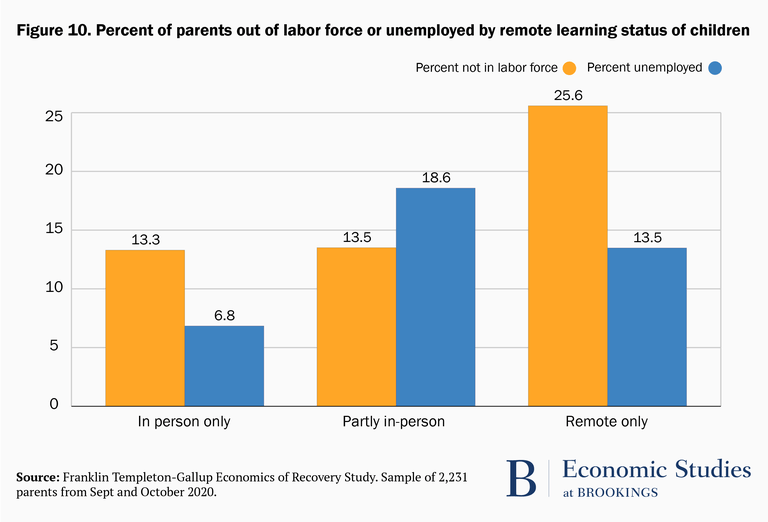
This despite the American Academy of Pediatrics pleading for kids to get back in the classroom, the CDC repeatedly indicating that kids were not extending the transmission of the virus and a large amount of data showing very low COVID infections among enrolled school children (and evidence that teachers contract the virus at rates similar to their non-teaching contemporaries).
Meanwhile, a crisis from COVID policies grips our kids – masses of students from Mason to Hilliard were hospitalized for suicide ideation, mental struggles and a prestigious medical journal reported that 13.8 million of years of life will be lost in kids aged five to 11 due to education disruption from, not COVID, but COVID policies.
Read the full statement by the 1851 Center for Constitutional Law:
– – –
Jack Windsor is the Statehouse Reporter at The Ohio Star. Windsor is also an independent investigative reporter. Follow Jack on Twitter. Email tips to jwindsor@theohiostar.com.
Photo “Small Business” by spurekar. CC BY 2.0.










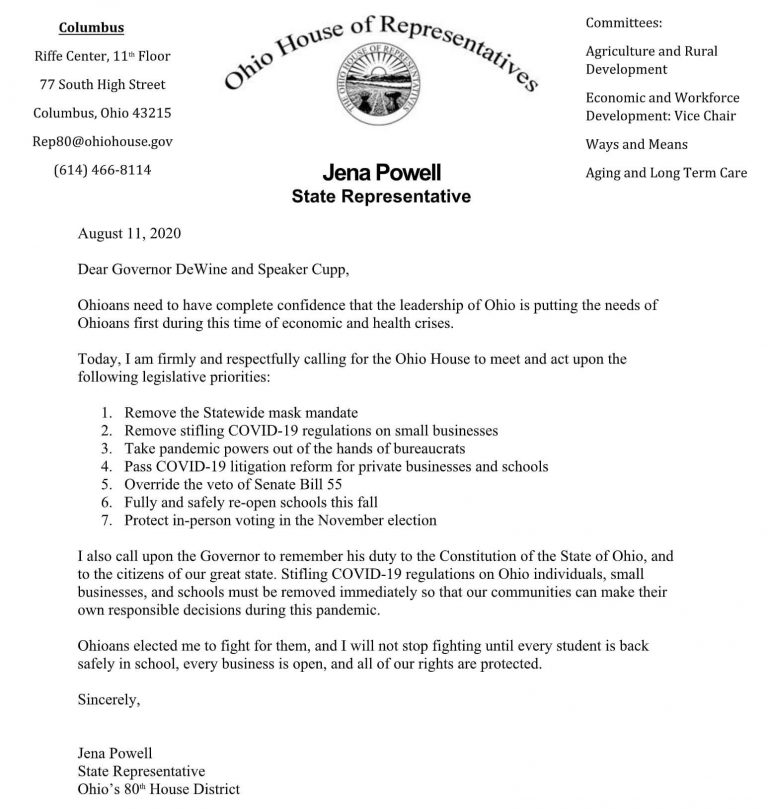 Remove mask mandate...........