Robert L. Bradley Jr.
– April 2, 2021 @ American Institute for Economic Research
Robert L. Bradley Jr.
– April 2, 2021 @ American Institute for Economic ResearchAt an environmental forum, Julian Simon once asked: “How many people here believe that the earth is increasingly polluted and that our natural resources are being exhausted?”
After a roomful of hands shot up, Simon then asked: “Is there any evidence that could dissuade you?” Encountering silence, he followed up: “Is there any evidence I could give you—anything at all—that would lead you to reconsider these assumptions?”
After more silence, Simon answered: “Well, excuse me. I’m not dressed for church.”
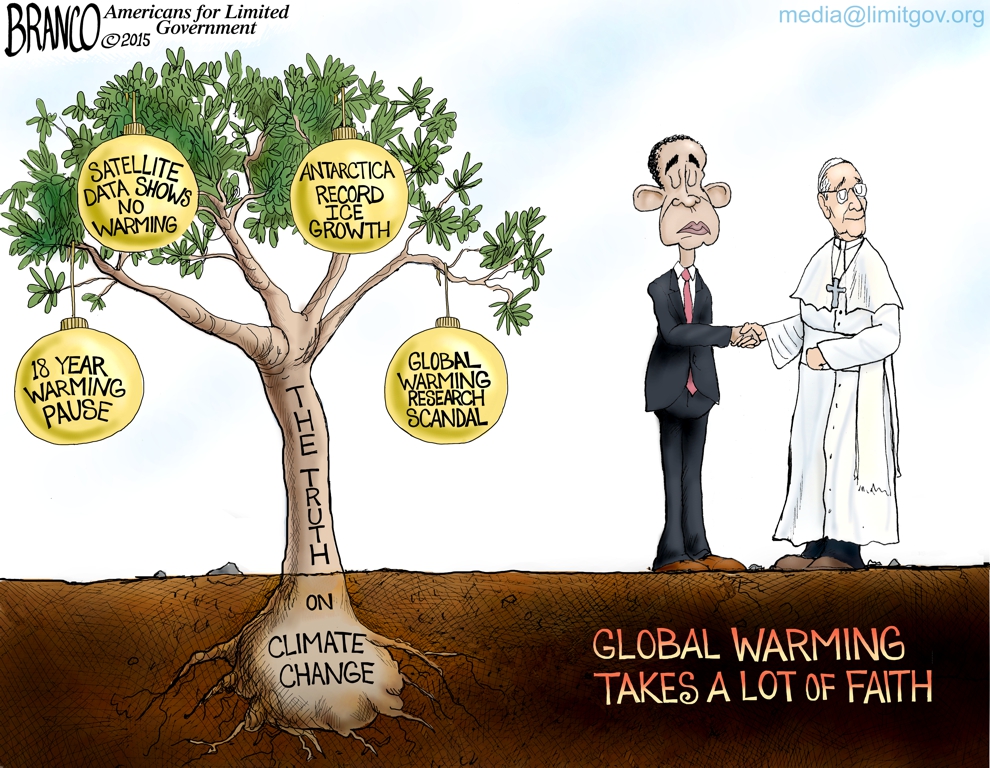
Today’s Church of Climate holds three resolute beliefs:
- The human influence on climate is pronounced and controlling
- That influence cannot be positive or benign, only catastrophic
- Global governance can and must solve this problem
Square this with the impressive, even stunning, statistics of human betterment since the Industrial Revolution, especially in the last 75 years. One would think that these parishioners should be relieved, even happy. But theirs is an anti-humanist philosophy, not to be debated but worshipped. It is a creed that sees nature as optimal, not to be violated by humankind. Deeply pessimistic, it is the deep ecology worldview.
Optimal Nature
Optimal nature lurks behind the current climate debate. As Yale climate economist Robert Mendelsohn noted in The Greening of Global Warming (1999: p. 12):
There is an unstated myth in ecology that natural conditions must be optimal. That is, we must be at the top of the hill now.
Back in the 1970s, a new Ice Age was feared from sulfur dioxide emissions from coal plants, the Global Cooling scare. Even offsetting forces were rejected by Paul Ehrlich, Anne Ehrlich, and John Holdren (Ecoscience: 1977, p. 686):
There can be scant consolation in the idea that a man-made warming trend might cancel out a natural cooling trend. Since the different factors producing the two trends do so by influencing different parts of Earth’s complicated climatic machinery, it is most unlikely that the associated effects on circulation patterns would cancel each other.
To members of the Climate Church, the planet “has been delivered in perfect working condition and cannot be exchanged for a new one.” An issue of World Watch magazine, “Playing God with Climate,” scolded man for interfering with the Earth’s default condition.
Deep Ecology
A radical wing of the modern environmental movement rejects an anthropocentric (human-centered) view of the world in favor of an ecocentric view.
In contrast to shallow ecology, concerned with pollution and resource depletion in the developed world, deep ecology defends “the equal right” of lower animals and plants “to live and blossom.” Deep ecology rejects what it sees as a master-slave relationship between human and nonhuman life. States Arne Næss (in Peter List, Radical Environmentalism: Philosophy and Tactics, 1993: p. 19):
Deep ecology stresses the interrelatedness of all life systems on Earth, demoting human-centeredness. Man must respect nature as an end in itself, not treat it as a tool of man. The human ego and concern for family and other loved ones must be joined by a similar emotional attachment to animals, trees, plants, and the rest of the ecosphere.
To hurt the planet, then, is the same as inflicting bodily harm on oneself. “In the broadest sense,” state Bill Devall and George Sessions (Deep Ecology, 1985, p. ix), “we need to accept the invitation to the dance—the dance of unity of humans, plants, animals, the Earth.” To get to this point, we need to “trick ourselves into reenchantment” (p. 10) with nature.
The platform of the Foundation for Deep Ecology (“a voice for wild nature”), formulated by Arne Næss and George Sessions, condemns the current interaction of man and nature and calls for population decreases and lower living standards. In its words:
- The well-being and flourishing of human and nonhuman life on Earth have value in themselves … independent of the usefulness of the nonhuman world for human purposes.
- Richness and diversity of life forms contribute to the realization of these values and are also values in themselves.
- Humans have no right to reduce this richness and diversity except to satisfy vital needs.
- Present human interference with the nonhuman world is excessive, and the situation is rapidly worsening.
- The flourishing of human life and cultures is compatible with a substantial decrease of the human population. The flourishing of nonhuman life requires such a decrease.
- Policies must therefore be changed. The changes in policies affect basic economic, technological, and ideological structures … will be deeply different from the present.
The platform goes on to state that radical change is necessary, “appreciating life quality … rather than adhering to an increasingly higher standard of living.”
From Al Gore …
Al Gore’s angst about “dysfunctional civilization” crosses over into deep-ecology metaphysics. “Our civilization is, in effect, addicted to the consumption of the earth itself,” Gore stated in Earth in the Balance (1992):
This addictive relationship distracts us from the pain of what we have lost: a direct experience of our connection to the vividness, vibrancy, and aliveness of the rest of the natural world. The froth and frenzy of industrial civilization mask our deep loneliness for that communion with the world that can lift our spirits and fill our senses with the richness and immediacy of life itself.
Eschewing incrementalism, Gore called for “bold and unequivocal” global action where “the rescue of the environment” is “the central organizing principle for civilization.”
That “central organizing principle” is what Ludwig von Mises and F. A. Hayek could not have envisioned: a global central planning where each and every economy of 196 sovereignties must be coordinated via taxes, tariffs (“border adjustments), and efficiency mandates to reduce, and even reverse, the emissions of the green greenhouse gas in particular, carbon dioxide (CO2).
… to Bill McKibben
Bill McKibben’s The End of Nature (1989: p. 216) fingered the “terminal sin” of man’s altering nature and complained that “the greenhouse effect is the first environmental problem we can’t escape by moving to the woods.” He lamented how “the cheap labor provided by oil” makes the “deep ecology model” difficult to fathom, much less implement” (p. 200).
McKibben in a recent New Yorker column put more of his climate cards on the table: “If one wanted a basic rule of thumb for dealing with the climate crisis, it would be: stop burning things.” The combustion era must reach “a swift end,” whether it concerns oil for transportation, natural gas or coal for electricity, wood fires in the home, or grilling outdoors. Don’t light a match either.
Humanistic Alternative
Getting humans back in the picture, philosopher Alex Epstein reminds all that untamed nature is not only of benefit but also perilous. “If good and evil are measured by the standard of human well-being and human progress,” he states, “we must conclude that the fossil fuel industry is not a necessary evil to be restricted but a superior good to be liberated.” In this regard, “We don’t need green energy–we need humanitarian energy.”
Epstein then reverses the climate narrative:
Nature doesn’t give us a stable, safe climate that we make dangerous. It gives us an ever-changing, dangerous climate that we need to make safe. And the driver behind sturdy buildings, affordable heating and air-conditioning, drought relief, and everything else that keeps us safe from climate is cheap, plentiful, reliable energy, overwhelmingly from fossil fuels.
In The Future and Its Enemies, Virginia Postrel warns against the stasis mentality—the belief that “a good future must be static; either the product of detailed, technocratic blueprints or the return to an idealized, stable past” (1998: xii)—versus dynamism, which embraces “a world of constant creation, discovery, and competition” (xiv).
Philosophy, not only economics and political economy, matters in the global warming/climate change debate. Start by checking your premises—and those of your intellectual opponents.
Robert L. Bradley Jr.
Robert L. Bradley Jr., AIER Senior Fellow, is the founder and CEO of the Institute for Energy Research. He is author of eight books on energy history and public policy and blogs at MasterResource.
Bradley received a B.A. in economics from Rollins College, an M.A. in economics from the University of Houston, and a Ph.D. in political economy from International College.
He has been a Schultz Fellow for Economic Research and Liberty Fund Fellow for Economic Research, and in 2002 he received the Julian L. Simon Memorial Award for his work on energy and sustainable development.