November 5, 2025 by Dan Mitchell @ International Liberty
When I unveiled my Eighth Theorem of Government in 2020, my target was the head of the International Monetary Fund, a bureaucrat with a very generous tax-free salary who wanted other people to pay higher taxes to fund bigger welfare states.
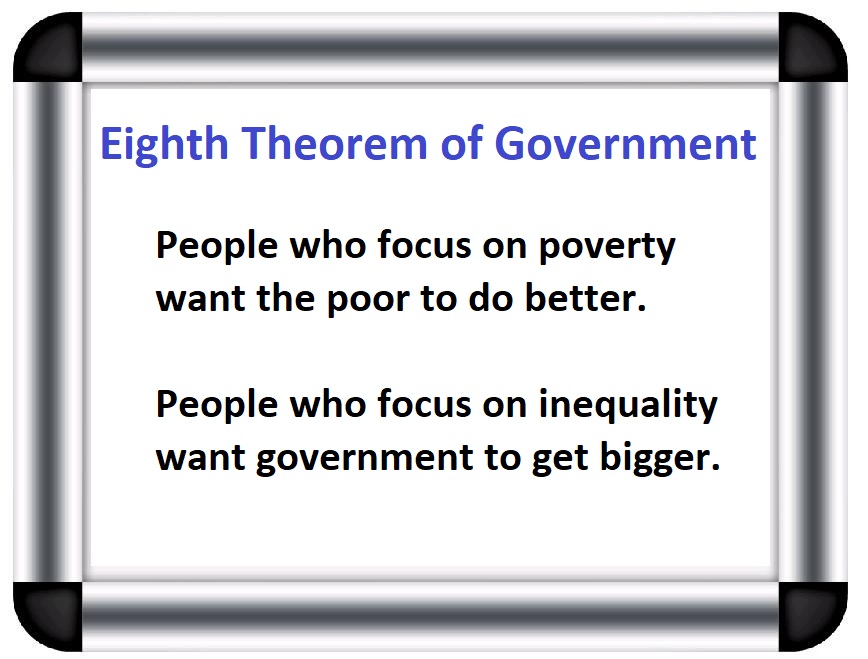
Her excuse was fighting inequality, but her policy was bigger government.
And since the IMF had published research implying that societies would be better off if everyone was poorer but more equal (I’m not joking), I decided that I needed a way of capturing this perverse mindset.
Now I have a new reason to share my Eighth Theorem. The failed government of South Africa recently paid some leftist academics to issue a report on inequality.
It was led by Joseph Stiglitz, the guy who infamously praised Venezuela’s failed socialist policies. And it included Jayati Ghosh, who was the lead signatory of the world’s most inaccurate letter.
Here’s their premise (keep in mind that “neoliberal” in much of the world means free market).

A series of economic policies that found favour from the 1980s led to steep increases in economic inequality in many high-, middle- and low-income countries. …Collectively, these policies have been described as ‘neoliberal’. They have been a common feature in most nations at different times over the last four decades… Broadly they are based on the idea that unregulated markets are the most efficient way of allocating resources. They were adopted nationally and globally through globalisation. Several of these policies led directly to higher inequality.
The authors are partly right. As I noted yesterday, there was a global shift to free-market policies that started under Reagan and Thatcher (an era sometimes known as the Washington Consensus).
Did this period of “neoliberalism” mean more inequality?
My responses is that I don’t care if some people get richer faster than other people get richer. I just want a system that produces more prosperity for everyone.
And, as Johan Norberg noted back in 2022 when responding to a different attack on neoliberalism, it was a spectacularly wonderful time for poor people.
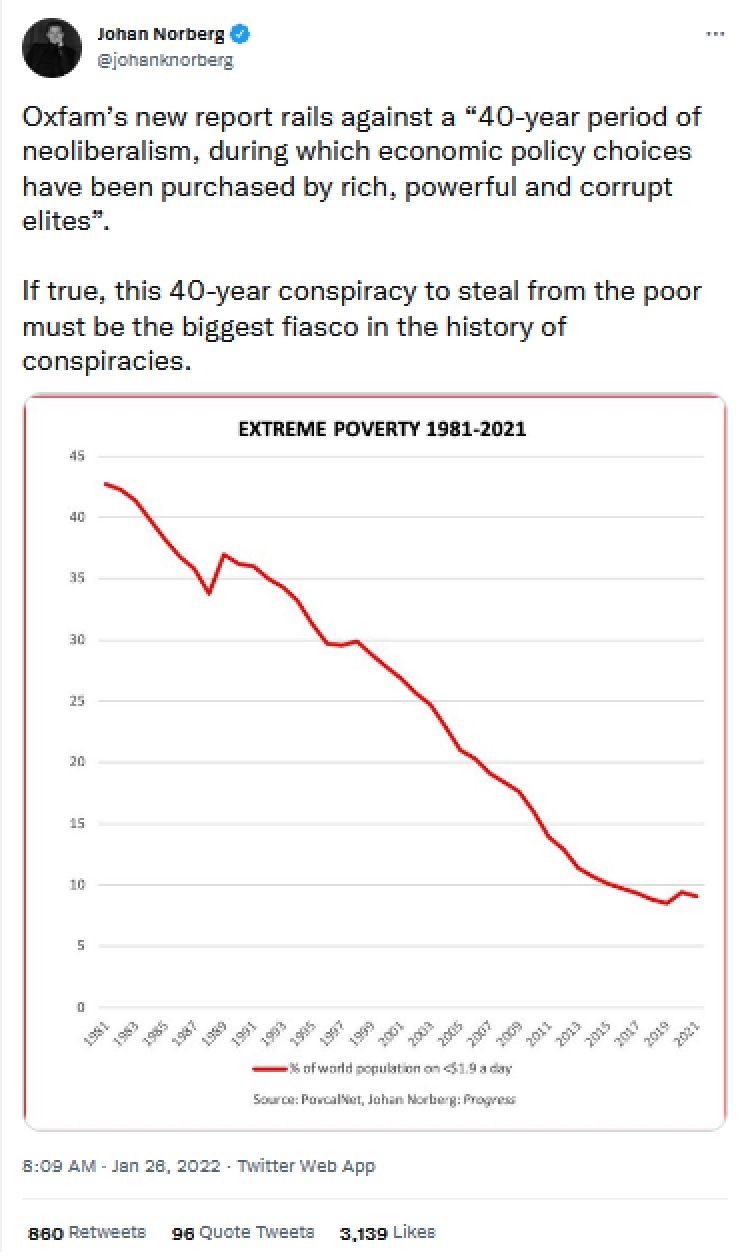
Since the authors started with the wrong premise (fixating on inequality rather than looking at how to reduce poverty), it will come as no surprise that their proposed policies are misguided as well.
At various points, they endorse more spending, industrial policy, price controls, weakening property rights, and protectionism.
As you might suspect, I found their analysis of tax policy especially loathsome.
There is no ‘magic bullet’ to reduce inequality. But there is a menu of prudent policies that have proven to be highly effective, and could even be seen as preconditions, for reducing various dimensions of inequality. …we have a specific emphasis on the international approaches and strategies to reduce inequality…
An agreement among countries to have a minimum corporate income tax would, for instance, help prevent the destructive race to the bottom in corporate taxation. …new negotiations at the UN towards a Framework Convention on International Tax Cooperation provide a historic opportunity to redesign the international tax architecture. Minimum global tax rates on corporate incomes and extreme wealth could be vital elements of this, which in turn would require…ideally the creation of a global asset register to identify and track wealth ownership.
Their agenda can be summarized as “eliminate tax competition to enable goldfish government.”
P.S. The part about a “global asset register” is especially Orwellian. Fits well with the left’s desire to abolish cash and require everyone to use central bank digital currencies.

No comments:
Post a Comment