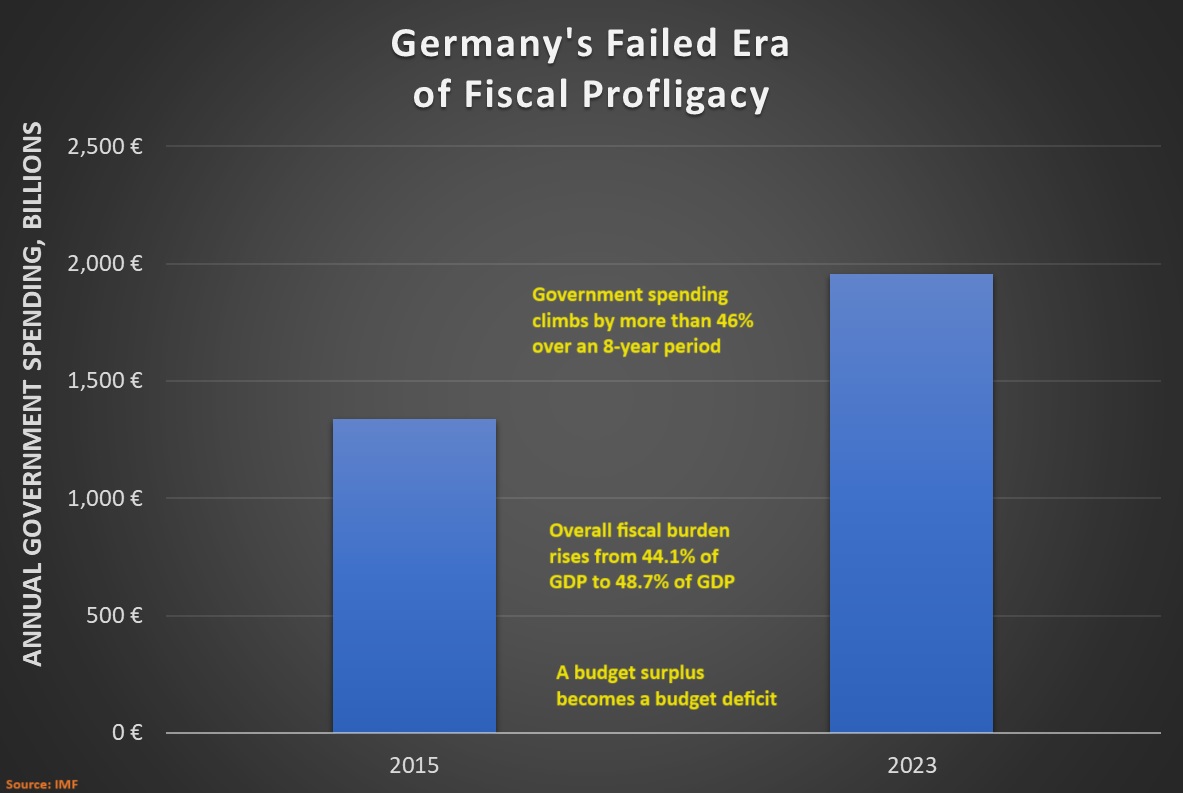
In 2023, I wrote about Germany’s fiscal decay, noting that the burden of government spending had been increasing faster than the productive sector of the economy.
This violated my Golden Rule.
In the accompanying chart, I noted that government was consuming 48.7 percent of economic output, up from 44.1 percent of GDP in 2015.
And, for those who fixate on red ink and fiscal balance, I also noted that Germany’s 8-year experiment in profligacy turned a budget surplus into a budget deficit.
My message was simple. Germany needed to change direction.
The good news is that politicians in Berlin did shift policy.
The bad news is that they decided to make a bad situation even worse. Following elections earlier this year, new Prime Minister Friedrich Merz decided to make government even bigger.
Even the Washington Post has noticed, as illustrated by the headline from this story from last month.

Though I can’t help but point out that it has been about 20 years since Germany budget could be described as “tightfisted.”
But the story was largely accurate even if the title had an error. Merz and the other politicians in Berlin are increasing the fiscal burden of government.
So I was flummoxed to see that Germany’s Prime Minister has suddenly realized that his country is in a fiscal ditch. Here are some excerpts from an editorial in the Wall Street Journal.

Friedrich Merz, the German Chancellor, said at a Christian Democratic Union conference on Saturday that “the welfare state that we have today can no longer be financed with what we produce in the economy.” Thank you, Chancellor, for this burst of candor. …Nations have built welfare and entitlement states that are so large they have outstripped the ability of slow-growing economies to pay for them. …there’s no more difficult challenge in politics than reforming government handouts—whether in pensions, jobless benefits, government healthcare, or income subsidies. It will be worth watching what Mr. Merz and his coalition propose. But the first step toward solving the problem is admitting it exists.
In my not-so-humble opinion, the WSJ‘s editorial writers are being too kind.
They are praising Merz for acknowledging the problem when they should have been condemning him for making the problem worse.
Merz reminds me of the old joke about the kid who murders his parents and then asks for mercy because he’s an orphan.
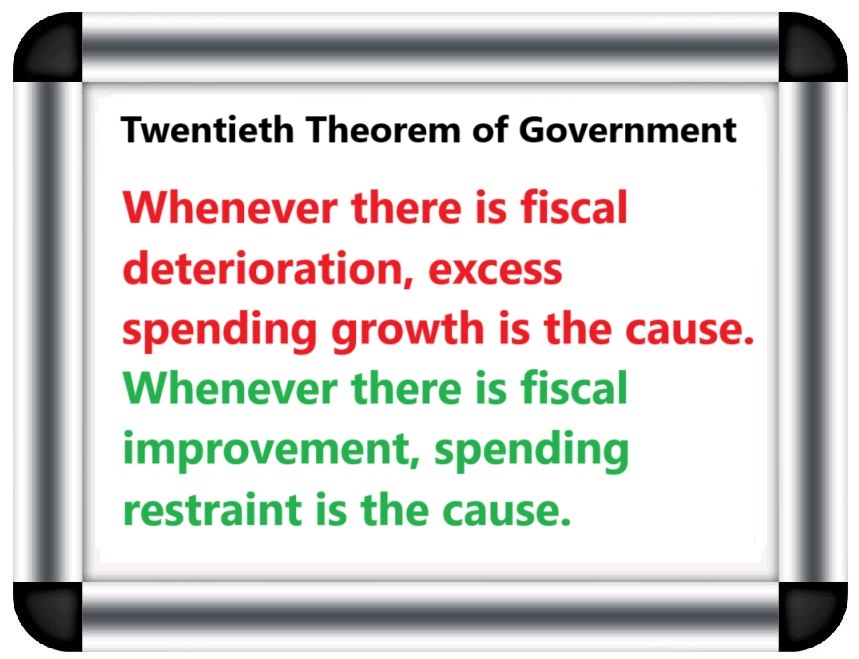
I’ll close by observing that Germany is another example of my 20th Theorem of Government. It’s running out of other people’s money because government is too big and it’s been growing too fast. Maybe Merz has had an epiphany and will now do what’s right, but I’m not holding my breath.
P.S. When I did the chart in 2023, I noted that the burden of government spending had increased by 4.6 percentage points of GDP since 2015. The latest numbers show that government is now consuming an additional 5.3 percent of GDP.
P.P.S. Predictably, the IMF is pushing the wrong advice for Germany.

No comments:
Post a Comment