Search This Blog

De Omnibus Dubitandum - Lux Veritas

Wednesday, May 2, 2018

Science fiction goes PC

Caruba's Corner: Global Warming? The Pope is Wrong

By Alan Caruba Monday, April 27, 2015 @ Warning Signs


I have devoted the better part of more than two and a half decades speaking out against the charlatans that have created and maintained the greatest hoax ever imposed on modern man. At the heart of this hoax has been the United Nations environmental program and at the heart of that program is an agenda to initiate a massive redistribution of wealth from industrialized, successful nations to those who have suffered, as often as not, from being ruled by despots of one description or another.

It is with profound sorrow and disappointment that I must now speak out against Pope Francis, the leader of 1.2 billion Catholics, whom observers have noted has “a green agenda.” He has become an outspoken advocate on environmental issues, saying that taking action is “essential to faith” and calling the destruction of nature a modern sin.

Before proceeding, let me note that I am not Catholic. My thoughts regarding the Pope are rooted in my knowledge of the long record of lies, false predictions, and claims by various environmentalists over the years.

When the Vatican announced it would hold a conference on April 28 called “Protect the Earth, Dignify Humanity: The Moral Dimensions of Climate Change and Sustainable Development”, I wondered why the Vatican is not holding a conference to organize the protection of Christians—particularly in the Middle East—against the wholesale genocide that is occurring. The Pope is not alone in this. There appears to be little urgency in addressing a threat comparable to the Holocaust of the last century that consigned six million Jews to death for being Jews.

I frankly do not know what is meant by “the moral dimensions of climate change.” Climate change is something that was occurring long before there was a human population on planet Earth. It is the measurement of the previous global cycles through which the Earth has passed for billions of years. It is profoundly natural. Applying a moral dimension to it makes no sense whatever.

As for “sustainable development”, that is a term that environmentalists use to deny any development that benefits the human population.

Environmentalism is deeply opposed to the use of any energy resource, coal, oil, natural gas, as well as other elements of the Earth we use to enhance and improve our lives with habitat of every description from a hut to a skyscraper. Over the last five thousand years we have gone from being largely dependent on wood to the use of fossil fuel energy that keeps us safe against nature—blizzards, floods, hurricanes, forest fires, et cetera.

At the heart of environmentalism, however, is a deep disdain and antagonism to the human race. From its earliest advocates, one can find allusions to humanity as “a cancer” on the Earth. The Catholic Church has been an advocate for the human race, most notably opposing abortion that kills humans in the womb. Its charitable work is legendary.

To grasp how far the forthcoming conference is from the most basic beliefs of Catholicism, one need only take note of the persons scheduled to speak. They include the UN Secretary General, Ban Ki Moon, the leader of the institution in which the hoax of global warming was created and advanced. Another is Jeffrey Sachs, the director of the United Nations Sustainable Development Solutions Network, another voice for global warming, but neither is going to tell those attending the conference that there is no warming and that the Earth has been a natural cooling cycle for the past eighteen years, tied entirely to a comparable cycle of the Sun.

The Green’s response to the voices of those scientists who courageously spoke out to debunk their lies has been to denounce and try to silence them. There is no science to support the global warming hoax.

The one-day summit will include participants from major world religions. The Pope will issue an encyclical on the environment later this year.

Is there a religious or spiritual aspect to opposing the forthcoming conference and encyclical? One need look no further than Genesis. In a Wall Street Journal commentary, William McGurn drew the lesson that it offers “a reminder that God’s creation is meant to serve man—not man the environment.

Quoting Genesis 2:15: “The Lord God took the man and put him in the Garden of Eden to work it and take care of it” concluding that “the Earth is to be worked and that this work and the fruit it bears are also blessed.” The spiritual truth to be drawn from this is that man is the steward of the Earth. That does not mean its resources should be abandoned because of bogus claims that the Earth is doomed.

McGurn reminds us that “it is the have-nots who pay the highest price for the statist interventions so beloved the Church of St. Green.” There are more than a billion on Earth who do not have any access to electricity which, in addition to hydropower, is generated by coal, oil and natural gas. Lacking the means to deter the impact of insects and weeds on agriculture, much of the Earth’s annual crops are lost. Lacking access to the beneficial chemicals that protect humans from the diseases transmitted by insects, millions die needlessly.

The Heartland Institute, a free market think tank is leading the effort to alert people to the dangerous message of the Vatican conference because “many people of faith who are familiar with the science and economics of climate change are worried this event will become a platform for alarmism over a controversial scientific issue” noting that “there is no scientific ‘consensus’ on whether there is any need to reduce mankind’s use of fossil fuels.”

The conference agenda is “profoundly anti-poor and anti-life” says the Institute. Plainly said, the Vatican conference incomprehensibly would advocate policies whose only result would be the reduction of human life in order to “sustain” the Earth.

“These unnecessary policies would cause the suffering and even death of billions of people. All people of faith should rise up in opposition to such policies.”

The Heartland Institute is sending a team of scientists and climate policy experts to Rome where they will be joined by Marc Morano of the think tank, CFACT. Says Morano, 'Instead of entering into an invalid marriage with climate fear promoters—a marriage that is destined for an annulment—Pope Francis should administer last rites to the promotion of man-made climate fears and their so-called solutions. This unholy alliance must be prevented.”

© Alan Caruba, 2015

Editor's Note: My friend Alan Caruba passed on June 15, 2015. Alan's work is insightful, logical, factual, and has a timeless about them. Alan had given me blanket permission to publish his work when he was alive. I had intended to archive many of his articles, but like most of us, I got caught up in life. Well, that effort is long overdue, so every week I intend to publish one or more of of his old articles from Warning Signs starting from the last one published as a tribute to my friend, Alan Caruba. Please enjoy Caruba's Corner!

Roy Moore Sues 4 Women, Claiming Defamation and Conspiracy

By Maggie Astor New York Times May 1, 2018
 
Roy Moore, the former Senate candidate from Alabama who has been accused of pursuing sexual and romantic relationships with teenagers, sued four of his accusers on Monday, alleging that they had defamed and conspired against him.

In a lawsuit filed in the Circuit Court of Etowah County, Ala., where Mr. Moore lives, he accused the women — Leigh Corfman, Debbie Gibson, Tina Johnson and Beverly Nelson — of committing libel and slander "by making statements which were false, malicious, and made with intentional or reckless disregard of the truth and with the intent that those statements be published to others, including through state and national media."  Continue Reading.....
 

Mirror, Mirror, on the Wall, Where are Workers Pillaged Worst of All?

April 26, 2018 by Dan Mitchell @ International Liberty
 
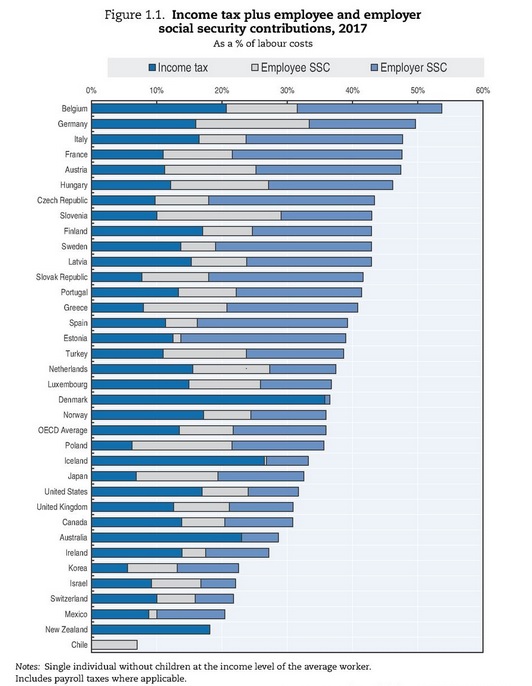
Congratulations to Belgium. According to the new edition of Taxing Wages, average Belgian workers have the dubious honor of surrendering the biggest chunk of their income to government. No wonder part of the country is interested in secession.

We can also give (sincere, this time, rather than sarcastic) congratulations to New Zealand and Switzerland, which impose the lowest overall tax burden on the labor income of average workers (with honorable mention to Chile and Mexico for low tax burdens in developing countries).
Here’s the key data, which shows how much of an average worker’s wages are lost because of income and payroll taxes.


The United States, I’m happy to report, is in the bottom half, which means the government confiscates a below-average amount of money from workers.

Other nations with onerous burdens include Germany, Italy, and France.

Regarding the Belgian tax burden, the government understands this is bad news for Belgium’s economy, so there are periodic discussions about reducing the tax burden on labor income. Unfortunately, the potential “reforms” tend to be senseless tax swaps which would involve higher taxes on consumption or higher taxes on capital.

In the former case, the government would take more money as income is spent, so workers wouldn’t benefit. And in the latter case, there would be less investment, so workers wouldn’t benefit since their pre-tax wages would suffer.

The bottom line is that it’s impossible to have a good tax system with a bloated government.
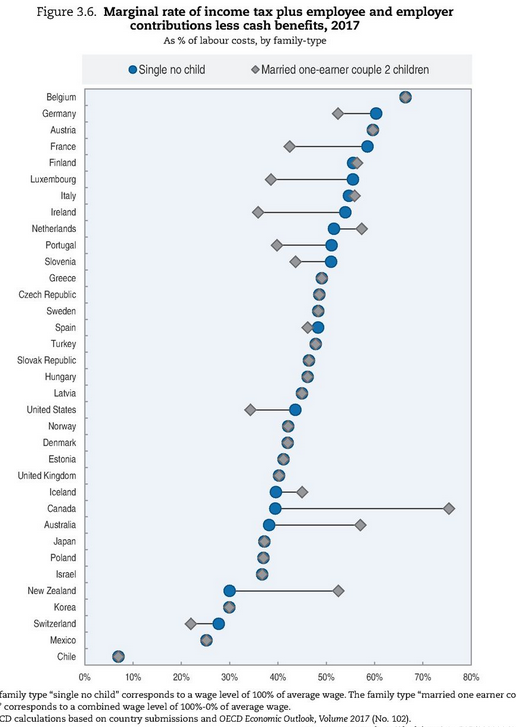
By the way, the previous chart looked at the tax burden on the average worker with no children. Some countries have preferential tax policies for households with kids.

Here’s that data. Belgium still wins the Booby Prize for highest tax burden. But there are some noteworthy difference. Households with kids enjoy significantly lower tax burdens in Germany, France, Luxembourg, Ireland, Portugal, Slovenia, and the United States.


But you probably don’t want to have kids in Canada, Australia, and New Zealand.
Let’s close with a couple of caveats.


First, we’re only looking at one slice of tax policy.

More specifically, this OECD data measures the tax burden on labor income, and it looks at that data only for middle-income workers.

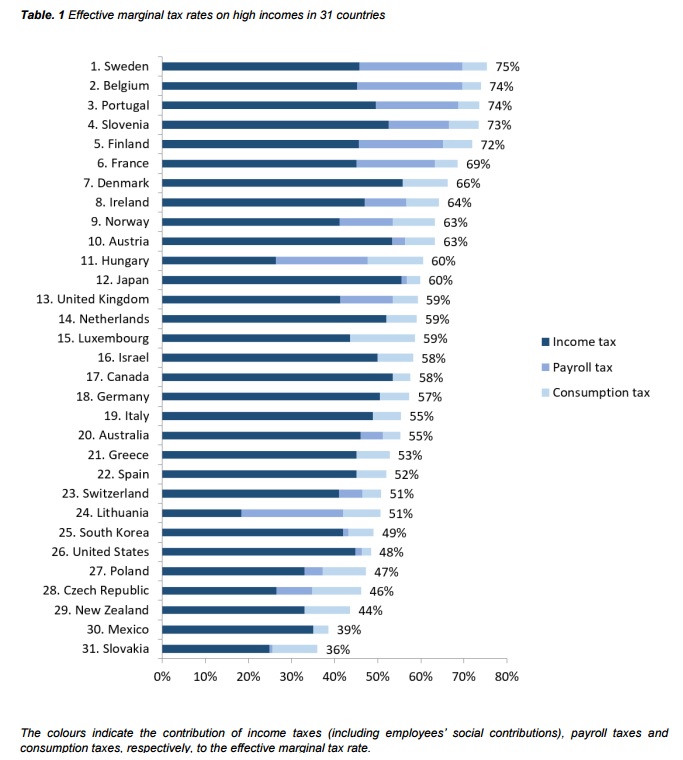
It’s also important to consider tax rates upper-income taxpayers since they tend to be the entrepreneurs and job creators. From this perspective, Belgium had the second-worst tax system for these households, slightly behind Sweden.

Nothing to brag about.

It’s also important to consider the overall tax burden on saving and investment. And there are several ways of looking at that data.
As you can see, Belgium doesn’t get high marks in these indices, but the United States invariably scores poorly.

Last but not least, there are many other policies – such as trade, regulation, and the rule of law – that also help determine a country’s competitiveness.

And while Belgium and other European nations have bad fiscal systems, they tend to score highly in other areas. Same for the United States.

The real key, of course, is to get good scores in all areas, like Switzerland, Hong Kong, and Singapore. Those are the best jurisdictions for workers, with good wages and low tax burdens.

Is climate alarmist consensus about to shatter?

Is this the Beginning of the End – or at least the End of the Beginning?

E. Calvin Beisner April 25, 2018 By 1 Comment  @ The Cornwall Alliance

On November 10, 1942, after British and Commonwealth forces defeated the Germans and Italians at the Second Battle of El Alamein, Winston Churchill told the British Parliament, “Now this is not the end. It is not even the beginning of the end. But it is, perhaps, the end of the beginning.”

In The Hinge of Fate, volume 3 of his marvelous 6-volume history of World War II, he reflected, “It may almost be said, ‘Before Alamein we never had a victory. After Alamein we never had a defeat’.”

The publication of Nicholas Lewis and Judith Curry’s newest paper in The Journal of Climate reminds me of that. The two authors for years have focused much of their work on figuring out how much warming should come from adding carbon dioxide to the atmosphere. In this paper they conclude that it’s at least 30% and probably 50% less than climate alarmists have claimed for the last forty years.

In fact, there are reasons to think the alarmists’ error is even greater than 50 percent. And if that is true, then all the reasons for drastic policies to cut carbon dioxide emissions – by replacing coal, oil and natural gas with wind and solar as dominant energy sources – simply disappear. Here’s another important point.

For the last 15 years or more, at least until a year or two ago, it would have been inconceivable that The Journal of Climate would publish their article. That this staunch defender of climate alarmist “consensus science” does so now could mean the alarmist dam has cracked, the water’s pouring through, and the crack will spread until the whole dam collapses.

Is this the beginning of the end of climate alarmists’ hold on climate science and policy, or the end of the beginning? Is it the Second Battle of El Alamein, or is it D-Day? I don’t know, but it is certainly significant. It may well be that henceforth the voices of reason and moderation will never suffer a defeat.

Shattered Consensus: The True State of Global Warming  was edited 13 years ago by climatologist Patrick J. Michaels, then Research Professor of Environmental Sciences at the University of Virginia and the State Climatologist of Virginia; now Senior Fellow in Environmental Studies at the Cato Institute. Its title was at best premature.

The greatly exaggerated “consensus” – that unchecked human emissions of carbon dioxide and other “greenhouse” gases would cause potentially catastrophic global warming – wasn’t shattered then, and it hasn’t shattered since then. At least, that’s the case if the word “shattered” means what happens when you drop a piece of fine crystal on a granite counter top: instantaneous disintegration into tiny shards.

However, although premature and perhaps a bit hyperbolic, the title might have been prophetic.

From 1979 (when the National Academy of Sciences published  “Carbon Dioxide and Climate: A Scientific Assessment”) until 2013 (when the Intergovernmental Panel on Climate Change published its “5th Assessment Report” or AR5), “establishment” climate-change scientists claimed that – if the concentration of carbon dioxide (or its equivalent in other “greenhouse” gases) doubled – global average surface temperature would rise by 1.5–4.5 degrees C, with a “best estimate” of about 3 degrees. (That’s 2.7–8.1 degrees F, with a “best” of 5.4 degrees F.)

But late in the first decade of this century, spurred partly by the atmosphere’s failure to warm as rapidly as the “consensus” predicted, various studies began challenging that conclusion saying “equilibrium climate sensitivity” (ECS) was lower than claimed. As Cornwall Alliance reported four years ago:
“The IPCC estimates climate sensitivity at 1.5˚C to 4.5˚C, but that estimate is based on computer climate models that failed to predict the absence of warming since 1995 and predicted, on average, four times as much warming as actually occurred from 1979 to the present. It is therefore not credible. Newer, observationally based estimates have ranges like 0.3˚C to 1.0˚C (NIPCC 2013a, p. 7) or 1.25˚C to 3.0˚C – with a best estimate of 1.75˚C (Lewis and Crok 2013, p. 9). Further, “No empirical evidence exists to support the assertion that a planetary warming of 2°C would be net ecologically or economically damaging” (NIPCC 2013a, p. 10).” [Abbreviated references are identified here.]
However, most of the lower estimates of equilibrium climate sensitivity were published in places that are not controlled by “consensus” scientists and thus were written off or ignored.

Now, though, a journal dead center in the “consensus” – the American Meteorological Society’s Journal of Climate – has accepted a new paper, “The impact of recent forcing and ocean heat uptake data on estimates of climate sensitivity,” by Nicholas Lewis and Judith Curry. It concludes that ECS is very likely just 50–70% as high as the “consensus” range. (Lewis is an independent climate science researcher in the UK. Curry was Professor and Chair of the School of Earth and Atmospheric Sciences at the Georgia Institute of Technology and now is President of the Climate Forecast Applications Network.)

Here’s how Lewis and Curry summarize their findings in their abstract, with the takeaways emphasized:
“Energy budget estimates of equilibrium climate sensitivity (ECS) and transient climate response (TCR) [increase in global average surface temperature at time of doubling of atmospheric CO2 concentration, i.e., 70 years assuming 1% per annum increase in concentration] are derived based on the best estimates and uncertainty ranges for forcing provided in the IPCC Fifth Assessment Scientific Report (AR5).
“Recent revisions to greenhouse gas forcing and post-1990 ozone and aerosol forcing estimates are incorporated and the forcing data extended from 2011 to 2016. Reflecting recent evidence against strong aerosol forcing, its AR5 uncertainty lower bound is increased slightly. Using a 1869–1882 base period and a 2007−2016 final period, which are well-matched for volcanic activity and influence from internal variability, medians are derived for ECS of 1.50 K (5−95%: 1.05−2.45 K) and for TCR of 1.20 K (5−95%: 0.9−1.7 K). These estimates both have much lower upper bounds than those from a predecessor study using AR5 data ending in 2011.
“Using infilled, globally-complete temperature data gives slightly higher estimates; a median of 1.66 K for ECS (5−95%: 1.15−2.7 K) and 1.33 K for TCR (5−95%:1.0−1.90 K). These ECS estimates reflect climate feedbacks over the historical period, assumed time-invariant.
“Allowing for possible time-varying climate feedbacks increases the median ECS estimate to 1.76 K (5−95%: 1.2−3.1 K), using infilled temperature data. Possible biases from non-unit forcing efficacy, temperature estimation issues and variability in sea-surface temperature change patterns are examined and found to be minor when using globally-complete temperature data. These results imply that high ECS and TCR values derived from a majority of CMIP5 climate models are inconsistent with observed warming during the historical period.
A press release from the Global Warming Policy Forum quoted Lewis as saying, “Our results imply that, for any future emissions scenario, future warming is likely to be substantially lower than the central computer model-simulated level projected by the IPCC, and highly unlikely to exceed that level.”

Veteran environmental science writer Ronald Bailey commented on the new paper in Reason, saying: “How much lower? Their median ECS estimate of 1.66°C (5–95% uncertainty range: 1.15–2.7°C) is derived using globally complete temperature data. The comparable estimate for 31 current generation computer climate simulation models cited by the IPCC is 3.1°C. In other words, the models are running almost two times hotter than the analysis of historical data suggests that future temperatures will be.

“In addition, the high-end estimate of Lewis and Curry’s uncertainty range is 1.8°C below the IPCC’s high-end estimate.” [emphasis added]

Cornwall Alliance Senior Fellow Dr. Roy W. Spencer (Principal Research Scientist in Climatology at the University of Alabama-Huntsville and U.S. Science Team Leader for NASA’s satellite global temperature monitoring program) commented on the paper Even Lewis and Curry’s figures make several assumptions that are at best unknown and quite likely false. He noted:
“I’d like to additionally emphasize overlooked (and possibly unquantifiable) uncertainties: (1) the assumption in studies like this that the climate system was in energy balance in the late 1800s in terms of deep ocean temperatures; and (2) that we know the change in radiative forcing that has occurred since the late 1800s, which would mean we would have to know the extent to which the system was in energy balance back then.
“We have no good reason to assume the climate system is ever in energy balance, although it is constantly readjusting to seek that balance. For example, the historical temperature (and proxy) record suggests the climate system was still emerging from the Little Ice Age in the late 1800s. The oceans are a nonlinear dynamical system, capable of their own unforced chaotic changes on century to millennial time scales, that can in turn alter atmospheric circulation patterns, thus clouds, thus the global energy balance. For some reason, modelers sweep this possibility under the rug (partly because they don’t know how to model unknowns).
“But just because we don’t know the extent to which this has occurred in the past doesn’t mean we can go ahead and assume it never occurs.
“Or at least if modelers assume it doesn’t occur, they should state that up front.
“If indeed some of the warming since the late 1800s was natural, the ECS would be even lower.
With regard to that last sentence, Spencer’s University of Alabama research colleague Dr. John Christy and co-authors Dr. Joseph D’Aleo and Dr. James Wallace published a paper in the fall of 2016 (revised in the spring of 2017). It argued that solar, volcanic and ocean current variations are sufficient to explain all the global warming over the period of allegedly anthropogenic warming, leaving no global warming to blame on carbon dioxide.

At the very least, this suggests that indeed “some of the warming since the late 1800s was natural” – which means the ECS would be even lower than Lewis and Curry’s estimatE.

All of this has important policy implications.

Wisely or not, the global community agreed in the 2015 Paris climate accords to try to limit global warming to at most 2 C degrees – preferably 1.5 degrees – above pre-Industrial (pre-1850) levels.

If Lewis and Curry are right, and the warming effect of CO2 is only 50–70% of what the “consensus” has said, cuts in CO2 emissions need not be as drastic as previously thought. That’s good news for the billions of people living in poverty and without affordable, reliable electricity. Their hope for electricity is seriously compromised by efforts to impose a rapid transition from abundant, affordable, reliable fossil fuels to diffuse, expensive, unreliable wind and solar (and other renewable) as chief electricity sources.

Moreover, if Spencer (like many others who agree with him) is right that the assumptions behind ECS calculations are themselves mistaken … and Christy (like many others who agree with him) is right that some or all of the modern warming has been naturally driven – then ECS is even lower than Lewis and Curry thought. That would mean there is even less justification for the punitive, job-killing, poverty-prolonging energy policies sought by the “climate consensus” community.

Regardless, we’re coming closer and closer to fulfilling the prophecy in Michaels’ 2005 book. The alarmist “consensus” on anthropogenic global warming is about to be shattered – or at least eroded and driven into a clear minority status.

E. Calvin Beisner, Ph.D., is Founder and National Spokesman of The Cornwall Alliance for the Stewardship of Creation.

Tuesday, May 1, 2018

Kasich denies leaving GOP: 'The Republican Party left me'

"I'm still a Republican," Kasich said. "I didn't leave the Republican Party. The Republican Party left me." "We should care about people from top to bottom, not just those at the top, but everybody," he told Tapper. "I can bring that party back. That's what I'm going to do in one way or another." ...........
A lame metaphor from a lame candidate. Who under the age of 30 even knows what a department store is? And Kasich is not conservative – at least as the term is defined by those who claim to adhere to it. It is no longer conservative to fight massive spending increases and skyrocketing debt. If Kasich believes he is "conservative," he is sadly mistaken. ............Read more

My Take - It's been my view that John Kasich suffers from a serious case of weird compounded by a massive infection of hubris.  It's also been my view for some time he intends to change parties, either attempting to run for President of the United States in the 2020 election as a Democrat or an Independent.  I don't think he has a chance anywhere, but it's also my belief his weird arrogant mentality has rendered him clueless and intends to officially change parties inspired by some strange delusional belief the nation needs him, or even wants him.  

As for Ohio, John Kasich and the Republican party - he's toast!

Peter Zeihan on Geopolitics: Syria


The Syrian War, 2.0
 
The Israeli Air Force announced April 21 that it would scale back participation in the Red Flag exercises in Alaska. The joint Red Flag drills are regular events hosted by the United States, with the upcoming April 26-May 11 exercises allowing the Israelis to train in an environment they rarely experience (non-coincidentally, Alaskan terrain is somewhat similar to the Persian highlands). IDF spokespersons attributed the decision to keep Israeli F-15s at home due to the changing situation assessment of tensions along its northern border that have left everyone holding their breath.  

We weren’t kept waiting long. In the early morning hours of April 30, the Israelis launched a series of significant strikes throughout western Syria, targeting infrastructure that supports weapons development and distribution. A rocket factory made for some particularly impressive fireballs.

The Israelis normally hold their cards much closer to their chest than this – particularly when it involves possible actions in their close-in neighborhood. But these are not normal times. The open secret is that the United States sees almost no role for itself in Syria going forward (at least, compared to what American engagement in the Middle East typically looks like). The Americans’ primary goal in Syria has been the eradication of ISIS. With the terror group’s holdings nearly obliterated, so too goes a compelling case for extending American involvement in Syria. This is compounded by the fact that a country as broken as Syria needs the kind of costly, involved, long-term occupation and rebuilding efforts the Americans pursued in Germany and Japan after World War II – a cost the Americans were unwilling to pay in either Iraq or Afghanistan.

The pending American withdrawal evolves the Syrian War in a much fiercer direction. Initially, the primary players in the fight were domestic: the Assad government, ISIS, the Syrian Kurds, and the various collections of anti-regime elements who seemed to occupy every spot on the spectrum from wonky democrats to those who felt ISIS would have been more successful if it had just been a bit more brutal. Foreign powers used these factions as proxies to meet their tactical and strategic needs in the country without committing significant troops. It also created plausible deniability in a very volatile situation with many major actors. In exchange, these factions received intelligence, money, weapons and on-site support far superior to anything they could hope for otherwise, not to mention promises for their role in the future in Syria that may or may not be fulfilled. While those foreign players could certainly make their presence felt, using proxies inherently means the foreigners were rarely present in sufficient strength to dictate events on the ground. (The sole exception might be Iran’s proxy militant group in Lebanon, Hezbollah, which has apparently redirected nearly all its fighters into the Syrian theater to assist the Assad government. More on that exception in a moment.)

The presence of U.S. forces in Syria has limited what all the outside players could do, as well as the sorts of risks they were willing to take. The Americans may have never had more than a couple thousand troops in-country, but their vast array of naval firepower combined with the base at Incirlik, Turkey meant they could at a moment’s notice squeeze off missile and bomb barrages at any target they desired. There was no point in baiting the eagle (as Moscow discovered Feb 7 when the Americans obliterated a Russian probe attempt).

But take the Americans out of the equation, and the lid comes off the pot. And since everyone has different goals, Syria is about to get consistently lively:

Russia was an early participant in the Syrian conflict for a mix of reasons:
•Syria is one of the few of Russia’s Cold War-era proxies that is still of some use, so propping up Assad holds some slight strategic value all its own.  
•Politically, being involved where the Americans were not helped burnish Russia’s credentials as a player, guaranteed it a seat at any table that discussed Syrian issues, and was an easy propaganda win back home.  
•Being in Syria annoyed the crap out of the Turks, forcing Ankara to rivet its gaze to its south rather than to the north where more core Russian interests were in play.  
•Being able to twist the Syrian fighting this or that way enabled the Russians to generate scads of refugees on demand. A mix of geographic, climatic and infrastructure patterns meant that most of those refugees could only go north to Turkey and Europe, enabling Moscow to scramble European politics with nothing more than a few dozen bombs.  
•More recently, the Russians have turned Syria into a vast testing and training range for its forces. Russia’s military may be huge, but it hasn’t seen 1% of the sort of expeditionary combat American forces have seen since 1992. Syria let’s the Russians play catch up. What do all these reasons have in common? Russia has a vested interest in seeing the Syrian War never end.   
Moscow, Russia
 
Iran is the closest to a strategic ally that the Assad regime has, and Syria has quite surprisingly – to Iran – become the lynchpin in Iran’s entire regional strategy. The most important tool Iran has is the militant group Hezbollah, which Iran uses not simply as a foothold in the Levant, but to threaten Israel and pressure the United States. When Saddam ran Iraq, the Iranians were able to shuttle support to Hezbollah via Iraq and Syria into Lebanon. Well, the Americans overthrew Saddam and now civil war threatens Syria. The Iranians didn’t just have no choice but to go all-in in Syria, but they are now the power seeking to maintain governments in the region rather than seeking overthrow them. That requires a degree of political, strategic, military and economic commitment that is downright… American.

Assad may have won the civil war, but now Iran has to hold the place together, and as the Americans learned in Vietnam, Afghanistan and Iraq, the second phase is far more difficult. But unlike the Americans, the Iranians can’t just go home. An ongoing Assad victory is absolutely critical to maintaining Iran’s current sphere of influence from Mesopotamia to the eastern Mediterranean. In short, the Iranians can never go home.

Directly opposite the Iranians are a series of powers that seem to be somewhat confused about what’s going on in their neighborhood: the Gulf Arab states – Saudi Arabia, the United Arab Emirates, and Qatar. Their efforts in Syria are, in a word, messy.
•Part of this is due to geography: large swathes of desert terrain separate the Gulf Arabs and Syria. •Partly it’s a lack of experience: the Gulfies are among the most dependent countries on earth when it comes to relying on the American security blanket.
•Partly it’s ineptitude: Saudi and Emirati and Qatari-backed groups spend as much time fighting each other in Syria as they do Assad or anyone else.
•Partly it’s an issue of distraction: these same powers are also fighting a war in Yemen. It all adds up to a lot of ammunition backed by a lot of money that’s causing a lot of deaths. And that just might be the point. For decades the Americans’ took on the mantle of preserving countries in their current form; If your job is to maintain the global system, then you want stability. But with the Americans leaving, the only power that really wants a stable Syria is… Iran. And if there is one thing the Saudis do not want, it is an Iranian-dominated anything. Better to burn the whole place down than allow the dust to settle in an arrangement that doesn’t suit Saudi preferences.  
Which puts Israel and Saudi Arabia more or less on the same side, with Israel in the perfect strategic and political position. The regional powers with which the Israelis have passably good relations – Turkey, Saudi Arabia, the UAE, Qatar and Egypt – are fighting against Assad and Iranian influence, which means Israel is free to strike targets according to its own national security prerogatives with little risk of even angry tweets from regional stakeholders.

The Syrian War has quietly ushered in a new era of Israeli security relations with its neighbors: rather than relying on the Americans, Israel is aggressively, proactively and decisively pursuing its national security interests and intervening in Muslim conflicts… and no one except Syria and Iran has anything to say about it. The Israeli Air Force has attacked over 100 targets within Syrian territory since 2012, from suspected missile and arms deliveries en route to southern Lebanon to high value Hezbollah and Iranian targets. With the Iranians now the force for order in the country, the Israelis will gleefully expand their target list to anything that will cost the Iranians lives, equipment or money.

It’ll be a long list.

Tehran, Iran

The role of Turkey in Syria has been… unmoored for a reinforcing pair of reasons.
•First, Turkey’s World War One defeat was so total and humiliating that Turkey in essence took a vacation from the world that lasted a century. The Turks are out of practice using the political, diplomatic, economic and military tools that are standard for pretty much everyone else. The learning curve is fairly steep, but it is still there and the Turks are starting from almost zero.
•Second is that the political situation within Turkey is flattening that learning curve. Prime Minister Recep Tayyip Erdogan has largely completed the process of purging the country of, well, everyone who opposes him. That has left this very Trumpian personality with zero competent allies, which means he is running Turkey’s $900 billion economy, 80-million citizens, and 900,000-strong military all by himself. Such concentration of power makes for erratic decision-making, with Erdogan highly vulnerable to bad intelligence, fake news, Russian manipulations, personal mental blocks, and a host of other issues that would routinely be filtered out in a more decentralized system.
At the end of the day the Turks’ primary concern in Syria is the military capacity and de facto independence of the Syrian Kurds. Ankara/Erdogan fear – with significant reason – that a Syrian Kurdish statelet will provide a template that could be reproduced within Turkey’s own Kurdish regions. To that end and despite Erdogan’s best efforts, the Turkish military/intelligence apparatus is steadily constructing effective networks of military groups throughout northern Syria. When the Turks do decide to move in force, they’ll be able to.  

And let’s not kid ourselves. Unlike the United States, Russia, Iran or Israel, Turkey can put troops on the ground in Syria in the hundreds of thousands if it wants to and the Turks have the motivation and staying power to see their strategy through in what will be a complex and bloody new stage in the war. It is ultimately Turkey that will decide what Syria will look like, and years from now we’ll all be looking back at the 2018 American withdrawal as the event that unleashed Turkish power in the region.

I’d like to end with one particularly dark thought. The primary reason the Americans were in Syria at all was because a militant group called ISIS was stupid enough to post the beheadings of a few American co-eds on social media. Expunging ISIS is pretty much done and so the Americans are now leaving. But look at what enabled ISIS to exist in the first place: local sectarian divisions, multiple competing power centers, an arid geography that complicates regional consolidation, meddling outside powers, and a metric butt-ton of easily attainable military-grade weapons. None of these factors have gone or are going to go away. Every power playing in the Syrian sandbox is creating, sponsoring and supporting their own constellations of mutually-antagonistic militias. It isn’t so much a petri dish from which will emerge the next ISIS as it is an ISIS factory.

Happy Monday.

Kaiser, Chronicle of Higher Education and More Outreach Last Week

By Hank Campbell — April 29, 2018 @ American Council on Science and Health

1. Governments love to pretend to accept science if it means more revenue for government employees, and nothing has been more prone to confirmation bias than that "sin" taxes are for the public good. Yes, they can correlate higher costs to lower uptake but that is simply government fiat handicapping the free market - there is not much evidence that sin taxes lead to better outcomes
Smoking is down, but it did not go down more because New York City dramatically increased taxes on cigarettes. Instead, in NYC the black market took over, then cops were told to enforce penalties on sales of "loose" cigarettes because revenue from cigarette taxes dropped, and a guy died on the street because he was selling them, to national outrage. Smoking went down because we hammered cigarette makers and the public with information about the harms of smoking, not because of taxes.
Now sugar is the latest target - but only some sugary drinks. Our Chuck Dinerstein, MD, noted the flaws in their data and how these were really regressive taxes on the poor, and that rationalizations by proponents of more government revenue bled from the poor is a good thing, because they will use it to pay for health care for the poor. Kaiser Family Foundation linked to our work exposing that taxes are just taxes - they don't make anyone healthier, and we shouldn't let governments pretend they are being evidence-based in their desire to pay themselves more.

2. When marijuana was still illegal, governments also began calling alternatives by the chemophobic name "synthetic marjuana." It's not marijuana of any kind but people who don't know any science make these kinds of mistakes. Newser linked to our work sounding the alarm on this K2/Spice junk, and that it is not marijuana at all. You are just as likely to be getting rat poison.

3. In a Fatherly article on parenting in California, I noted that play was different now than when I was a kid, but it isn't necessarily worse. I never once played catch with my dad, but I played baseball. My kids have little interest in it even though I have played catch with them plenty of times. They do like making short films, writing scripts, and doing more intellectual things.  So engage with kids but you don't need a how-to manual on what that means. Have them do what you like, do what they like as they grow. It's all good.

Here is a video my kids made when they were younger. I held the camera.


4. In the Chronice of Higher Education, they discuss a hate-monger who has been allowed tenure at a California university. Which means she can never be fired. They link to our work on the psychology of hate and ask the awkward question that needs to be asked; if a white man said this stuff, would a California school find a way to get rid of him?

5. The Joplin Globe asks about what "treats" are really healthy - that is why we call them treats and tell people to eat snacks in moderation - and links to our work on sensible diets.

While we support the freedom of everyone to binge on pizza daily and blow up to 400 lbs. and die at an early age of heart failure - American science made it possible for even the poorest people to eat enough to get fat, which is an achievement unheard of three generations ago - it is not a good idea.

6. IFL Science linked to our working warning people that gluten-free may not be gluten-free. So if you are celiac or have a child is celiac, some caution is warranted. If you are instead one of the food fad people who claim you have some special concern toward gluten since you saw it in the New York Times, you'll be fine.


7. Brownfield Ag Daily linked to our work noting the many junk science claims involving cancer and coffee.
The corruption is worse than many realize. Take the example of Berkeley Professor Martyn Smith. He and a trial lawyer firm created an NGO - Council for Education and Research on Toxics (CERT) - to sue companies over coffee and french fries. It uses the same address as the law office. Smith then got activist friends inside IARC to place him on a working group, which unsurprisingly evaluated acrylamide, the thing he and his friends at the Metzger law group sue over. Who does Metzger now use as an expert witness, because he was on IARC? Martyn Smith. The trial lawyers created an NGO who hired the trial lawyers and then use the guy who created the NGO as their expert witness.
Prop 65 is corrupt and has been for a while - because the people of California made it into law back when IARC was not corrupt. It now needs to go.

Caruba's Corner: The Prison Called Cuba

By Alan Caruba Monday, April 20, 2015 @ Warning Signs


We are told we need to feel sympathy for the Cuban people who have suffered from a U.S. embargo and lack of diplomatic recognition. That ignores a long history of oppression in Cuba no matter who was in charge.

Prior to Fidel Castro, Cubans were in the grip of Flugencio Batista who overthrew the existing government in September 1933 and then dominated Cuban politics for the next 25 years until Castro’s revolutionary movement took control of the capitol in January 1959.

Fifty-six years ago in 1959, I was about to graduate from the University of Miami and among my friends were young Cubans sent there to get a degree. I have often wondered which among them returned to Cuba and which, like those who could afford it, were joined by their family who fled Cuba.

The U.S. had been involved with Cuba from the end of the Spanish-American War in 1898 when Spain ceded Puerto Rico, the Philippines, and Guam for $20 million. We stayed in Cuba until it was granted independence in 1902 as the Republic of Cuba. Its first president faced an armed revolt in 1906 so we returned to briefly occupy Cuba to restore some stability, but they never really got the hand of being a democratic self-governing nation.

How much better it would have been for the Cubans if the U.S. had decided to make the island a territory like Puerto Rico. Then we could have let the island prosper without having to end up with becoming a Communist nation closely allied, first with the Soviet Union and after its collapse in 1991, with others like China and Venezuela.

The lesson we might be expected to draw from this is that Communism does not work. It is an utterly failed economic and social system that can only stay in power by jailing or executing anyone who resists. That is exactly what the brothers, Fidel and Raul Castro, have done since seizing power. One consistency of the past five decades has been the anti-America policies they have pursued.

The reason given by Obama was that U.S. policies toward Cuba “have not worked” and that it is time for a change. There is some truth in this and it should be noted that Canada has long had good relations with Cuba as have European and, of course, Latin and South American nations.

Even so, what are we to conclude from the report that Russia plans to join military drills with Cuba and North Korea that may also include Vietnam and Brazil? Russia’s aggression in Ukraine has left it sanctioned and isolated, so the military drills send a message that it still has nations friendly to it, but what nations!

Cuba was caught not long ago when it attempted to ship weapons to North Korea, so we are talking about two dedicated Communist nations. Over the years, it has more than demonstrated its anti-American hostility.

Generally, there is little to be gained by exchanging embassies or relieving Cuba. Lifting our embargo and other sanctions leaves the U.S. with even less leverage, if any.

What has been largely overlooked since Obama’s announcement is the fact that Cuba is still ruled by a Castro and is likely to remain so because Raul’s son, Alejandro Castro Espin, a colonel in Cuba’s intelligence apparatus is likely being groomed to take over after becoming a general and a member of the Communist Party Politburo, Cuba’s ruling body. As noted in an article in The Atlantic, it is the Cuban military not only that plays a major role in the Politburo, it also controls at least sixty percent of the island nation’s economy.

I have no doubt that reaching out to Cuba ranks just below reaching out to Iran as Obama contemplates his “legacy.” Both are notorious enemies of the U.S. Nor would it surprise me if Obama would try to unilaterally shut down Guantanamo. Failing that, he will do everything he can to empty it by the time he leaves office.

Since the collapse of the Soviet Union in 1991, Cuba has had to struggle to survive economically. Its earlier behavior got it banned from the Organization of American States that was not lifted until 2009, but which did not confer full membership until it was deemed to be “in conformity with the practices, purposes, and principles of the OAS.” At the time, Fidel said he was not interested in joining.

Not much has changed in terms of the enmity the Castro brothers have expressed toward the U.S. but practical considerations to keep unrest among elements of Cuba’s population under control require them to ease some of the earlier control over being able to travel and likely who Cubans can do business with would improve whatever commerce will be permitted.

At this point, the only “winner” is Cuba.

© Alan Caruba, 2015

Editor's Note: My friend Alan Caruba passed on June 15, 2015. Alan's work is insightful, logical, factual, and has a timeless about them. Alan had given me blanket permission to publish his work when he was alive. I had intended to archive many of his articles, but like most of us, I got caught up in life. Well, that effort is long overdue, so every week I intend to publish one or more of of his old articles from Warning Signs starting from the last one published as a tribute to my friend, Alan Caruba. Please enjoy Caruba's Corner!

In a Display of Moral Blindness, President of European Commission Celebrates Marxist Totalitarianism

April 28, 2018 by Dan Mitchell @ International Liberty
 
The evil ideology known as communism left a track record of unimaginable horror. Experts estimate that 100 million people were killed by Marxist regimes.

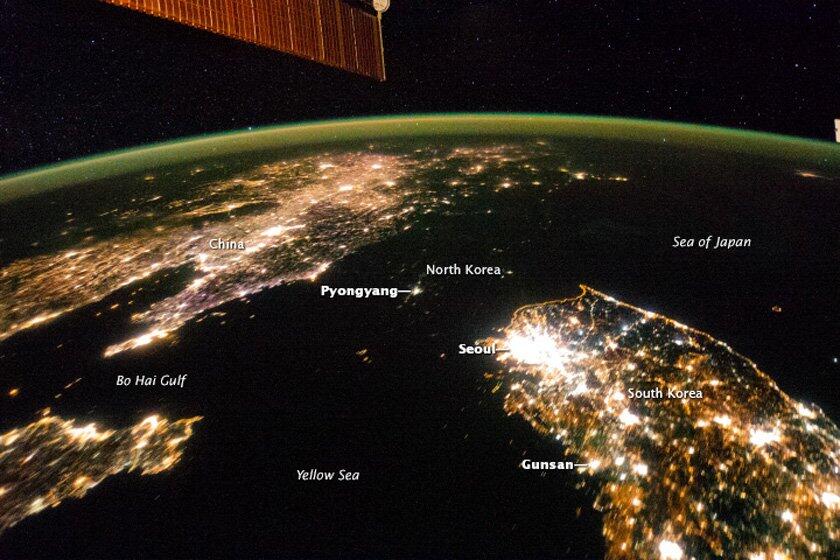
North Korea v South Korea

Some were murdered. Other starved to death because of the pervasive economic failure of communism.

Yet there are dupes and apologists who overlook all this death and misery.

One of them is Jean-Claude Juncker, the President of the European Commission. A few days from now, this über-bureaucrat will help celebrate the 200th birthday of Karl Marx.
The European Commission President will travel to Trier, Germany, where he will give a speech to celebrate the 200th anniversary of Marx’s birth. …The Commission President will give a speech at the opening ceremony of the Karl Marx exhibition in the city. …The chief eurocrat’s trip has received critics, who have suggested the 63-year-old forgetting how Marx’s “warped ideology” led to millions of deaths across the world. Ukip MEP and the party’s former leader Paul Nuttall said: “It is appalling that Jean-Claude Juncker feels it necessary to commemorate a man whose ideology – Marxism/Communism – led to more than 100 million deaths. …Conservative MP Daniel Kawczynski…, who as a seven-year-old boy fled to Britain with his family from the Communist regime in Poland, said Mr Juncker should reject any invitations to commemorate the event. He said: “I think it’s in very poor taste we have to remember that Marxism was all about ripping power and individual means away from people and giving to State. “Marxism led to the killing of millions around the world as it allowed a small band of fanatics to suppress the people we must learn the lessons from this and share with our children.”
How disgusting.

And let’s not forget that communism is still claiming victims in places such as Cuba and North Korea.

Here’s the part of the story that caused my jaw to drop.
A commission spokeswoman defending Mr Juncker’s visit… She said: …“I think that nobody can deny that Karl Marx is a figure who shaped history in one way or the other.
In that case, why not celebrate Hitler’s birthday as well?

Writing for the Atlas Society, Alan Charles Kors expresses dismay that communism does not receive the same treatment as its sister ideology of National Socialism.
No cause, ever, in the history of all mankind, has produced more cold-blooded tyrants, more slaughtered innocents, and more orphans than socialism with power. It surpassed, exponentially, all other systems of production in turning out the dead. The bodies are all around us. And here is the problem: No one talks about them. No one honors them. No one does penance for them. No one has committed suicide for having been an apologist for those who did this to them. …The West accepts an epochal, monstrous, unforgivable double standard. We rehearse the crimes of Nazism almost daily, we teach them to our children as ultimate historical and moral lessons, and we bear witness to every victim. We are, with so few exceptions, almost silent on the crimes of Communism. So the bodies lie among us, unnoticed, everywhere. We insisted upon “de-Nazification,” and we excoriate those who tempered it in the name of new or emerging political realities. There never has been and never will be a similar “de-Communization,” although the slaughter of innocents was exponentially greater, and although those who signed the orders and ran the camps remain. In the case of Nazism, we hunt down ninety-year-old men because “the bones cry out” for justice. In the case of Communism, we insisted on “no witch hunts”… The Communist holocaust should have brought forth a flowering of Western art, and witness, and sympathy. It should have called forth an overflowing ocean of tears. Instead, it has called forth a glacier of indifference. Kids who in the 1960s had portraits of Mao and Che on their college walls —the moral equivalent of having hung portraits of Hitler, Goebbels, or Horst Wessel in one’s dorm—now teach our children about the moral superiority of their political generation. Every historical textbook lingers on the crimes of Nazism, seeks their root causes, and announces a lesson that should be learned. Everyone knows the number “six million.” By contrast, it is always “the mistakes” of Communism or of Stalinism (repeated, by mistake, again, and again, and again). Ask college freshmen how many died under Stalin’s regime, and they will answer, even now, “Thousands? Tens of thousands?”
Of course, some of these kids are probably wearing t-shirts celebrating Che Guevara, so it goes without saying that they are ignorant.


Or, if they actually know Che’s track record, the kids are immoral punks.

In any event, Jean-Claude Juncker should know better. Sounds like he wants his name to be added to the biggest-clown-in-Brussels contest.

P.S. I’m embarrassed to admit that some economists were apologists for communism.

P.P.S. There’s a very small silver lining to the dark cloud of communism. You can click here, here, here, and here to enjoy some clever anti-communism humor.

Trump's International Art of the Deal

Posted by Daniel Greenfield 4 Comments Sunday, April 29, 2018 @ Sultan Knish Blog
 
It’s really not that complicated.

But President Trump’s Syria strikes have reopened the debate over what defines his foreign policy. Is he an interventionist or an isolationist? Foreign policy experts claim that he’s making it up as he goes along.

But they’re not paying attention.

President Trump’s foreign policy has two consistent elements. From threatening Kim Jong-Un on Twitter to moving the embassy to Jerusalem to bombing Syria, he applies pressure and then he disengages.

Here’s how that works.

First, Trump pressures the most intransigent and hostile side in the conflict. Second, he divests the United States from the conflict leaving the relevant parties to find a way to work it out.

North Korea had spent decades using its nuclear program to bully its neighbors and the United States. Previous administrations had given the Communist dictatorship $1.3 billion in aid to keep it from developing its nuclear program. These bribes failed because they incentivized the nuclear program.

Nukes are the only thing keeping North Korea from being just another failed Communist dictatorship.

Instead, Trump called North Korea’s bluff. He ignored all the diplomatic advice and ridiculed its regime. He made it clear that the United States was not afraid of North Korean nukes. The experts shrieked. They warned that Kim Jong-Un wouldn’t take this Twitter abuse and we would be in for a nuclear war.

But the Norks folded.

The Communist regime held high level talks with the United States and South Korea. It’s reportedly planning to announce an official end to the war. That probably won’t amount to much in the long term, but it shifts more of the responsibility for the conflict away from the United States and to the Koreas.

Trump accomplished more with a few tweets than previous administrations had with billions of dollars.

An instinctive negotiator, Trump’s realpolitik genius lay not in ideology, but in grasping the core negotiating strategy of the enemy and then negating it by taking away its reason not to make a deal.

When Trump called North Korea’s bluff, its nuclear weapons program was transformed from an asset that it used to blackmail aid from its potential targets into a liability that could end with its destruction.

Trump did the same thing with Jerusalem.

The PLO had refused to make a deal with Israel because its constant refusals to negotiate allowed it to keep escalating its demands. The more it sabotaged negotiations, the better the offers became.

The PLO’s Palestinian Authority didn’t have nukes, but its weapon of choice was terrorism. And it had played the same game as North Korea for decades. It would begin negotiations, demand payoffs, then sabotage negotiations, threaten violence, and demand an even higher payoff for ending the violence.

The PLO/PA knew that it could get the best possible deal by not making a deal.

Just like North Korea, Trump cut the PLO down to size by negating its negotiating strategy. Instead of the deal getting better and better, Trump showed that it would get worse by taking Jerusalem off the table.

Previous administrations had rewarded the PLO/PA for its refusal to make a deal by sweetening the pot. Instead Trump threatened to take away Jerusalem, the biggest prize in the pot. And then he warned that the PLO would lose even more of its demands if the terrorist group continued to refuse to make a deal.

Unlike Clinton, Bush and Obama, Trump did not overcompensate for the US-Israel relationship by pressuring the Jewish State to make a deal with the PLO so as to seem like an “honest broker”. Instead he leveraged that relationship to move the United States away from the conflict.

Moving the embassy to Jerusalem sends the signal that the US-Israel relationship doesn’t depend on a deal with the PLO. That’s the opposite of the messages that Clinton, Bush and Obama had sent.

Their old failed diplomacy that made the US-Israel relationship dependent on a deal with the PLO had given the terrorists control over our foreign policy. The US and Israel were perversely forced into appeasing the terrorists of the PLO just to be able to maintain a relationship with each other.

Trump kicked the PLO out of the driver’s seat. And the terrorist group is becoming isolated.

Saudi Arabia and its allies are much more focused on Iran than the old proxy war against Israel. And, for the moment, that leaves the PLO with few allies. If it doesn’t make a deal, then the United States will rebuild its relationship with Israel around regional security issues. And the Saudis have signaled that they are willing to do the same thing. Then everyone else exits the conflict except Israel and the PLO.

Trump left it to the South Koreans to decide the conflict with North Korea. Ditto for Israel.

The United States will put forward proposals, but the long game is to get America out these conflicts. And Trump does that by turning the United States from an eager mediator to a bully with a big stick.

He made it clear to Kim Jong-Un that he would have a much easier time negotiating with South Korea than with America. And he’s made it equally clear to the PLO that it’s better off turning to Israel than to its allies in the State Department. The message is, “You don’t want to get the United States involved.”

Previous administrations believed that the United States had an integral role in resolving every conflict. President Trump’s America First policy seeks to limit our involvement in foreign conflicts without robbing us of our influence by making those interventions as decisive and abrasive as possible.

It breaks every rule of contemporary diplomacy. But it has plenty of historical precedents. And it works.

President Trump wants to get out of Syria. But he doesn’t want to hand Iran another win. And he doesn’t want to get the United States bogged down in another disastrous regional conflict.

So, just like in North Korea and Israel, he sent a decisive message of strength.

The strikes were a reminder that unlike his predecessor, he was not afraid of using force. But just as in North Korea and Israel, the show of strength was only a lever for disengaging from the conflict.

Instead, Trump wants to bring in an “Arab force” to stabilize parts of Syria. That would checkmate Iran, split Syria between the Shiites and Sunnis, and ‘Arabize’ the conflict while getting America out of it.

The threat of more strikes would give an Arab force credibility without an actual American commitment.

And the threat of a Sunni Arab force is meant to pressure Assad into making a deal that would limit Iran’s influence over Syria. If Assad wants to restore complete control over Syria, he’ll have to make a deal with the Sunnis inside or outside his country. And that will limit Iran’s influence and power in Syria.

The debates over chemical attacks were never the real issue. Keeping weapons like that out of the hands of terror-linked states like Syria is good policy. But there was a much bigger picture.

Iran took advantage of the Obama era to expand its power and influence. Trump wants to roll back Iranian expansionism while limiting American exposure to the conflict. Once again he’s using a show of strength to mobilize the local players into addressing the problem while keeping his future plans vague.

Assad’s biggest reason for refusing to make a deal was that Iran’s backing made his victory inevitable. Iran and Hezbollah had paid a high price for winning in Syria. But they were unquestionably winning. The only thing that could change that is direct American intervention. And Trump wants Assad to fear it.

Trump is offering Assad the rule of his country. But to get it, he has to dump his biggest partner.

When Trump came into office, the two bad options were arming the Sunni Jihadis or letting Iran’s Shiite Jihadis win. Instead Trump has come up with a third option. Either keep the war going or force a deal.

Either the conflict will drag on, but with minimal American involvement. Or Assad will sell out Iran.

None of these are ideal options. But there are no good options. Not in North Korea, Israel or Syria. The Norks and the PLO aren’t likely to reform. Syria, like Iraq, will stay divided between feuding Islamic sects. None of these problems will go away at the negotiating table. And Trump understands that.

Trump is too much of a dealmaker to believe in the unlimited promise of diplomatic agreements. He knows that it takes leverage not just to make a deal, but to keep it in place. And he doesn’t believe that the United States can make a deal work when a key player really doesn’t want the deal to happen.

Trump’s Art of the International Deal identifies the roadblocks to previous agreements, breaks them down, puts the local players in the driver’s seat and then makes fixing the problem into their problem.

Obama’s people dubbed his failed diplomacy, “Smart Power”. Call Trump’s diplomacy, “Deal Power.”


Daniel Greenfield is a Shillman Journalism Fellow at the David Horowitz Freedom Center. This article previously appeared here at the Center's Front Page Magazine.

Click here to subscribe to my articles. And click here to support my work with a donation.

Thank you for reading.

The Left Hates You

April 29, 2018

An unusual Bible lesson from GQ Magazine. Man is a temporary being. Constrained by physical limitations — as well as temporal ones — human beings used to strive for ways to overcome those limitations. Or, rather, the tale of Mankind is one in which we must first acknowledge our own limits and then figure out ways to impart the best bits of ourselves on eternity. Children were traditionally viewed as a way to leave one’s legacy.

Great civilizations throughout history sought to one-up each other with the construction of great edifices as a testament to their peoples’ timelessness. Today, humans live among the great ruins of previously great cultures that dared to dream about how tomorrow would view them. We celebrated great thinkers, writers, philosophers, and scientists, for they deposited greatness into the saga of our race. Specifically, in the case of Western civilization, we venerate great writers and the books they wrote as being ineffable extensions of ourselves.

At least, we used to do that. Nowadays, we venerate ourselves and ignore the past — to our great detriment. Recently, one of the most popular men’s magazines in the world, GQ, voted the Bible as the twelfth (on a list of 21) “most overrated” books in history. Also on this list are such works as Huckleberry Finn and The Catcher in the Rye. This isn’t just your typical assault on Christianity that is, unfortunately, endemic in modern Western society. It certainly isn’t a mere “book review” either. What GQ Magazine has done is to reveal the full-throated assault — the “deconstruction” — on Western civilization.

The assault has gone on since at least 1968 (though I’ll gladly hear arguments that it started with the Progressive Movement at the turn of the 20th century)..........To Read More.....