Search This Blog

De Omnibus Dubitandum - Lux Veritas

Showing posts with label EU. Show all posts

Tuesday, October 7, 2025

Should Iceland Join the European Union?

October 6, 2025 by Dan Mitchell @ International Liberty

I left Iceland this morning, where I spoke at a conference examining whether that island nation in the North Atlantic should join the European Union.

My speech focused on the European Union’s economic performance (which is anemic and on a downward trajectory) and my main takeaway is that joining the E.U. would be akin to booking a ticket on the Titanic.

After it hit the iceberg!

More specifically, the E.U. is almost surely destined to suffer a massive fiscal crisis and more responsible nations in the region will be expected to bail out the irresponsible countries such as France and Italy.

Not just “expected.” Both the European Commission and the European Central Bank already have violated their charters to prop up profligate governments, so the only unknown is the degree to which taxpayers in countries such as Estonia and Denmark will get pillaged.

And Iceland, if it decides to climb on the E.U.’s sinking ship.

To augment my views, I want to share a couple of slides from a presentation by Professor Ragnar Arnason, an economist from the University of Iceland.

Here’s his analysis regarding whether there would be a net economic benefit if Iceland joined the E.U.

As you can see, he is very skeptical.

He also had some slides examining national security arguments and social arguments.

In both cases, he explained that likely costs of E.U. membership would be much higher than likely benefits.

But here’s the most interesting part of his presentation.

As shown by this next slide, he makes the elementary – but insightful – observation that there is no downside to saying no today and seeing what happens in the future.

From this perspective, the strong case against joining the E.U. becomes a slam-dunk case.

For what it’s worth, I’ve written that E.U. membership may make sense for a poor nation from Eastern Europe (and the case is weak even for those countries).

For a relatively prosperous country like Iceland, E.U. membership would be a lot of pain and little if any gain.

P.S. If you want to enjoy some E.U.-themed humor, click here and here.

Tuesday, September 30, 2025

UN, EU, ICJ, Climate Cabal want to keep world’s poor impoverished

They proclaim a ‘human right’ to ‘clean environment’ but not to reliable energy or better health  

By Paul Driessen

On the evening of September 30, 1882, Henry Rogers turned a switch and the Hearthstone Historic House living room in Appleton, Wisconsin (my mother’s hometown) was bathed in a soft amber glow. Hearthstone became the first home in the world lit by electricity.

Today, few can imagine our lives without plentiful, reliable, affordable electricity – for lights, computers, washers, driers, dishwashers, heating, air conditioning, television, vehicles, hospitals, schools, factories, data centers, artificial intelligence and more, to light, improve and sustain our lives. 

And yet nearly 750 million people still have no access to electricity. Billions more have minimal, sporadic access. The vast majority live in Sub-Saharan Africa: 600 million with no electricity; hundreds of millions more with minimal or sporadic power. Many Asians and Latin Americans are similarly deprived. Often, electrification rates are high in cities but extremely low in the countrysides.

Incredibly, across much of Europe, millions of poor and middle-class families are also deprived. Many simply cannot afford electricity prices that have skyrocketed in the wake of coal, gas and nuclear power plant closures, in favor of wind and solar installations.

Other Europeans no longer have jobs, because factories and entire industries cannot afford those prices, closed down and sent their jobs to China and other coal-based-electricity nations. Still others are being told by climate-obsessed pressure group, media and political elites to light, heat and cool only one room, wear more sweaters, and appreciate electricity when it’s available, not gripe about its cost or absence.

Europe refuses to frack for oil and gas … but imports Russian fuels, thereby sustaining Putin’s war on Ukraine’s citizens and civilian infrastructure.

Several US states have also imposed Euro-style electricity rates, rolling or recurring blackouts, and economic disruption in the name of saving the planet from climate calamities.

Leading, applauding and demanding this insanity are the United Nations, European Union, International Court of Justice (ICJ), multilateral anti-development banks, non-governmental organizations and even the now-defunct USAID. They harp about climate emergencies, demand that countries switch to “clean” energy, and refuse to approve or finance fossil fuel projects even for Africa.

The ICJ recently asserted that people have a “human right” to a “clean, healthy, sustainable environment” – which to the court means no impacts from fossil-fuel-driven climate change. It said nothing about rights to reliable and affordable energy, modern healthcare or decent living standards.

These proclamations and policies carry serious and often lethal consequences, especially for the world’s poorest people. They excuse and justify policies that effectively keep families and nations mired in poverty, squalor, joblessness, disease and malnutrition.

President Trump has excoriated the UN for its “brutal” climate and Net Zero policies. The rest of the world should do likewise.

The ICJ-defined right to a clean, healthy, sustainable environment also ignores the reality that “clean energy” requires extensive mining and minerals processing, using fossil fuels and resulting in extensive toxic land, air and water pollution. Much of this dirty work is done in the poor families’ own backyards (because the elites want no mining or processing in their fiefdoms), and much of it involves child and slave labor, no or substandard workplace safety rules, and rampant land and habitat desecration.

The subsequent wind, solar and transmission installations impact hundreds of times more crop, habitat and scenic lands than coal or gas power plants that generate electricity in far greater quantities, far more reliably, far less expensively.

In India’s Thar Desert, next to Pakistan, native species are being sacrificed on the climate crisis and clean energy altar. Solar panels already blanket over 200 square miles; more than 2.5 million trees have been cut down to install them; and another 14,000 square miles of habitat (almost equal to Switzerland or half of South Carolina) could be clear cut for more panels, Vijay Jayaraj reports.

Even ponds that once attracted pelicans and a dozen other species are covered with solar panels. Numerous other wild species are also struggling to survive as their habitats are destroyed. Cleaning and cooling the panels already requires the equivalent of 300,000 people’s drinking water needs every week.

This destruction is happening all over the world. The ICJ still insists wind and solar power foster “clean, healthy, sustainable, climate friendly” economies – and ignores the privation it perpetuates.

The limited, intermittent, unpredictable electricity from Climate Cabal-approved generators guarantees that the world’s still-impoverished people will never have the appliances we take for granted. They may eventually have cell phones and laptops, a few lights, dorm-room refrigerators, and jobs maintaining “renewable” power systems.

However, they will never enjoy the modern healthcare, homes and living standards that require 24/7/365 coal, gas, nuclear or hydroelectric power.

So before we let Net Zero fanatics in the Climate Industrial Complex inflict their lies, ideologies and policies on people who’ve never had an opportunity to enjoy – much less reject – the marvels of modern civilization, let’s ask those prospective victims if they’re okay with that version of a “clean, sustainable” future. With giving up their aspirations for the lives and wonders they see in movies and magazines.

Let’s find out whether they’ve had a chance to speak with their European counterparts, and inquire about how Europe’s automotive, glass, pharmaceutical and other industries are faring. How many workers still have jobs. How many companies have moved their operations to China, India or other faraway locales. How much they enjoy living under the costs and restrictions imposed by EU politicians and bureaucrats.

Eastern Europeans weren’t overjoyed to exchange six years under the Nazis for 50 years under the benevolent people’s republics of the Soviet Union. Poor families in Africa, Asia and Latin America might not equally unexcited about the prospect of swapping their current daily grinds for the minimally better lives envisioned for them by would-be global ruling elites.

Perhaps they will no longer have to live in mud-and-thatch huts, carry water from distant wells, cook over wood and dung fires that infect women and babies with lung diseases, get intestinal diseases from parasite-infected water and spoiled food, suffer from malaria and other insect-borne diseases, be treated in antiquated hospitals that don’t even have window screens, and die decades before they should.

But how much better will their lives be under policies imposed by elites who decide their fates after flying private jets from one of their mansions to the next 5-star UN-sanctioned climate or economic conference?

The world’s poor don’t just have a human right to truly clean, healthy, sustainable environments. They have a right to enjoy the benefits of affordable 24/7 electricity, well-paid jobs, and all the modern appliances, healthcare, homes, prosperity and 6,000+ products made from petrochemicals that most people in industrialized nations already enjoy.

And do so without being guilted and conned by phony claims that aspiring to such energy and lives will bring worsening storms and inundations from rising seas, more forest fires, stressed blood supplies and other catastrophes conjured up by climate grifters and their political, academic and media allies.

Poor and developing nations need to band together, finance their own energy infrastructure, development, health and prosperity – and tell the carbon colonialists to take a hike.

Paul Driessen is senior policy analyst for the Committee For A Constructive Tomorrow (www.CFACT.org) and author of Eco-Imperialism: Green Power - Black Death, and other books and articles on energy, climate change, economic development and human rights.

Thursday, September 11, 2025

The United States vs. Europe, Part IV

September 9, 2025 by Dan Mitchell @ International Liberty

I put a lot of focus on “convergence” and “divergence” because economic theory says rich countries should not grow faster than poor countries.

So when there are examples of divergence, especially when looking at decades of data, we can learn very important lessons about economic policy.

Those lessons, in every single case, teach us that free markets and limited government are a recipe for faster long-run growth and higher living standards.

Today, let’s consider another example. And we’ll start with this chart from Sam Bowman, which shows that Americans are getting richer faster than Europeans are getting richer.

The chart comes from an article he wrote for Reason on the prosperity gap between the United States and Europe.

Here are some excerpts, starting with some comparative statistics.


Europe may be beautiful, but it has become a byword for economic malaise… Most of us in Europe don’t own ice makers. …air conditioning is still a luxury across the continent. …Like most Europeans, I don’t own a dryer. The average American could stop working in the first week of October and still will have earned more than the average Frenchman working until the end of the year. In Western Europe, GDP per capita—the average economic output per person—is about $63,000 per year, adjusted for the cost of living. In the United States, it is $86,000. … 

For roughly two decades, Western Europe, home to the continent’s largest economies, has stagnated. In 1995, its labor productivity—the value of goods and services produced per hour worked—was 95 percent of what it was in the United States, having risen from just 22 percent in 1945. By 2023, it was down to 80 percent. …the median American household has a disposable income that is 16 percent higher than the median German household, adjusted for purchasing power.

He then looks at potential reasons for Europe’s lagging performance.

He touches on several areas. I especially liked his discussion of labor market red tape.

What explains this gap between Europe and the U.S.? There are many factors, from rigid labor markets to energy restrictions to trade barriers to burdensome regulations on tech companies. The connecting thread is that Europe is poor because of specific policy choices. Europe is poor because it chose to be poor. …what really separates European companies from American ones is Europe’s high cost of business failure, rooted in its inflexible labor laws. …In markets where companies have to take risks, mass layoffs can be unavoidable. But in the United States, layoffs are usually quick and relatively low-cost; in the E.U., they can take months or even years.

Regular readers presumably won’t be surprised. So called employment-protection legislation discourages employers from creating jobs.

You can and should read the entire article for analysis of how other policies are undermining European prosperity.

I’ll close by pointing out that the growing gap between Europe and the United States is not just a story about divergence.


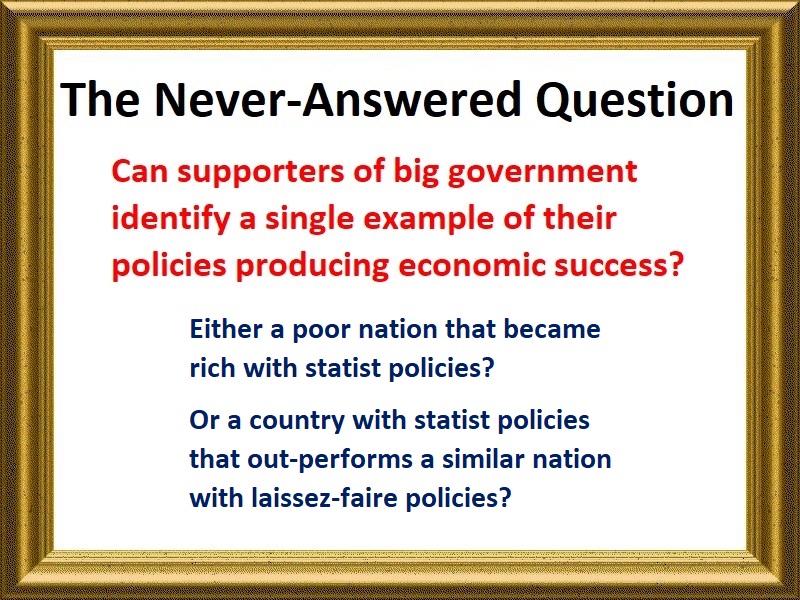
It also gives me a good excuse to recycle my never-answered question.

Supporters of free markets have dozens and dozens of examples of how economic liberty leads to more national prosperity.

I keep asking my leftist friends to show me any example, at any point in history, of big government leading to more prosperity.

They can’t answer, because global economic history shows there is only one economic system that generates mass prosperity.

P.S. The article also includes a section on “mutual recognition,” which is vastly underappreciated as a cornerstone of good cross-border economic policy.

Rather than trying to harmonize regulations with a single rule book written in Brussels, trust that rules that are good enough for Swedish consumers are acceptable for Spanish ones too. If something is legal in one European country, you should be able to trade it and use it in all the others, provided it is clear where it comes from. “Mutual recognition” of this kind was supposed to be the basis of the single market. Restoring it would be one of the biggest trade liberalizations in world history.

Our friends on the left don’t like this approach, however, since it means jurisdictional competition. They prefer harmonization, which effectively means cartels for the benefit of governments.

P.P.S. The three previous editions in this series can be read here, here, and here

Wednesday, August 20, 2025

Oppressive European Tax Burdens

August 19, 2025 by Dan Mitchell @ International Liberty

I’ve written before how ordinary workers are basically tax slaves in Europe.

Today, let’s look at new evidence about the absurd extent of taxation in Europe.

Here’s a chart shared by Michael Arouet, showing how much it costs a company to employ a €60,000-per-year worker compared to how much money a worker actually receives.

The numbers for France and Italy are especially horrifying.

  • In France, it costs a company more than €95,000 to hire a worker, yet the worker receives only €39,000. An effective tax rate of about 60 percent.
  • In Italy, it costs a company more than €88,000 to hire a worker, yet the worker receives only €36,o00. An effective tax rate of about 60 percent.

Even in the countries with the lowest tax burden, effective tax rates are almost 50 percent.

I have three observations on this grim data.

  1. Marginal tax rates in all these nations will almost surely be higher than the average (of effective) tax rate. So no wonder there is very little incentive to be productive.
  2. Payroll tax burdens often are more oppressive than income tax burdens, at least for ordinary taxpayers. That’s why nations such as Estonia and Slovakia score poorly.
  3. While the above numbers for European taxpayers are grim, they don’t include value-added taxes which grab more than 20 percent of whatever money is left after income and payroll taxes.

Actually, I’ll add one final observation. Europe has horrible tax policy because it has horrible spending policy.

Heck, one more observation is that Europe’s stifling burden of government explains why the continent is lagging far behind America.


Tuesday, July 22, 2025

Ranking European Paternalism

July 18, 2025 by Dan Mitchell @ International Liberty

Being a libertarian is refreshingly simple.

You get to control your own life and you have no desire to dictate how other people live.

Government exists (or should exist) basically to protect life, liberty, and property. Maybe a few additional “public goods” if you’re a soft-core libertarian. Or maybe nothing at all if you’re a hard-core libertarian.

Regardless, you definitely don’t want government to tell people how to live. You may think people shouldn’t smoke, drink, gamble, over-eat, do drugs, or engage in other potentially risky activities, but it’s up to them to make those choices.

Unfortunately, many politicians have decided they should tell people how to behave.

But not all of them. According to the new Nanny State Index, which ranks 29 European countries, German politicians are the most tolerant, followed by Luxembourg and Italy.

Turkey is in last place, with Lithuania and Finland being the next worst.

For what it’s worth, the rankings have not changed much since I wrote about the 2019 version of the Nanny State Index.

Without looking at the data, I would have assumed that Southern Europe would have a more laissez-faire approach than Northern Europe.

But this map shows that there there’s not an ironclad geographical pattern. Though I find it interesting that Denmark is an outlier among Nordic nations.

P.S. The United States is not included in the rankings, so I don’t know how America would compare to European nations. But readers can look at the rankings for personal freedom in Freedom in the 50 States (a publication that looks at many of the same variables) to see which states are tolerant or oppressive. You’ll see that Nevada ranks #1 and Texas ranks #50 (though both are in the top 10 for economic freedom).

Thursday, May 29, 2025

Trump, Tariffs, and the EU’s Dirty Little Secret

An existential crisis in the making.

By | May 27, 2025 @ Liberty Nation News, Tags: Articles, Opinion, Politics

On Sunday (May 25), President Donald Trump granted the European Union a brief lifeline in his quest for reciprocity on tariffs, extending the proposed 50% burden imposition to early July. “Europe is ready to advance talks swiftly and decisively,” declared EU Commission President Ursula von der Leyen shortly after the hiatus was announced. However, her situation, and that of the 27 participating member states, is far more precarious than one might initially assume.

Mighty Markets, Many Tariffs

Without doubt, the EU bloc is a big and valuable trading partner to the United States. Indeed, America purchased more than $600 billion worth of goods and services from the Union in 2024, with members, in return, buying around $370 billion. Princely sums, but uneven – especially considering that there are more potential consumers in the EU market than the US one (450 million souls compared with 347 million).

There’s a unique reason for this trade imbalance, however. Consider that the EU is little more than a protectionist market with multiple layers of government attached. It was founded on the idea that nations with close economic ties would not go to war (as they had done in both 1914 and 1939). As trade became more globalized, the project morphed into a series of mechanisms and institutions that could ultimately impose political will on its members.

In fact, currently, the European Union is considering stripping Hungary of its voting rights within the EU parliament for attempting to implement a law on transparency in its own parliament. This supranational behemoth has gone well beyond scripting rules on single-market access. But therein lies the issue with negotiating a tariff deal with the Trump administration: If the EU is not a protectionist market for its members, it serves no real purpose.

Single Market? Time to Update Your Status

The EU describes its “single market” like this:

“The EU aims to enable EU citizens to study, live, shop, work and retire in any EU country and enjoy products from all over Europe. To do this, it ensures free movement of goods, services, capital and persons in a single EU internal market. By removing technical, legal and bureaucratic barriers, the EU also allows citizens to trade and do business freely.”

Sounds fine, but such boilerplate is strictly for the tourists. In reality, the EU commission enacts rules and regulations in a highly partisan manner for each country in order to support and protect certain industries.

Play Video
Your News – How You Like It!

For example, the champagne industry – comprising some 16,000 producers in the region – gets subsidies from the EU courtesy of taxpayers in all 27 countries in the bloc. Or how about the German car industry? As a special carve-out, manufacturers no longer have to hit their global emissions deadlines by this year and can instead average emissions over a number of years, putting other carmakers at a serious disadvantage. Such climate-forgiving largesse will not be extended to foreign producers, naturally.

But if the European Union wants to avoid the fast-approaching 50% tariffs, it may have to do the unthinkable.

Remember Brexit?

In the run-up to the 2016 Brexit vote that saw Britain leave the EU, doom-mongers predicted economic turmoil for the tiny UK as it would not have specialized access to the single market that comes only with membership in the bloc. Almost a decade later,  Trump is trying to do just that.

If the EU cannot offer intimate protections for specialized markets that tip the scales in favor of bloc members, why should such industries support the Union at all? After all, its sole purpose is trade protectionism within member states to the exclusion (and cost) of those outside its hallowed markets. The days of European Union exclusivity are surely coming to an end and, with it, the false sense of Pax Romana that globalists worldwide have long sought to emulate.

~

Liberty Nation does not endorse candidates, campaigns, or legislation, and this presentation is no endorsement.

 
Read More From Mark Angelides Editor-in-Chief

Wednesday, May 7, 2025

Points to Ponder

 By Rich Kozlovich

How did Hamas get control of Gaza?  In 2005, Prime Minister Ariel Sharon, who was Israel's Prime Minister then, embraced leftist dogma about getting along with Muslims, which has failed over and over again, but he thought it would be a great idea to just give Gaza over to the Muslims and even provide necessary services for them they could not and would not provide for themselves, that way Muslims wouldn't hate Israel, and the world praised him.

It's clear the man either never read a history book or didn't believe history mattered.  Well, it does.  Hamas was an Islamic genocidal movement, it has always been such, and the people of Gaza like their genocidal insanity as they demonstrated by dancing through the streets as the coffins of innocent children who were hostages of Hamas were paraded before them.

Giving Muslims Gaza and the West Bank was in effect a practical application of the Two State solution. It was stupid then, it’s stupid now, and will always be stupid. Israel should take the example of Jordan and other Arab states who kick all the “Palestinians’ out, and tell the UN, the EU nitwits, American leftists, Jewish leftists, in and out of Israel, and the rest of the world to shove it.

After the Reconquista of Spain the first ones they kicked out were the Jews. Sephardic Jews who were well assimilated, but they thought the Muslims would adjust and all would be just fine and dandy. They were wrong, and had to kick all the Muslims out of Spain. They were Muslims and Muslims will always be Muslims, and assimilation isn’t an Islamic concept, domination however is.

Now Spain seems to have forgotten their history and are allowing Muslims to pour in, almost uncontrolled, and guess what, they’re acting like …. Muslims …… as Muslims have acted for almost 1500 years.

As for these EU nitwits, Does the European Union actually think radical Muslims will reform themselves?  Which means rejecting the foundational philosophy if Islam, jihad.  It they do that, they're not Muslims, they're heretics, and the Koran demands death to heretics.  If the EU wishes to commit suicide, well, I really don’t care since Europe is a spent force, and the EU is doomed anyway, but they need to stop demanding Israel commit suicide.

Definition leads to clarity, and it boggles my mind how people play with words to alter reality. I've read recently how Trump's cabinet needs to stand up to Trump, as it's an advisory board to the President.  Let's try and get this right once... just once.. please.  While cabinet member may make suggestions and give advice, their job as cabinet members isn’t to be an advisory board, it’s a management team whose job is to salute, say yes sir, and carry out the instructions of the President of the United States. If they can’t live with that, then they need to find other employment.  

I keep reading about this new Golden Age that's coming as a result of tariffs and trade agreements, all of which I think are necessary, and beneficial to America, but there will be no golden age. I've read three books on historical cycles, all hard drudging, since they all have their own terminologies and time frames.  If there ever was a subject that needs a formalized academic disciple, that's it.

But the one thing all the books dealing with historical cycles agree on is we’re in an end cycle, which entails huge economic downturns, and violence. Unlike many of the world’s nations America will survive intact for six reasons. We can feed ourselves, fuel ourselves, arm ourselves, defend ourselves, create our own internal market, and pay off our national debt.

The rest of the world cannot meet all of those six basic necessities to remain stable.  They're taxing, spending, over regulation, national debt, and immigration will kill Europe.  As this end cycle progresses there will be a lot of restructuring before the beginning of a new historical cycle, but Europe as we know it will no longer exist, and who knows what direction that will take.

The world's leaders are divided into two groups. The Winston Churchill’s, and the Neville Chamberlain’s. Everyone loves the Chamberlain’s, they go along to get along guys, and everyone hates the Churchill’s, who just can’t seem to get along.At least until the go along to get along crowd’s failure to deal with what’s going wrong hits the fan. 

Then, all of a sudden, they discover they need a Winston Churchill to be the answer, and they hate it, and they hate him.   And no matter how successful a Churchill may be, they just can’t stop shooting arrows at the Churchill’s, which in America's case right now involves Donald Trump and Elon Musk. 

Why?  

Neither Trump or Musk is one of them, and the only thing they excel at is criticism, not problem solving. Adam Schiff epitomizes that quality. Go along to get along elitism is a human physiological disorder that’s plagued humanity throughout history, and it’s always going to be with us. Most leaders aren’t leaders, they’re managers who organize the direction everyone wants to go, no matter how foolish that may be. 

A leader stands up and says…. You’re all wrong, and I’m gonna tell you why! And if or when that person gets a leadership role, they act accordingly. If they’re successful, they’re hated all the more. No matter what you may read, that explains everything. How insane is that?

Saturday, February 15, 2025

P&D and The Week That Was

 Truth is the Sublime Convergence of History and Reality

De Omnibus Dubitandum, (Everything is to be questioned!)

This Link will take you to My Commentaries. 

Friday, January 24, 2025

Mocking European Statism

January 23, 2025 by Dan Mitchell @ International Liberty

Editor's Note:  I publish Dan's articles because he has a lot of great information that I embrace, but he and I don't agree on what he calls Trump's protectionism.  Otherwise it's a great article. RK

I have a special page for humor involving Europe, but I have not added to it since sharing some Brexit humor in 2016.

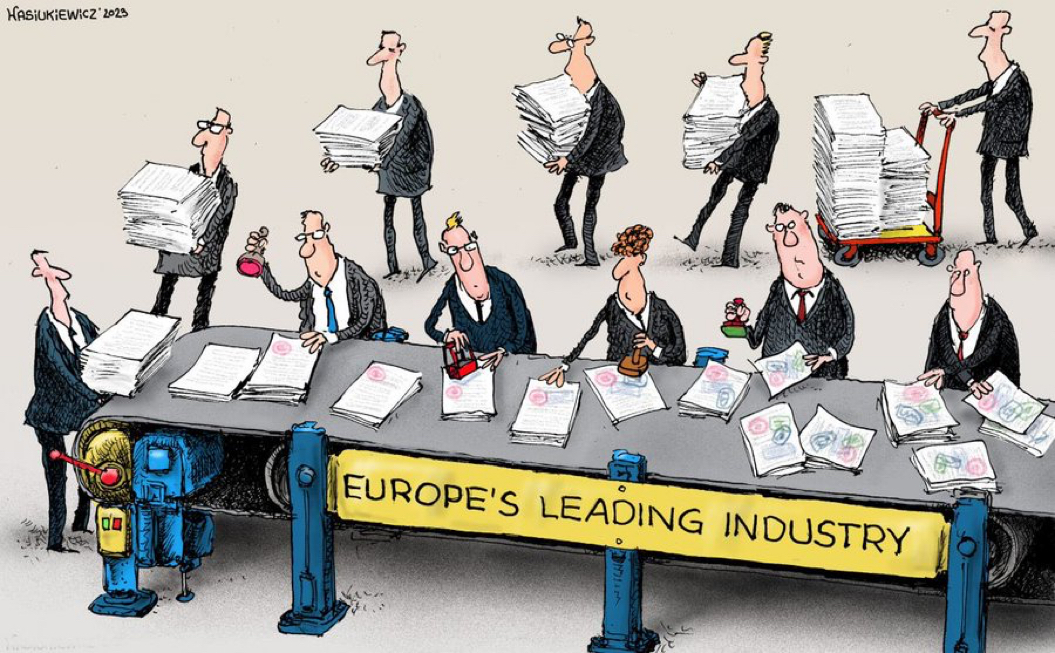
Let’s being the process of catching up with some amusing cartoons and memes mocking our government-loving cousins on the other side of the Atlantic Ocean.

I’ve made the serious point that bureaucrats in Brussels, when dealing with any issue, have a knee-jerk response of “more centralization.” This cartoon is a humorous version of that.

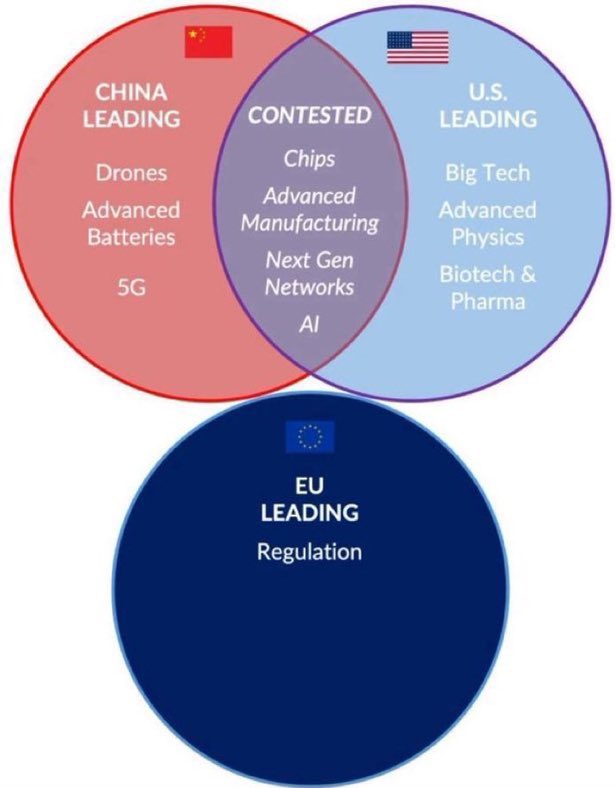
Sticking with that theme, here’s a comparison of where Europe leads compared to where China and the United States have an advantage.

 https://freedomandprosperity.org/wp-content/uploads/2024/12/GfjCJw6XYAARmNy.jpg

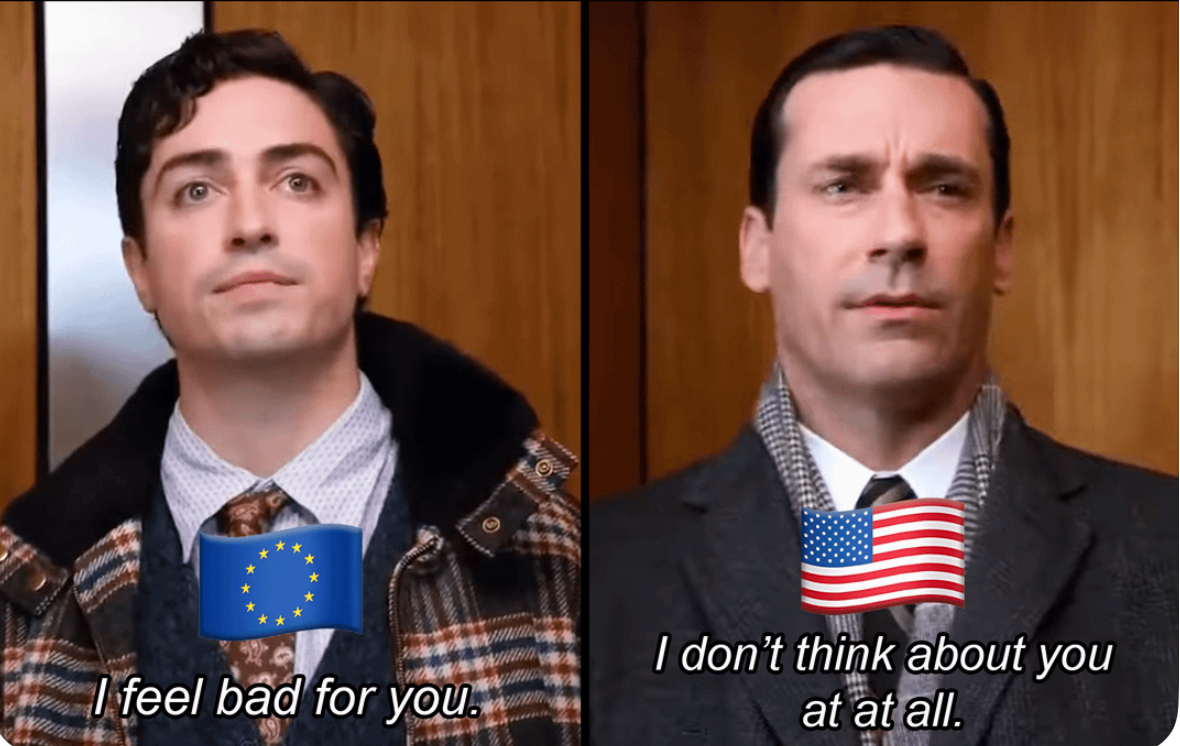
Europeans often try to compensate for their economic inferiority by mocking the United States.

As this next meme indicates, Americans feel no need to play that game.

 https://freedomandprosperity.org/wp-content/uploads/2024/12/52661.jpg

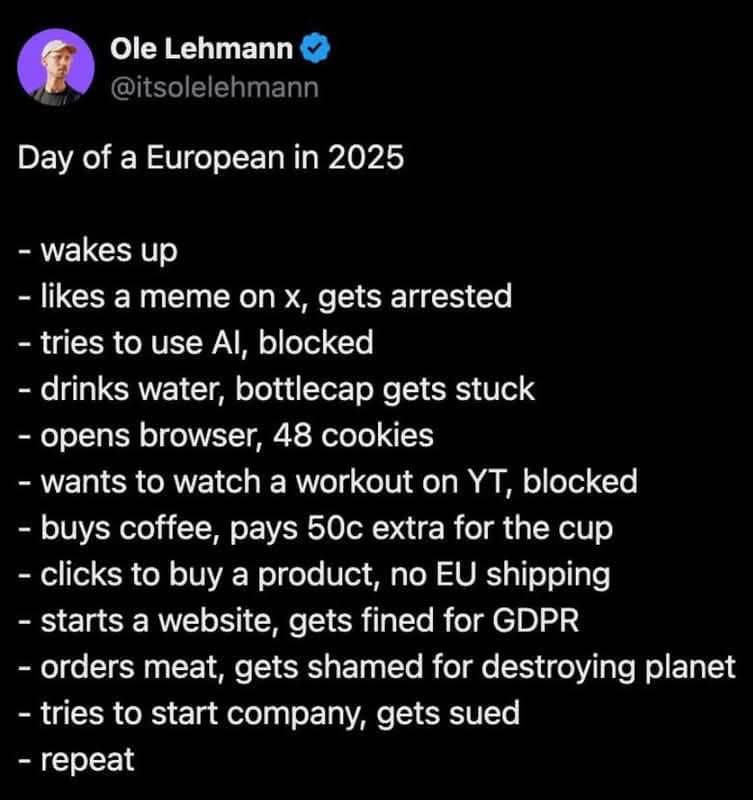
For our fourth item, here’s a list of things to do in Europe in 2025.

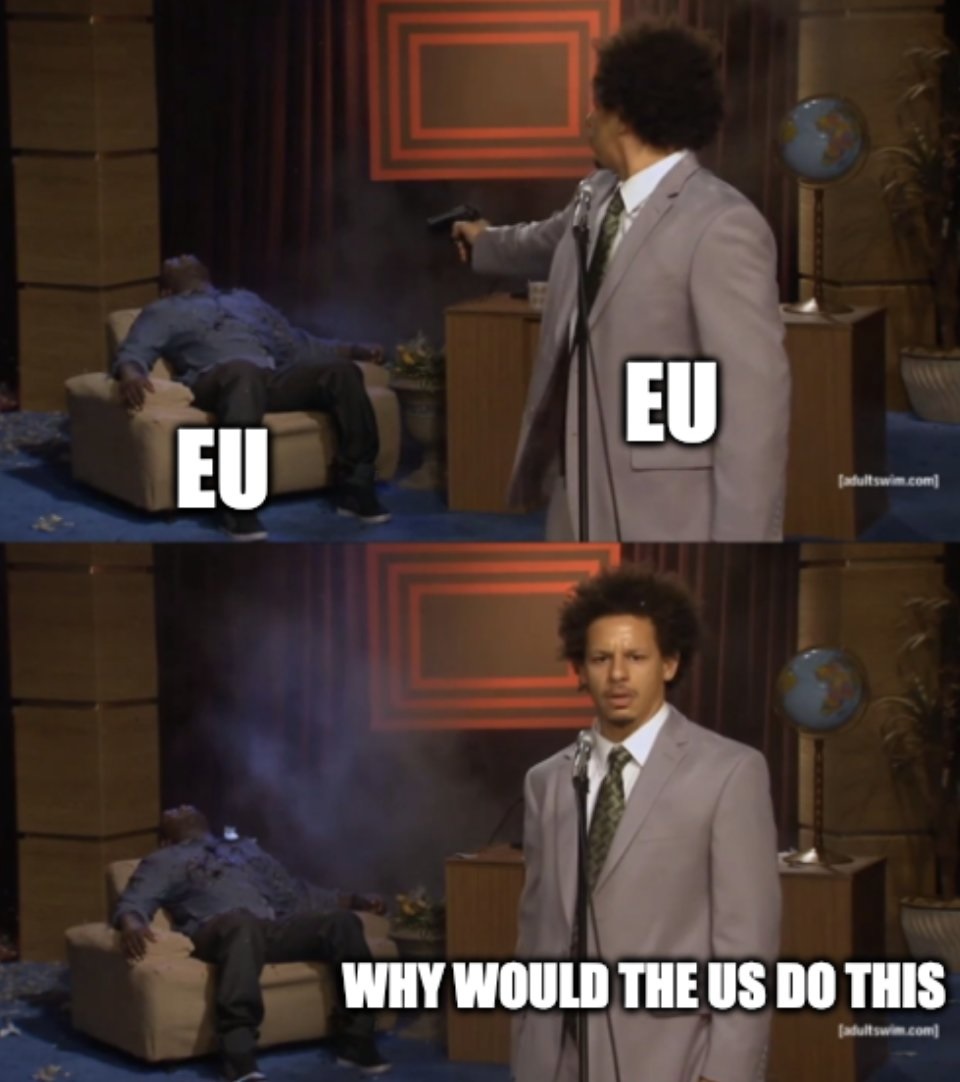
As usual, I’ve saved the best for last.

Though Trump may be about to impose protectionist policies that will hurt Europe, so the shooter may have a point (those protectionist policies also will hurt the US, so it will be a lose-lose situation).

I’ve used that same visual for my meme about the European Central Bank, so I’m obviously a fan.

I’ll close with a serious point. The European Commission in Brussels is a source of needless red tape, has a pro-centralization ideology, and it’s always trying to push for more tax harmonization.

All of which explains why I was a fan of Brexit (even if British politicians have been too stupid to take advantage of their independence).

However, Europe’s biggest economic problems are excessive taxation and a stifling burden of government spending – and those are almost entirely the fault of national governments.

P.S. I’ve also pointed out that the euro currency is not a big cause of European economic stagnation (even though the head of the European Central Bank is a joke).

P.P.S. Europeans will correctly complain about Trump’s protectionism, but they will be throwing stones in a glass house.

Monday, November 25, 2024

Avoiding Self-Inflicted Trade and Economic Wounds

By Paul Driessen

President-elect Trump says he will impose tariffs on foreign products to raise revenue and respond to practices that give foreign manufacturers unfair advantages over American companies. Europe’s debates over similar issues offer relevant guidance, advisories, and impetus. 

As the European Union looks ahead to the next five-year term of its new European Commission and Parliament, officials talk about playing “its full part on the world stage in geopolitics.” Europe and the world have heard of it since Ursula von der Leyen promised a “geopolitical Commission” at the start of her first presidential term in Brussels in 2019. It didn’t happen then, and it’s not likely to happen now. 

To be fair, it was a challenging five years. The unprecedented COVID pandemic kept the EU focused on domestic healthcare questions, lockdowns, debt financing, and student learning. Russia’s Ukraine invasion shortly after ensured that European policy priorities remained largely regional. 

However, possibly the most significant blow to her dream of a geopolitical Commission was entirely self-inflicted: the EU’s obsession with the utopian Green Deal. 

The Green Deal regulatory regime undercut EU competitiveness, particularly in agriculture and industry, by raising energy and petrochemical prices to exorbitant levels. Thus, the European Commission's international ambitions were reduced to a domestic protectionist agenda designed to hobble potential competitors by erecting non-tariff barriers that affected and infuriated Europe’s trading partners, whether they compete on productivity or cost. 

Citing the “climate crisis,” the EU demanded that the rest of the world adopt its own crippling regulations – or risk losing access to its markets. Soaring prices for “clean, renewable, sustainable” wind and solar energy (and duplicative backup power) destroyed jobs, made home heating and food extremely expensive for many families, and reduced living standards. 

The EU Deforestation Regulation would have required European trading partners to certify the ecological purity of entire supply chains. Brussels’ recent U-turn on the EUDR demonstrated that the law was a huge miscalculation in climate and trade policymaking. 

Even the famously “green” Biden-Harris administration opposed the Brussels proposals as too onerous and too hastily introduced. Imagine having to document and geolocate every cocoa bean in a bar of chocolate, every particle of coffee in an espresso, every chip of wood in a particle board, or every gram of cobalt in backup and electric vehicle batteries. Only Brussels would concoct such insanity!

Even Germany, the EU’s richest economy and arguably Europe’s most vocal advocate of planet care, balked at the prospect of implementing the EUDR. 

If geopolitics truly matters to the EU in the coming term, the EU Commissioner will return to core principles on trade and not invoke trade suppression. That means identifying the biggest market opportunities. Europe, India, and ASEAN are obvious examples. 

Equally obvious, alienating the USA – the biggest and wealthiest market in the world, capable of self-reliance and in-kind responses to hostile trade regulations – does not seem like a smart idea. 

The European Union is interested in advancing international commerce rather than wantonly raising regulatory barriers that developing countries cannot afford and developed economies won’t accept. 

European economies are exporters. As with the USA, EU jobs and financial systems depend on selling high-value goods and services. A mercantilist, capricious, quasi-lawless global economy – like China’s – is not in Europe’s (or America’s) interest. 

The starting point should be liberalizing, rather than raising barriers, and working with allied trading partners with similar principles. And yet, the EUDR is a perfect example of a regulation that has the EU actively working against its closest partners; it’s also been disastrous for the EU’s international image. Indeed, other than a few single-issue NGOs and a handful of unelected EU officials, the Commission would be hard-pressed to find any EUDR proponents.

Second, trade policy needs to be strategic, not dogmatic. China and Russia – especially in their growing alliance with Iran, North Korea, and other BRICS countries – are the most obvious and significant threats to the global economic order, and Europe has a responsibility to mitigate such threats. 

Weaponizing trade is justified when the goal is preventing carnage in Ukraine or stopping hacking or surveillance equipment from being installed in the grid and other networks. Similarly, deliberate attempts to dump subsidized products or flood markets should not be confused with free trade and should be addressed accordingly. In such cases, a smart, deliberate, targeted response is warranted. 

One problem with the Green Deal’s EUDR lies in its indiscriminate, dogmatic application of punitive measures, including against allies like Malaysia, Mexico, Thailand or the United States. Moreover, materials targeted under the EU Deforestation Regulation (rubber, coffee, cocoa, palm oil, and cobalt) are key ingredients for Europe’s own supply chains

Palm oil from Malaysia, for example, is an ingredient in some of Europe’s most famous food and cosmetic brands. Besides, Malaysia already has its own sustainable palm oil standard, so there is no need for additional punitive EU regulations. 

Similarly, Brussels shouldn’t impose deforestation restrictions on cutting trees for wind and solar metals and minerals – if trade-partner countries are trying to comply with EU climate and environmental rules. 

Wage, child labor, and deforestation standards for cobalt mining for wind energy and battery technologies are problematical primarily because China, the Democratic Republic of Congo, and their ore producers deliberately mix all ores – from artisanal and corporate mines alike. That makes it impossible to determine which ores come from operators that exercise strong environmental and human rights standards and which involve horrible ecological and human rights abuses. 

Tariffs often help domestic producers of materials like lumber and steel but hurt consumers of those same materials. They raise the costs of building houses and manufacturing automobiles, thus increasing the prices already strapped families must pay. Retaliatory tariffs on products that involve near-slave wages or other abuses or come from adversarial nations are more justifiable, but consumers still pay more. 

Greater international cooperation is a good third principle. While rhetoric in Brussels is cheap, over the past five years, the EU has engaged in more bullying than cooperation toward its own member states and partners outside the Union. In trade, unilateral and punitive Green Deal barriers have too often trumped dialogue and cooperation. 

This approach rarely worked. It enraged everyone, from European and American businesses to Asian small farmers. For instance, the EU should not reject Malaysia’s Sustainable Palm Oil standards (MSPO) just because of its EUDR. 

Other countries also have analogous standards for their major commodities, which should be considered for acceptance. There is no reason not to address sustainability and environmental progress as part of free trade, voluntary partnerships, or mutual recognition agreements rather than through tariffs, other trade barriers, or excessive regulations.

The new European Commission will certainly experience the unexpected during its five-year term. However, it should at least try to avoid self-inflicted injuries and prioritize economic growth over anti-competitive regulations. 

The incoming Trump Administration and Republican Congress will undoubtedly apply that approach. 

Paul Driessen is senior policy advisor for the Committee For A Constructive Tomorrow (www.CFACT.org) and author of Eco-Imperialism: Green Power, Black Death, and articles on energy, environmental, climate, and human rights issues.

Tuesday, October 22, 2024

Part III: Another European Fiscal Crisis?

In April of 2023, I wrote about the fact that there is more spending and more debt in the PIGS (Portugal, Italy, Greece, and Spain) compared to levels before the last European fiscal crisis.

In December of 2023, I wrote about the growing burden of spending and debt in all European nations.

Today is Part III in this series. We’re going to look at which European Union nations face the greatest fiscal challenges.

From an economic perspective, the best way of measuring fiscal challenges is simply looking at some mix of the current spending burden and the future spending burden (which is driven by a combination of demographics and program design). After all, spending is the problem, whether it is financed by taxes, borrowing, or money printing.

That being said, others generally focus on deficits and debt. So it is quite common to see analysis that is based on fiscal imbalances.

My role is to then dig into that type of data to find out what it actually means.

For instance, a Brussels-based think tank, Bruegel, has a new report looking at fiscal policy for European Union countries.

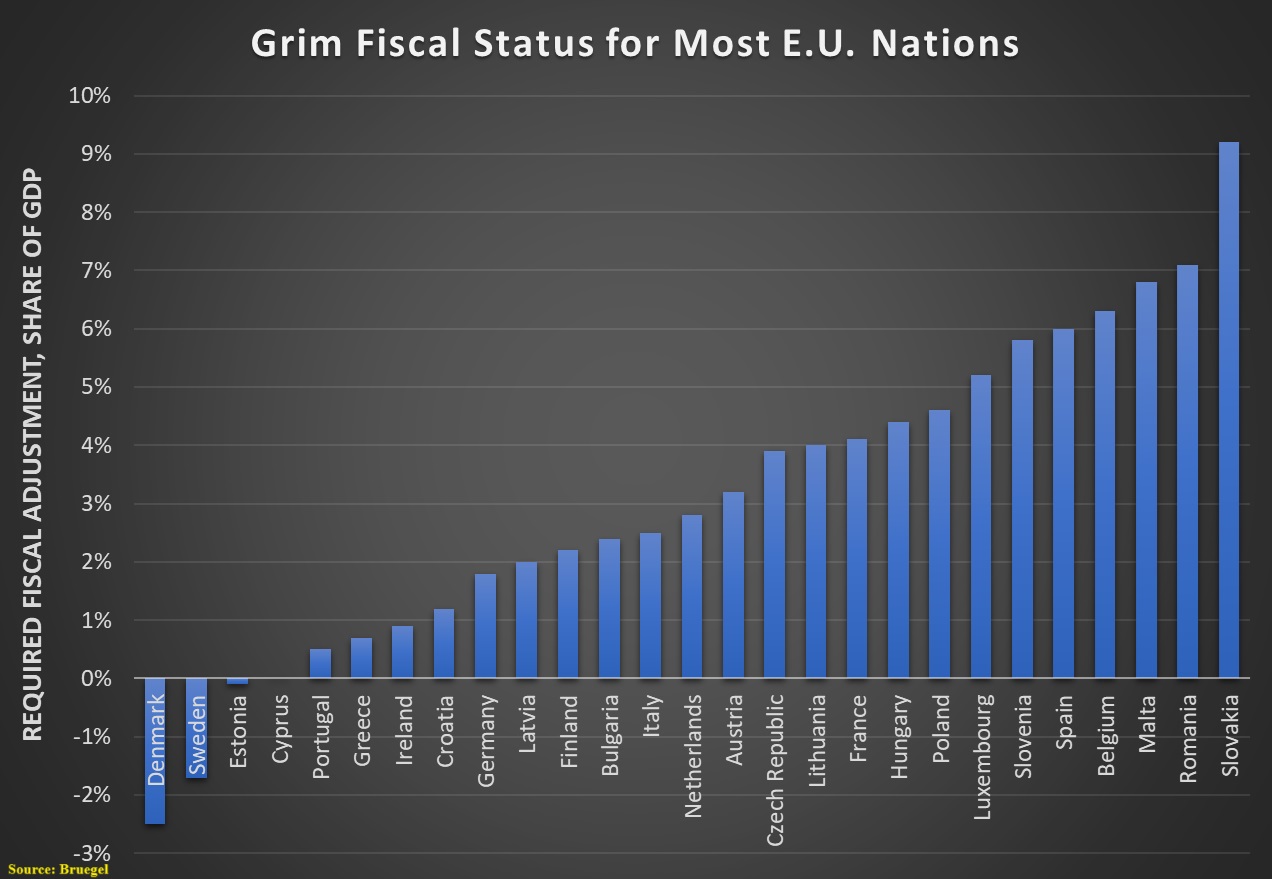
Here’s a chart I created, based in the last column from Table 2 in the report. It shows the amount of fiscal adjustment needed to comply with the European Union’s fiscal rules. At the risk of stating the obvious, it’s good to be on the left side and bad to be on the right side.

I would have preferred if the report focused on spending, but nonetheless it contains a lot of useful information.

Here’s my two cents on the big takeaways.

The common theme is that these two points involve spending. To elaborate, Social Security reform leads to a smaller spending burden, particularly in the long run,  and populist politicians can’t resist squandering taxpayer money as they seek to buy votes.

In other words, the problem in the European Union is spending and the solution is spending restraint.

If you want more conventional analysis, here are some relevant excerpts from the Bruegel report.


Population ageing is putting pressure on the public debt-to-GDP ratios of European Union countries, both by raising net public expenditures and by lowering potential growth. To keep debt ratios under control and to comply with EU fiscal rules, EU countries will need to run sufficiently high structural primary balances – the difference between non-cyclical revenue and non-interest spending.

Because the EU’s fiscal rules require countries to anticipate and offset the fiscal costs of ageing during the adjustment period and in the 10 years beyond, the impact of ageing on overall fiscal indicators, such as the structural primary balance, will be felt mostly during the initial four-to-seven-year adjustment period that begins in 2025. …However, in countries in which fiscal ageing costs are rising…fiscal adjustment in the nonageing portion of the budget needs to continue…

Unless ageing cost can be brought under control, this would require the re-allocation of expenditure from non-ageing to ageing-related items, or further increases in taxation. This creates difficult adjustment choices for many EU countries. … there are major differences in EU countries’ adjustment requirements, driven by substantial differences in initial fiscal positions and in projected ageing costs. …by 2052, the sum of required unadjusted structural primary balances and the required adjustment in the non-ageing budget will amount to over 4 percent of GDP for six countries and above 3 percent of GDP for another five countries.

I’ll close by observing that the fiscal rules in the European Union are better than nothing, but they are misguided in that they seek to control deficits and debt.

The European Union should copy Switzerland and have fiscal rules that limit spending growth (as the German government recently recommended).

Saturday, October 19, 2024

EFW 2024: Continuing Deterioration in Global Economic Liberty

October 17, 2024 by Dan Mitchell @ International Liberty

The newest edition of Economic Freedom of the World has been released by the Fraser Institute and I will continue my tradition (2023, 2022202120202019, etc) of sharing the big-picture highlights.

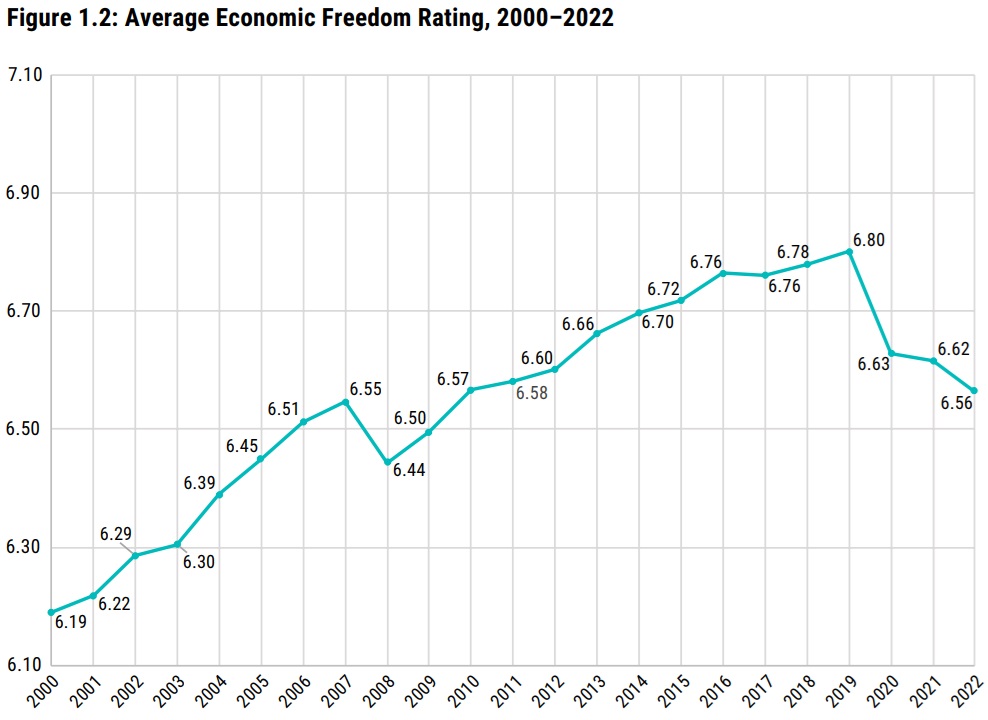
I normally start by applauding the jurisdictions with the highest scores, but today’s column will start with some bad news for the global economy. As shown by Figure 1.2, there’s been a significant drop in average economic liberty over the past three years.

This is a depressing reversal of what had been a very positive trend this century.

What’s particularly disappointing is that rise in the global average had been driven by pro-growth reforms in the developing world (scores have dropped this century for the United States and European Union). Now it seems policy is getting worse in all regions.

Now that we’ve shared that bad news, let’s look at the (relative) good news.

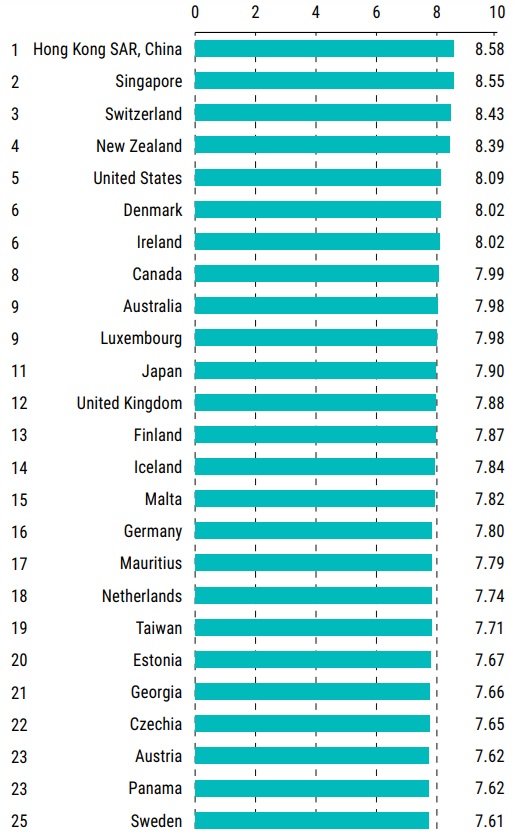
Here are the world’s 25-freest jurisdictions. Interestingly, Hong Kong is still at the top even though the report warns that “Hong Kong’s rating continues to fall precipitously from 9.05 in 2018 to 8.58 in 2022.”

Kudos to Singapore, Switzerland, New Zealand, and the United States for being in the top 5 (though the U.S. score has fallen significantly since 2000 – from 8.83 to 8.09).

Before sharing other visuals, here are a few excerpts that explain the methodology in the report.

The EFW index is designed to measure the degree to which the institutions and policies of countries permit people to make their own economic choices. To achieve a high EFW rating, a country’s government must do some things, but refrain from others. Governments protect economic freedom when their laws safeguard voluntary exchange and defend individuals and their property from aggressors who might use fraud or force.

To this end, the legal system is a particularly important guarantor of economic freedom. In more economically free places, legal institutions protect the person and property of all individuals from the aggressive acts of others and enforce contracts in an even-handed manner.

These governments also permit people to access sound money and do not expropriate property through unexpected inflation or deflation. In economically free places, governments refrain from actions like high taxation, barriers to trade, and excessive regulations that restrict personal choice, interfere with voluntary exchange, and limit entry into markets.

The EFW index might be thought of as an effort to identify how closely the institutions and policies of a country correspond with the classical liberal ideal of a limited government, where the government protects people and property rights from aggressors but otherwise allows them to make their own economic choices.

And good things happen when people “make their own economic choices.”

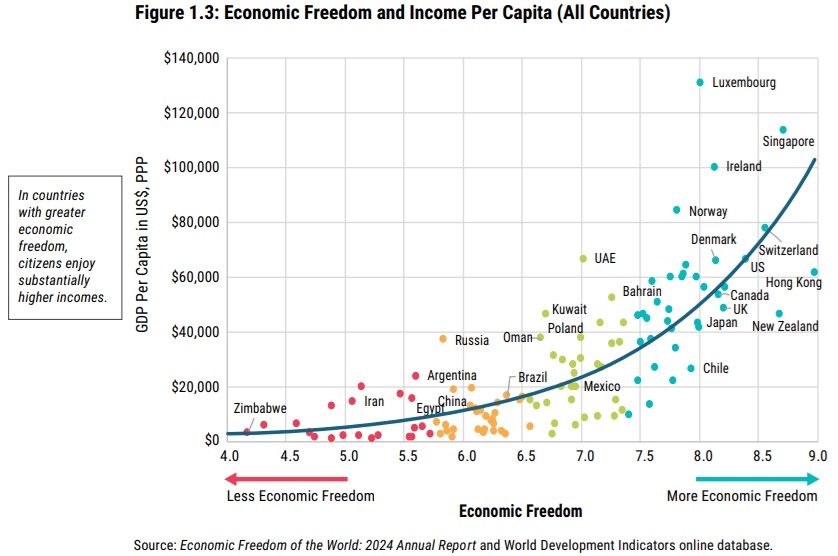
Here’s a chart showing the very clear relationship between economic freedom and national prosperity.

Gee, it’s almost as if there’s a recipe that nations can follow if the goal is more prosperity.

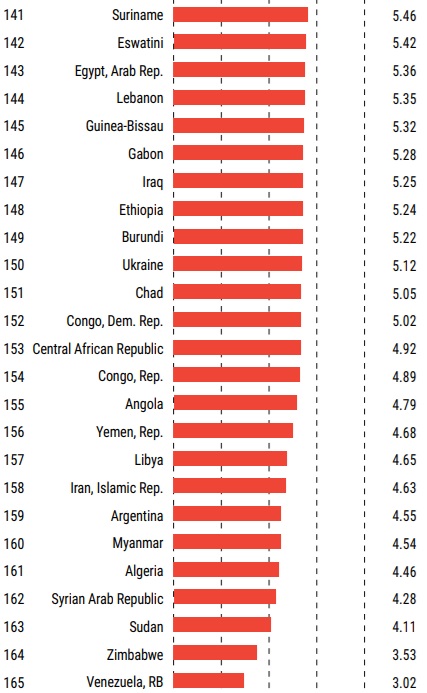
Let’s now close with bad news. Unsurprisingly, the world’s lowest-ranked nation is Venezuela (though Cuba and North Korea would probably be even lower if there was enough reliable data to include them in the report).

P.S. Argentina is still one of the world’s worst nations for economic policy because EFW measures policy as of the end of 2022. Yes, that nation now arguably has the world’s best leader, but he didn’t take office until the end of 2023 and his positive reforms (see here, here, and here) have been implemented this year. So we’ll have to wait two years to see (what I predict will be) a big improvement.