Search This Blog

De Omnibus Dubitandum - Lux Veritas

Showing posts with label Temperatures. Show all posts

Friday, January 19, 2024

Climate Change Fears Driven by a Belief in an Imaginary Temperature

By Tom Harris 

It seems that not a day goes by when we don’t hear about skyrocketing “global temperature.” The problem is—global temperature doesn’t exist. Yet Bing AI reports:

“According to my search, there were about 1,820,000 results for “global temperature” in the media from January 1, 2014 to December 31, 2023. This means that the phrase was referenced on average about 182,000 times per year, or 500 times per day, in the past ten years.”

Of course, governments, the United Nations and even some scientists also use the term often, hyping meaningless records in an imaginary parameter in order to frighten us about something that doesn’t matter.

Climate activists venture even further into the realm of unscientific fantasy chanting “1.5 to stay alive,” meaning that we must prevent the “global temperature” from rising more than 1.5 degrees Celsius (oC) above pre-industrial levels or we are all doomed. But the so-called “global temperature,” at least the way the UN calculates this make-believe parameter, has already risen 1.2 oC since pre-industrial times. Only a climate hypochondriac would think that a further 0.3oC rise would be noticeable, let alone catastrophic.

Unknown to most of the public, and indeed many scientists who should know better, is the fact that “global temperature” or “global average temperature” or even “global temperature anomaly” is not real. It is merely a statistic that, outside of politics, has no meaning in the real world.

In their award-winning book, “Taken By Storm,” Canadian researchers Christopher Essex and Ross McKitrick explain,

“Temperature is not an amount of something [like height or weight]. It is a number that represents the condition of a physical system. In thermodynamics it is known as an intensive quantity, in contrast to quantities like energy, which have an additive property, which we call extensive in thermodynamics.”

For example, a person’s height is an extensive quality; it can be added to other people’s heights to give a meaningful result, namely the total height of all the people involved if they laid head to toe on the floor. Dividing that total height by number of people gives the mean height, or the average height of the people in the group. The same applies to weight and other extensive qualities. We can combine two or more systems and the values of extensive variables for the whole system will simply be the sum of the values of the individual components.

But this does not apply to intensive qualities like density, pressure, chemical potential, color, viscosity, concentration and, of course, temperature, none of which can be added up in any meaningful fashion. Intensive variables are independent of system size and represent a quality of the system. And, if you can’t generate a physically meaningful answer when you add them up, how can you end up with a meaningful answer when you divide the total by the number of measurements? You can’t.

Let’s say, at a particular moment in time, you measure 1,000 temperatures, ranging from 0oC (or, in the absolute temperature scale used in science, 273 degrees Kelvin, oK) to 20 oC (293 oK) at 1,000 different locations. Adding them yields a number, perhaps 283,000. That means nothing of course. There is no place or thing that measures 283,000 oK. So, how can you take that meaningless number and divide it by a meaningful number (1,000, the number of temperature measurements) and generate a meaningful result? In fact, that is a test that reveals whether measurements can generate a meaningful average; does the intermediate sum mean anything?

In the final analysis, it is no more meaningful to calculate an average temperature for a whole planet, or even a state or a city (or even a room in your house), than it is to calculate the “average phone number” in the telephone directory of a city. If you called that “average phone number,” would you be in touch with the average citizen? Individual telephone numbers are useful and meaningful, while the sum or average of the telephone numbers in a directory have no meaning. Similarly, temperature, like viscosity and density, is not something that can be meaningfully averaged. “Global temperature” does not exist.

Even if enough accurate surface temperature measurements existed to ensure reasonable planetary coverage (it doesn’t) and some sort of global temperature statistic was calculated, interpreting its significance would be challenging. What averaging rule would you use to handle the data from thousands of temperature-sensing stations? Mean, mode, median, root mean square? Science does not tell us. For some groups of close temperature measures (and NASA and NOAA are dealing with thousands of very close temperatures across a huge temperature field that varies from -93.22 oC (the low temperature record, detected by satellite observations on August 10, 2010 along a ridge in Antarctica) to +56.7 oC (the high temperature record, observed on July 10, 1913 in Death Valley), one method of calculating an average can lead to a determination of warming while another can lead to a conclusion of cooling.

In 2007, an important paper written by Essex, McKitrick and Bjarne Andresen was published in the Journal of Non-Equilibrium Thermodynamics. Titled, “Does a Global Temperature Exist?” the authors give examples of how different averaging methods can show a system is both warming and cooling at the same time. They point out, however,

“The notion of being globally ‘‘hotter’’ or ‘‘colder’’ for out-of-equilibrium systems [the Earth is obviously “out-of-equilibrium” which is why we have variable weather] is not altogether without merit. Miami in January, with temperatures ranging from 20 to 30oC, say, is certainly warmer than Toronto at, say, -15 to -5oC. However, this ranking of relative warmth is not based on averages, but on the ranges [my bold] in respective temperature fields. Since the ranges do not overlap, all averages will agree which field seems to be the warmer. It is independent of the choice of average.

“Not so for the case of comparisons of Earth’s temperature field at times a few years apart. The range over the globe (about -80oC to +40oC) is essentially the same for both when compared to statistical trends in averages (i.e., about +/-0.01oC/year), which are three orders of magnitude smaller. In cases where ranges overlap, not all averages over a given set of actual observations agree on trends, throwing into doubt for this case what ‘warmer’ or ‘cooler’ means.”

Essex, McKitrick and Andresen come to three critical conclusions:

  • “Sums or averages over the individual temperatures in the field are not temperatures. Neither are they proxies for internal energy.”
  • “The utility of any global spatial average of the temperature field as an index for global conditions has been presumed but not demonstrated.” 
  • In private communications, Dr. Christopher Essex, Emeritus Professor of Mathematics and Emeritus Professor of Physics at the University of Western Ontario, summed up today’s preoccupation with “global temperature” well:  “The idea that a single local state variable (i.e., temperature) drives everything is breathtakingly naive.”
  • “If there are no physical or pragmatic grounds for choosing one over another, and one increases while the other decreases, there is no basis for concluding that the atmosphere as a whole is either warming or cooling.”

So, how can we tell if a system, in this case, the Earth, is warming or cooling? You cannot, unless the range of temperatures at different times change so much that they do not overlap. There is no chance of that occurring anytime in the foreseeable future on this planet, so confident pronouncements of global warming in the past century are entirely misguided. We have no way of knowing if “global warming” is real since we have nothing meaningful to base it on.

Governments must stop wasting trillions of taxpayer dollars trying to stop a climate crisis that no one knows actually exists. The world has real problems to solve.

Tom Harris is Executive Director of the International Climate Science Coalition (ICSC) at www.icsc-climate.com. Please share this article and support ICSC through its GiveSendGo crowdfunding webpage at GiveSendGo - THERE IS NO CLIMATE EMERGENCY!: The Leader in Freedom Fundraising.

Monday, August 1, 2022

Garbage In, Garbage Out: 96% of NOAA Temperature Stations Fail ‘Uncorrupted Placement’ Standards

Penny Starr 29 Jul 2022 

A study that investigated the placement of National Oceanic and Atmospheric Administration (NOAA) temperature stations found that 96 percent of the facilities used to measure heat failed to meet the agency’s own “uncorrupted placement” standards. 

Research for the study shows the 96 percent corruption is because the stations’ measurements are tainted by the effects of urbanization – or heat produced because of their close proximity to asphalt, machinery, and other heat-producing, heat-trapping, or heat-accentuating objects. 

The Heartland Institute compiled the report using satellite and in-person surveys of NOAA weather stations that contribute to the “official” land temperatures in the United States. “With a 96 percent warm-bias in U.S. temperature measurements, it is impossible to use any statistical methods to derive an accurate climate trend for the U.S.” 

Heartland Institute Senior Fellow Anthony Watts, who directed the study, said is the study announcement distributed to the press. “Data from the stations that have not been corrupted by faulty placement show a rate of warming in the United States reduced by almost half compared to all stations.”............. To Read More......

Tuesday, August 10, 2021

Europe’s ‘unprecedented manmade floods’

Separating myth from reality about extreme weather events today and over the centuries

Paul Driessen 

Deadly floods in Germany and Belgium have put climate change back in the news in time for the COP-26 climate gabfest in Glasgow. Not surprisingly, government officials again blamed fossil fuels, greenhouse gases and manmade climate change for the calamities, to deflect attention from their official incompetence – as they did with SuperStorm Sandy and recurrent wildfires. 

They’re blaming the very fossil fuels that power Europe’s economy; build, heat and electrify homes; and power the boats, ambulances and other equipment that were used to rescue people, recover bodies, and nurse survivors back to health. 

They’re the same officials who could and should have prepared their communities for floods like those that hit Germany and Europe every few decades. But failed to do so. They were warned days in advance that the rains and floods were coming – and were told almost exactly where and when the rains and floods would hit. But did nothing. 

They were supposed to warn people – and get them out of harm’s way. But they failed to warn their citizens that they, their homes and their children would be swept away by raging waters, if they didn’t evacuate immediately. 

No wonder they want to blame manmade climate change – for almost every extreme weather event. They want to avoid accountability and protect their political and financial stakes in Climate Crisis, Inc. About the last thing they want people to see are the climate realities that would confound their myths and fear-mongering, put today’s extreme weather events into proper context, and keep their constituents from being bamboozled by future climate lies. 

FLOODS are not uncommon, they are not unprecedented, and they are not kind to people, civilization or nature. Indeed, devastating rains and floods occur with regularity, and the more concrete, asphalt and buildings we put in cities, the less drainage we have, and the more flooding we get – in Europe, Houston, New York City and everywhere else. 

The great Arno River flood of 1966 impacted much of Florence, Italy and damaged or destroyed many magnificent works of art. The 2002 Vltava River flood left high water marks 10 feet up on buildings, and 30 feet above the river’s normal water line; 1784, 1845 and 1997 Czech floods were even worse. 

What caused all those floods? the deadly German floods of 1790 and 1910? the Johnstown, Ohio Flood of 1889? the 1976 Big Thompson Canyon flash flood that roared down a narrow Colorado gorge, leaving residents and campers few avenues of escape? All those floods were natural, but today’s are manmade? 

HURRICANES are also common, recurring, devastating and deadly. It’s fashionable to blame Harvey and Irma and other recent hurricanes on fossil fuels, carbon dioxide, and us humans. But it’s ridiculous. 

Between Hurricane Wilma in 2005 and Harvey and Irma in 2017, the United States enjoyed a 12-year major hurricane drought: 12 years without one Category 3-5 hurricane making US landfall. It was the longest period in recorded history that America was not hammered by a major hurricane. 

If we’re going to blame every modern era hurricane on fossil fuel emissions – shouldn’t we also thank fossil fuel emissions for that unprecedented 12-year absence of truly deadly hurricanes? (It wouldn’t be honest science, but it would be honest politics.) A far better approach would be to prepare better for all of Mother Nature’s future onslaughts. 

US property damage in raw dollars from hurricanes has certainly increased – because more people are building more expensive homes along our coasts, where hurricanes strike with regularity and intensity. But death tolls are way down, because buildings are built better, and (unlike in Germany and Belgium recently) people get warned far enough in advance to get out of harm’s way. 

Equally positive, global property damage from weather-related disasters, as a proportion of global gross domestic product, went down significantly since 1990, largely for the same reasons. Deaths are down too. 

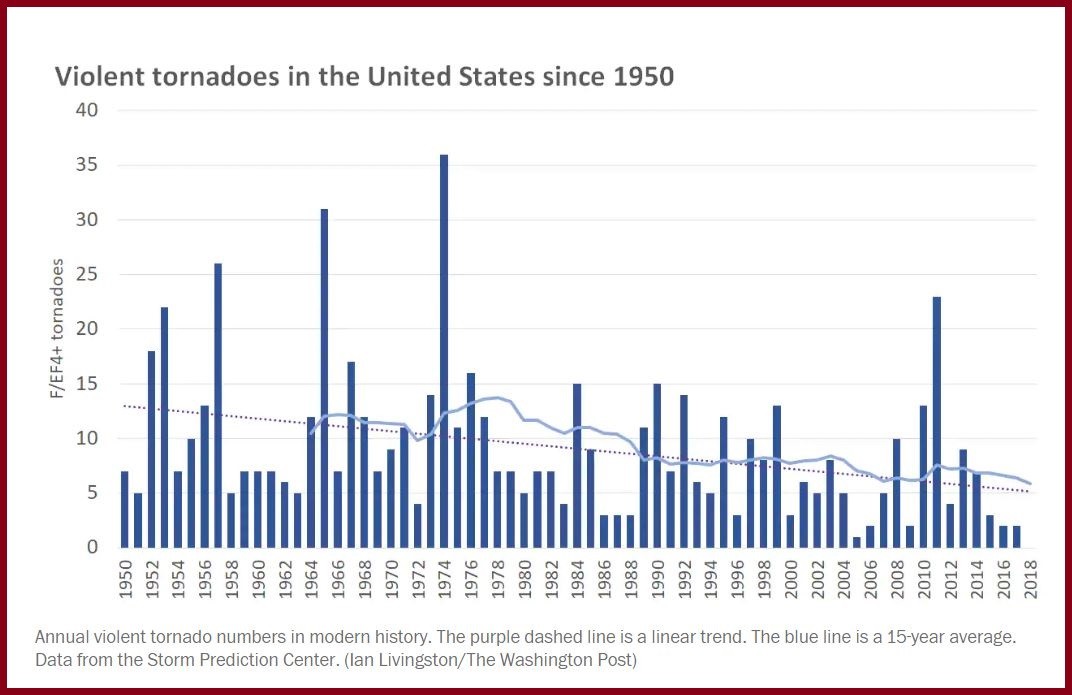
TORNADOES. A Washington Post chart makes it abundantly clear that violent F4 and F5 tornadoes have been less frequent the last 35 years than they were during the 35-year period 1950-1985. Even more amazing, for the first time in history, the United States was not hit by a single violent twister in 2018. Was that because of fossil fuel emissions? 

Indeed, very few tornadoes compare to the horrific Gainesville, Georgia tornado of 1936, which killed 450 people – or the even more horrendous, record-setting the Tri-State Twister of 1925. That one lasted 3.5 hours, traveled 220 miles, obliterated entire towns, and killed nearly 700 people

BLIZZARDS are also common. But predictably, almost every big winter storm nowadays gets blamed on “carbon” (CO2) emissions, and we’re told to expect far more if we don’t end fossil fuel use. 

Climate con artists want us to forget the Nebraska School Children’s Blizzard of January 1888, when a relatively warm day, with snow melting all around, suddenly became a vicious storm. In less than three hours, Midwestern temperatures plummeted from plus-35 to minus-20 and even minus-40. Winds howled down from the North, bringing several feet of heavy snow. The storm killed some 500 people across several states, most of them in Nebraska. Many were children trying to get home from collapsing schoolhouses, and parents out looking for their children. 

That blizzard made US and international news. But it was soon overshadowed by the Great Mid-Atlantic Blizzard of March 1888. That one buried New York City and much of the East Coast under mountains of snow, and killed over 400 people. Dozens of New Yorkers weren’t found until days later, when their frozen remains were dug out of massive snow drifts. 

TEMPERATURES. The dawn of the industrial age coincides with the end of the Little Ice Age, so the warming is mostly natural. Climate models predict much higher temperatures than we’re experiencing. And average global temperatures have barely budged since 2002, except during El Niño events. 

People once learned important lessons from extreme weather events. Midwesterners invested in stronger homes and schools, developed better weather forecasting, made sure they kept winter clothing with them and their kids even when the weather looked balmy, and built tornado warning systems and shelters. New York City built a subway system, enabling people to travel underground, safe from deadly cold and snow. 

Today, too many government officials prefer to collude with activists, subsidy-seekers and media sidekicks to blame “manmade climate change” for every disaster. They ignore their own roles in the property damage and death from natural disasters like SuperStorm Sandy. They pretend they can control the climate and weather – while getting richer and more powerful embracing anti-fossil fuel policies. 

After countless millennia of natural disasters, we’re supposed to believe extreme weather events are now manmade, and temperature changes, droughts and storms are now our fault. At humanity’s most technologically advanced level in history, we’re supposed to be unable to cope with, adapt to or recover from climate and weather events. 

We cannot afford to be bamboozled by climate con artists – who for their own selfish reasons claim we must immediately get rid of the fossil fuels that provide 80% of America’s and the world’s energy ... and then magically replace those fuels with expensive, intermittent, weather-dependent, land-intensive and  raw materials-hungry wind, solar and battery power. 

If we let ourselves get deluded, electricity prices will skyrocket, blackouts will become commonplace, our jobs will disappear, our living standards will plummet, our lives will be at greater risk, our environment will be destroyed – and we’ll deserve what we get. It’s time to fully and honestly reassess “the science” behind this supposed “climate crisis.”

Paul Driessen is senior policy analyst for the Committee For A Constructive Tomorrow (www.CFACT.org) and author of books and articles on energy, climate change, human rights and economic development.