O
A favorite subject of mine over the years has been the New York City Housing Authority, or NYCHA. NYCHA operates hundreds of buildings housing some 500,000 people, in some 170,000 +/- apartments, mostly built from the 1950s to the 1970s. Organized on a pure socialist model of public ownership with heavily subsidized rents, NYCHA has followed the trajectory of all socialist schemes ever attempted, having gone from an excited beginning into a long, slow death spiral that has now been ongoing for at least two decades.
When NYCHA was building the buildings, everyone seems to have assumed that bricks and mortar just last forever; so nobody bothered to consider that at some point the capital investment would need to be renewed, or to plan for how that would be done. By the 2010s, the buildings were turning 40, 50 and even 60 years old. In 2015 NYCHA announced that it had suddenly discovered a need for some $17 billion to fund urgently-needed repairs. Thereafter, the amounts claimed to be needed for such repairs escalated rapidly: by 2021 it was $32 billion; and by 2023 a new “audit” found the “need” to be $78 billion — about $460,000 per unit. And this is for “low income” housing. (For comparison, according to the most recent data from FRED, the median price of a single family house in the U.S. in the second quarter of 2025 was about $410,000.)
So what’s the plan now? In recent weeks, news reports have revealed that renovation projects are now moving forward on substantial numbers of NYCHA buildings (although a small percentage of the total). Costs, to the extent announced, are in the range of well over $400,000, and up to about $600,000, per unit. And where is the money going to come from? You will not be surprised to learn that they are being as opaque as possible about that. However, it is clear that the main plan is to scam the money out of the federal taxpayers.
HUD: It is time for you to get on top of this situation and shut it down.
Here is a smattering of reports on NYCHA renovation projects that I have come across in the past couple of weeks:
- Something called the NYCHA Journal had a piece on September 25 with the headline “NYCHA & Partners Close on Financing for $433M PACT Project to Renovate 5 Brooklyn Developments.”The piece states that the $433 million will cover “nearly 2,000 residents” in “14 residential buildings.” Since NYCHA buildings average about 3 residents per unit, this plan involves about 700 units, which means that the renovation cost per unit is in the range of $600,000 per unit.
- On October 3, the New York YIMBY website reported that a NYCHA project in East Harlem called the Gaylord White Houses had secured some $272.6 million in financing to renovate four buildings with 523 residential units. That would come to some $521,000 per unit. Again, the financing was said to come via this PACT program.
- On October 4, YIMBY reported that a “$93M Renovation Project [had been] Approved For Bronx River Addition In Soundview, The Bronx.” “The project will include repairs across 226 apartments in two buildings. . . .” $93 million divided by 226 units comes to about $412,000 per unit.
- An October 6 piece, again at New York YIMBY, reported that the NYC Public Housing Preservation Trust is seeking “requests for proposals” to renovate two NYCHA buildings in Bushwick, Brooklyn. The two buildings are said to contain “more than 400 residents” in 209 units. No price is yet available for this prospective renovation.
So what exactly is the plan to pay back these very large new loans?
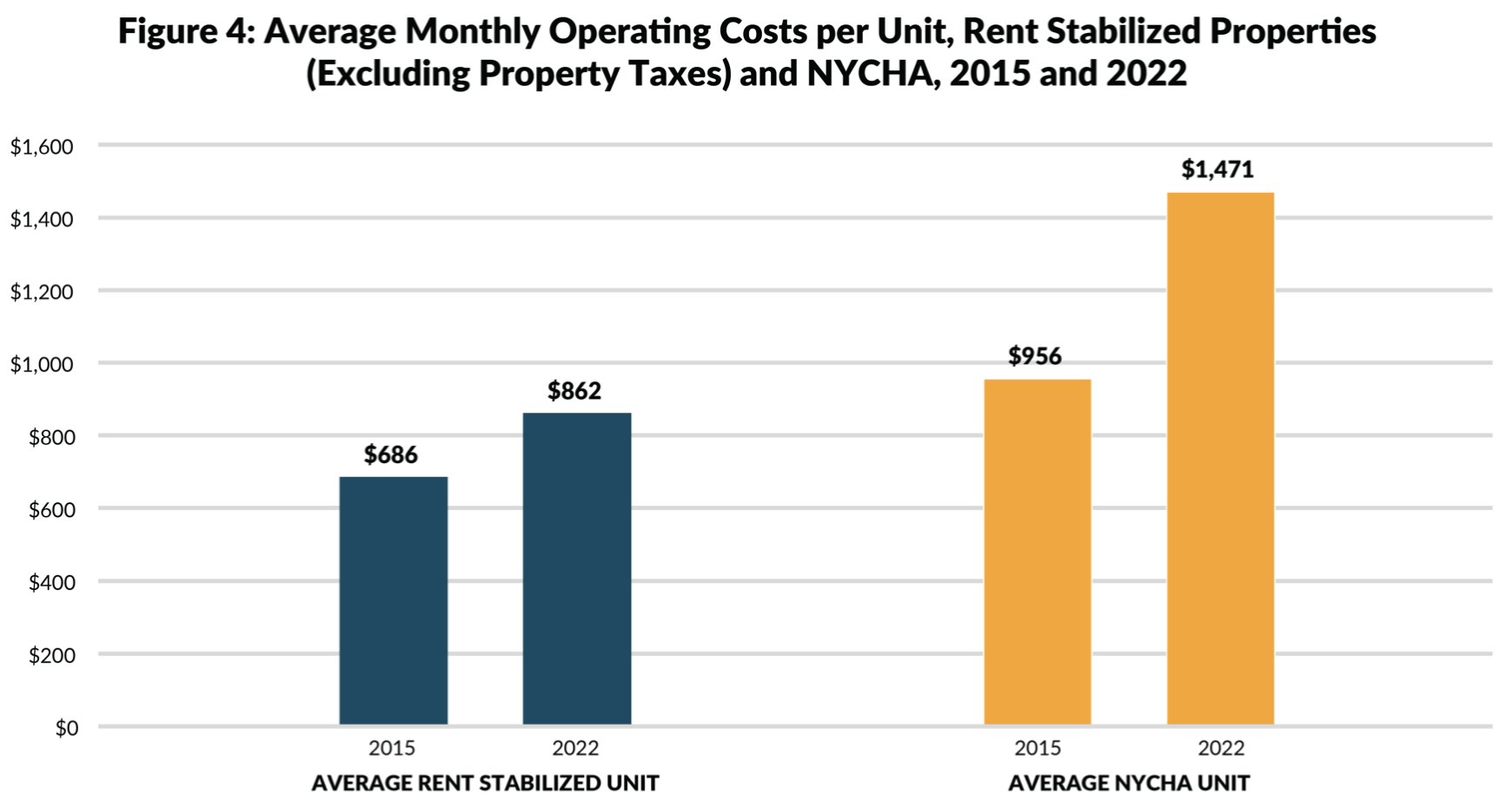
As background, the average rent on a NYCHA apartment (2024 data) is $588 per month, or just over $7000 per year. Moreover, rents are limited to 30% of resident income, and the average income (same link) is said to be about $25,000 — so NYCHA has almost no ability to raise rents. The $588/month current rent covers only about a third of operating costs, with almost all of the rest provided by federal subsidies totaling in the range of $2.5 billion per year.
But the new loans are going to more than double the operating shortfall. Assuming that the borrowing entity can get a 6% interest rate (likely better than you could get today), and a renovation cost per unit of $400,000 (very optimistic), that means $24,000 annually of added interest cost per unit, or $2000 per month. Tenant rent stays at $588 per month, so taxpayer subsidy must then go from about $1500 per month to more like $3500 per month. If extended to all NYCHA apartments and paid for by the federal taxpayers, the extra $2000 per month per unit would take annual federal subsidies to NYCHA from about $2.5 billion to more like $6.5 billion. (For comparison, the total of rents collected from all NYCHA tenants is around $1 billion per year.)
The renovations are being financed under something called the PACT program (Permanent Affordability Commitment Together). The NYCHA Journal piece linked above has this to say about the PACT program:
The PACT program transitions developments from traditional Section 9 assistance to Project-Based Section 8 and unlocks funding for resident-selected PACT partners to complete comprehensive repairs and to oversee daily property management of the campus.
New York City has a web page further describing the PACT program. From that page:
Through PACT, developments will be included in the federal Rental Assistance Demonstration (RAD) and convert to a more stable, federally-funded program called Project-Based Section 8. This allows NYCHA to unlock funding to complete comprehensive repairs, while also ensuring homes remain permanently affordable and residents have the same basic rights as they possess in the public housing program. . . . Why do we need PACT? NYCHA needs more than $78 billion to fully restore and renovate all of its buildings, but the federal government has provided only a fraction of the funding needed for these improvements.
They are “unlocking” federal funding by going from “traditional Section 9 assistance” to “project-based Section 8" funding. “Section 9” means a multi-billion dollar annual subsidy payable directly from HUD to NYCHA. “Section 8” means that each tenant gets a subsidy in the form of a housing voucher covering the difference between his rent (30% of income) and a rental amount sufficient to cover all the new costs. This will then be “more stable” — with that term apparently meaning no more need to rely on tenants who may or may not pay rent when due, when you can now just get a big regular handout from Uncle Sugar’s infinite pile of money. The federal taxpayer will go from paying around two-thirds of the cost of operating these buildings, to more like five-sixths. And by the way, these buildings don’t pay property tax!
So, HUD, if you just let this happen, you will get scammed for an additional $4 billion a year or so, while NYCHA will remain as a sore tooth in New York City for potentially generations to come. You have an opportunity to shut it down now, through the device of not awarding unlimited Section 8 subsidies to this left-wing graft factory. With that step, you can force NYCHA into a long overdue fundamental restructuring, which otherwise will never occur. Time to pay attention!