Search This Blog

De Omnibus Dubitandum - Lux Veritas

Showing posts with label Massachusetts. Show all posts

Friday, May 30, 2025

The Governor of Massachusetts is a Hoot!

Susan Daniels May 29, 2025 @ Susan's Newsletter 

“ICE agents stormed the islands of Nantucket and Martha's Vineyard and arrested 40 illegal immigrants — but Massachusetts' Democratic Governor Maura Healey demanded 'answers' and 'clarification' from ICE about the covert operation.” (DailyMail)

You’d think the irate Healey lived there, but you’d be wrong. She lives in Arlington, MA, with her partner Joanna Lydgate.

Healey may come to regret a comment she made: “It's one thing to go after and target those who have committed crimes, who are here unlawfully.”

So what’s the difference between those who are there illegally and those who are just there unlawfully? Healey didn’t define that for anyone.

“It's concerning when we see people, moms and dads, being ripped away from families,” Healey said. “Neighbors, coworkers taken away, literally it looks like, on the way to job sites in Nantucket and on the Vineyard.”

She must be worried about who is going to cut the grass, even though the apprehended included an MS-13 member and a child sex offender. But, damn, someone has to manicure the lawns and wash those pots and pans.

Healey must have forgotten that she was the MA Attorney General when forty-nine illegals were dropped off on Martha’s Vineyard in September 2022 and given the bum’s rush forty-seven hours later. She was silent on that matter.

But masked residents jumped right in 2022 and fed the illegals, gave some cots to sleep on, and waved goodbye to them within two days.

"Everything from beds to food to clothing to toothbrushes, toothpaste, blankets, sheets — I mean, we had some of it ... but we did not have the numbers that we needed," said Lisa Belcastro. She runs the island's homeless shelter in one of the wealthiest areas of the country.

Local high school students served as translators for the Spanish-speaking group, mostly from Venezuela, who arrived with the help of Florida Governor Ron DeSantis.

Despite their false claims, residents wanted them out as fast as possible in 2022.

DeSantis, said during a speech in Iowa in 2023: “We even were able to deliver 50 illegal aliens to beautiful Martha’s Vineyard. They said they were a sanctuary area. They had signs saying nobody is illegal. They said all the refugees and the illegals are welcome and then they deported them the next day. Are you kidding me?”

His speech was met with cheers and applause. Everyone in the country knew by then the hypocrisy of the residents called “Bay Staters” or “Massholes,” if you want to be crude.

Tourist season is upon Martha’s Vineyard and Nantucket, extra hands are needed, and Healey claims she wasn’t notified about the raid.

According to the DailyMail: “Healey's comments sparked immediate and furious backlash from Trump administration DHS Assistant Secretary Tricia McLaughlin.

“She told Fox News that local authorities were notified about the operation.

“Before the Governor criticizes our brave law enforcement, she should get her facts straight—apparently, she is the one with ‘zero information,’ McLaughlin said.

“What we find ‘disturbing’ and ‘concerning’ is politicians like Massachusetts Gov. Healey fighting to protect criminal illegal aliens.

“Our ICE officers will continue putting their lives and safety on the line to arrest murderers, kidnappers, and pedophiles that were let into our country by the Biden administration's open border policies.”

And that’s the end of that story—for now.

https://m.media-amazon.com/images/I/61Tg652gkjL._SL1500_.jpg

Susan Daniels is a private investigator and the author of The Rubbish Hauler’s Wife versus Barack Obama: A True Story which is available on Amazon.com.

Politics like we have never seen.  Recommend Susan’s Newsletter to your friends. 


Friday, December 15, 2023

DC and California Going Broke Fast

What's the common denominator?

by | Dec 15, 2023 @ Liberty Nation News

The fiscal year just started, and the US government is already running a massive budget deficit. In November, the federal shortfall was a larger-than-expected $314 billion, fueled by a 17% increase in spending. In only the first two months of FY 2024, the gap totals $381.5 billion, thanks to huge outlays for Social Security, Medicare, national defense, and interest payments. Washington’s river of red ink and IOUs stretches across the nation, including into one of the largest states in the country: California.

Budget Deficit in California

GettyImages-1796587831 Gavin Newsom

Gavin Newsom (Photo by Liu Guanguan/China News Service/VCG via Getty Images)

While California Gov. Gavin Newsom (D) proved to the nation during his debate with Florida Gov. Ron DeSantis (R) why his state is a mess, the latest figures confirm what many already know: The Golden State is being sucked into a fiscal black hole. The non-partisan Legislative Analyst’s Office (LAO) confirmed on Dec. 8 that the state’s budget deficit soared to an all-time high of $68 billion, driven by shrinking tax revenues. This topped the June estimate of a $14.3 billion shortfall.

State budget analysts warn that California will need to address the ballooning deficit. This could involve using its $30 billion cash reserves, employing one-time spending cuts, and adjusting how it funds education and other generous social programs. However, all of these options could be short-term solutions, as the LAO forecast that California could face annual budget deficits of $30 billion for the next few years.

The good news for Newsom is that California is not facing a crisis. LAO official Gabriel Petek told reporters: “The state remains in a good cash position, and that really wasn’t the case back at the start of the Great Recession. We don’t face the same kind of liquidity challenges that we had at that time, and so I would stop short of describing it as a crisis.” At the same time, massive budget deficits suggest that the state needs to be more cautious moving forward, says California Senate President Pro Tem Toni Atkins. She told Politico that “we’re going to have to slow down over time,” pertaining to existing and new spending. But will Gavination decelerate its expenditures? Unlikely.

Other States in the Red

The Golden State isn’t the only one facing an immense budget deficit. In fact, nine others are enduring long-term fiscal imbalances, including Connecticut, Illinois, Massachusetts, New Jersey, and New York. This has been driven by governors and legislative chambers overpromising, overspending, and underdelivering for years without any respite.

More could be joining the list soon, including Minnesota, which is forecast to see a shortfall of $2.31 billion in the 2026-27 fiscal years. Mark Koran, a GOP senator in North Branch, summarized the situation in a recent statement following the Office of Minnesota Management and Budget’s economic projection:

“In only one session, single-party Democrat control of government has taken us from a $19 billion surplus to a projected $2.31 billion deficit in the near future. Their record of reckless overspending, massive tax increases, broken tax relief pledges, and now looming deficits are simply not sustainable. At the same time, inflation continues to put pressure on family budgets every month. Minnesotans cannot afford Democrats’ irresponsible governing any longer.”

Sorry, Cheney, Deficits Do Matter

Former Vice President Dick Cheney famously said that “deficits don’t matter.” This Republican mantra was shared shortly before former President George W. Bush declared that the United States needed to sacrifice free-market principles to save the free market. Democrats might not be so blunt in their support of debt and deficits, but their actions, whether at the state or federal level, show that they also lack the ability to balance the books. Since arriving at the White House in 2021, President Joe Biden has overseen the national debt soaring by approximately $7 trillion while recording some of US history’s largest deficits. Many experts have warned of the growing consequences of fiscal irresponsibility, but with interest rates at their highest levels in more than two decades, budget deficits being the new normal might breed a fiscal crisis.

 Tags: Articles, Business News, Opinion

 
Read More From Andrew Moran

Tags: Articles, Business News, Opinion

Wednesday, October 12, 2022

The Most Important Ballot Referendum of 2022

October 11, 2022 by Dan Mitchell

While most people pay attention to which political party enjoys success when there’s an election, I think it’s also important to look at ballot initiatives.

But, as we’ve seen in California and Oregon, not every referendum produces a sensible result.

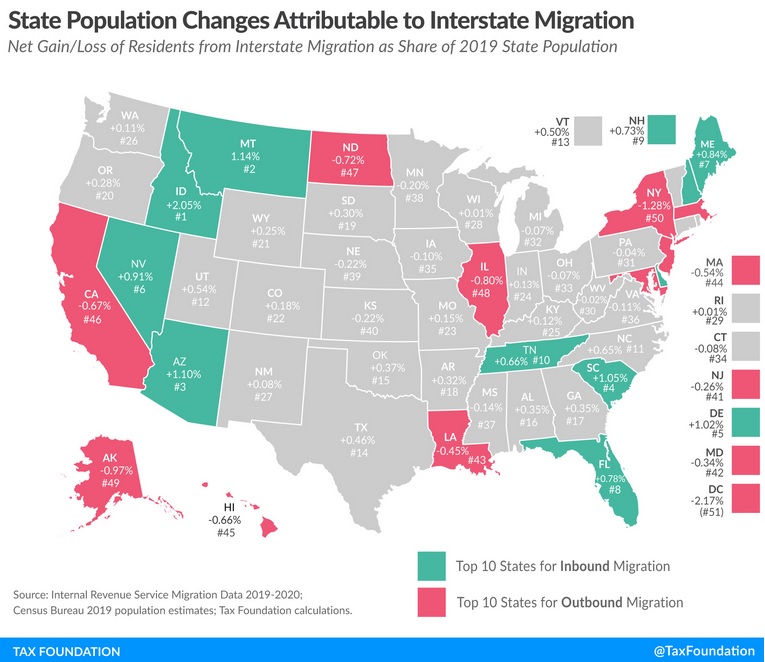
Today, we’re going to look at the most important ballot initiative of 2022. But before looking at the details, here’s a map showing the states gaining and losing population when Americans move across borders.

You’ll notice that Massachusetts is one of the top states for outbound migration, which means people are “voting with their feet” against the Bay State.

But bad news can become worse news. And that will definitely be the case if voters in Massachusetts approve a referendum next month to junk the state’s flat tax and replace it with a class-warfare system that has a top rate of 9 percent.


Jeff Jacoby wrote last year about the idea in a column for the Boston Globe. A century-old provision of the Massachusetts Constitution commands that if the commonwealth taxes income, it must do so at a “uniform rate.” Five times in the modern era — in 1962, 1968, 1972, 1976, and 1994 — tax-and-spend liberals have invited voters to discard that rule and make it legal to soak the rich at higher tax rates. Five times voters have said no. …

There is considerable arrogance in the way advocates of the surtax blithely disregard the voters’ repeated refusal to overturn the constitutional ban. Their attitude seems to be that no matter how many times the people uphold the uniform-rate rule, there is no reason to take them seriously.

 …more than 150 Massachusetts businesses representing almost 16,000 workers sent lawmakers an open letter imploring them not to hobble the state’s economy with a stiff new tax, and expressing “alarm” at the proposed constitutional amendment. They…know that a surtax aimed at millionaires is bound to injure countless people who will never earn anywhere close to a million bucks.

The Wall Street Journal has editorialized against the proposal.


…progressives in Boston want to join New York and other nearby states in a high-tax arms race. …Bay State ballots in November will give voters the choice to place a 4% surtax on incomes above $1 million, bringing the top rate to 9% from 5%. The proposal would amend the state constitution to remove its flat-tax mandate. Passing the measure would rocket Massachusetts to seventh from 31st on the list of states with the highest marginal income-tax rates. …

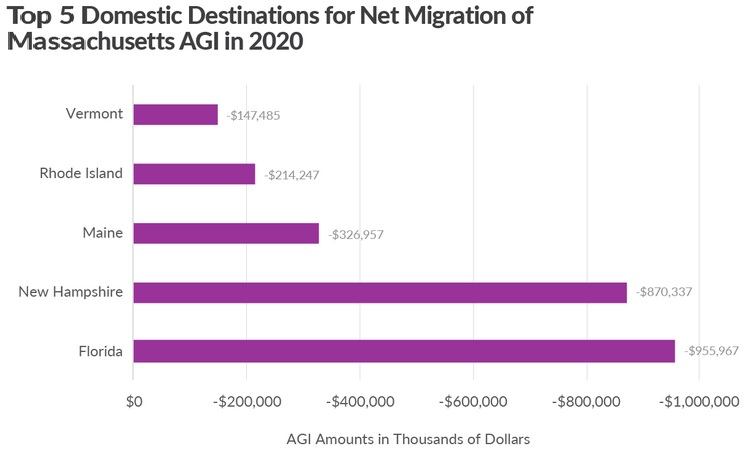
A $2.3 billion revenue surplus shows that the state is already taxing more than it needs. This year’s tax haul was so big it triggered a largely forgotten state law that caps revenue. Residents may soon receive checks that refund a portion of last year’s taxes. …Approving the tax would speed up a wealth exodus already under way. The Pioneer Institute last year noted that Massachusetts’ tax base has been eroding, and there’s no surprise about where the escapees are going. The top two destinations are Florida and New Hampshire, both of which lack an income tax.

…The constitution’s flat rate mandate is a crucial limit on the demands of interest groups for ever-more spending. If tax rates rise and the revenue cap goes away, spending will soar to snatch the new revenue and soon the politicians will return to seek even higher rates, as they always do.

The economic consequences of class-warfare taxation are never positive.

And that will be true in Massachusetts. A study from the Beacon Hill Institute in Massachusetts estimates the economic damage that the surtax would cause.


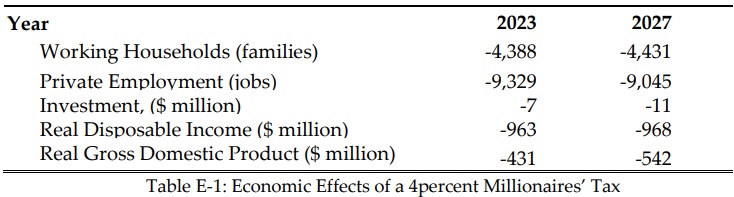
…we find, using our in-house computer model (MA-STAMP) that the effects on the economy will be as follows: In its first year of implementation, the amendment will cause the state to lose 4,388 working families due to out migration. This out migration plus a reduction in labor hiring and labor-force participation will cause a loss of 9,329 jobs. …the state economy, real (inflation-adjusted) gross domestic product, will shrink by $431 million… Advocates of the measure claim that it will make possible a $2 billion annual in state spending. …Instead, we find that the revenue yield of the tax will be far less, the result of the expected shrinkage in economic activity. (See Table E-2.) In its first year of implementation, combined state and local revenues will rise by only about $1.2 billion.

Here’s a table showing some of the negative effects.

Alex Brill of the American Enterprise Institute also estimated that revenues would be lower than expected once the effects of the Laffer Curve are incorporated into the analysis.

Here are some excerpts from his article in the Hill.


Modifying the revenue forecast to incorporate evidence from the academic literature about likely behavioral changes yields a significantly lower estimated revenue pickup. I estimate that about 400 of the 22,000 taxpayers affected by the surtax would exit the state and many others would reduce work or shift and relabel their income to avoid the tax. By my estimate, the surtax would generate approximately $1.5 billion in 2023, since these behavioral responses would offset 32 percent of the revenue gain that would occur if taxpayers kept their behavior unchanged. Using a similar approach, Tufts University’s Center for State Policy Analysis recently estimated that the proposed surtax would generate only $1.3 billion in 2023.

Last but not least, the Tax Foundation crunched the numbers and also found the surtax would cause significant economic damage.


…while no one would mistake Massachusetts for a low-tax state, it has carved out a place as a competitive area to live and work within the Northeast corridor. …but consider the Commonwealth’s ranking on the Tax Foundation’s State Business Tax Climate Index…in 2022, the Bay State still ranked 34th overall on the Index—well below the median. …Massachusetts’ competitive tax advantage in New England is primarily due to its individual income and sales tax systems, which rank 11th and 12th on the Index, respectively. With regard to its neighbors, only New Hampshire has a better overall Index ranking than Massachusetts.

…In 2007, Christina Romer and David Romer, professors of economics at the University of California Berkeley, conducted a study to determine the impact of legislated tax changes on the economy. …The study found that a tax increase equal to 1 percent of gross domestic product (GDP) resulted in an estimated 3 percent decline in GDP after three years. …If the Romer and Romer study were applied to the Massachusetts surtax it would result in a 0.942 percent decline in GDP after three years. In other words, the Commonwealth’s total economic output could contract by $5.98 billion by the end of 2025.

Here’s a table from the report, showing that zero-income tax New Hampshire and Florida already are big winners when people escape Massachusetts.

If the referendum is approved, we can easily predict that future versions of this chart will show much bigger numbers.

Simply stated, some of the geese with the golden eggs will fly away (while the ones that stay will decide to produce fewer eggs – as well as figure out ways to protect the eggs that remain).


Thursday, March 11, 2021

Buckeye Institute Press Release


In The Sun, Robert Alt, president and chief executive officer of The Buckeye Institute, and Andrew Cline, president of the Josiah Bartlett Center for Public Policy in Concord, NH, look at the issue at the center of New Hampshire v. Massachusetts—the unconstitutional income taxes that remote Granite State workers are required to continue paying to Massachusetts—a state where they do not live, cannot vote, and no longer work.

The Sun
By Andrew Cline and Robert Alt
March 10, 2021
 
When Massachusetts Gov. Charlie Baker declared a state of emergency on March 10, 2020, many New Hampshire residents who were commuting to the Bay State began working from home instead.

Ordinarily, Massachusetts could not continue withholding taxes from these workers’ paychecks while they were not working in the Bay State. But under a new Baker administration rule, out-of-state remote workers were required to continue paying income tax to Massachusetts — a state where they do not live, cannot vote, and no longer work.

Remote-working Granite Staters were understandably outraged. As was New Hampshire Gov. Chris Sununu. Accordingly, New Hampshire Attorney General Gordon MacDonald filed an original jurisdiction case with the U.S. Supreme Court to protect Granite Staters from Massachusetts’ unconstitutional money-grab. Fourteen other states, along with several public interest groups including The Buckeye Institute, have urged the high court to hear this consequential case.

New Hampshire v. Massachusetts should matter to anyone who works from home or employs remote workers. Teleworking has skyrocketed during the pandemic, with approximately half of Americans now working from home, according to a recent study by the Brookings Institution.

Software giant Salesforce.com, the largest private employer in San Francisco, recently announced that most of its employees would continue to work remotely after the pandemic, and that the company would shrink its physical office space, as a leading indicator that American work and commuting patterns are changing for the long term.

This shift to remote work started well before the pandemic and benefits employers and employees alike. It enables employers to attract top-notch talent from outside of their immediate geographic area. It gives employees the flexibility to locate their households in more affordable or otherwise preferable areas. And it saves everyone money.

A Global Workplace Analytics study found that those who work remotely half the time can save nearly $11,000 per year for their employers and between $2,500 and $4,000 per year for themselves.

The remote-work revolution can also help bridge the growing urban-rural economic divide. People who work from home are almost twice as likely to earn a six-figure salary compared to the general population, and small towns and rural areas stand to profit substantially if more high-income earners relocate there while telecommuting to work for employers in larger metropolitan areas.

Some government officials have lauded the shift to telework, and even encouraged it. As Gov. Baker himself said, “Now as we look to the weeks and months ahead, we’re urging businesses to continue to promote remote-work and work from home as much as possible.”

The governor, it seems, wants to have his cake and eat it too — advising Granite Staters to stay home at the same time he taxes them as though they didn’t.

If being taxed without representation weren’t enough, Massachusetts — home to John Hancock and the Boston Tea Party — wants to levy taxes for unused services, too.

Being taxed where you work makes sense only because the taxing jurisdiction generally incurs commuters’ wear-and-tear burden on its roads, utilities, community services, and infrastructure.

But absent the commuter presence and burden to pay for the same, there is no good reason — short of greed — to tax telecommuters’ wages while they have no say or vote on the tax or the election of its assessors.

If Massachusetts prevails in New Hampshire v. Massachusetts, other states and jurisdictions will quickly adopt a similar soak-the-teleworker tax policy. In Ohio, for example, cities are already taxing the income of remote workers who used to work there, but are now working elsewhere.

Income taxes should be paid by people who live or, at the very least, actually perform work there.

Working from home is here to stay. Employers and employees have both learned to adapt and adjust their budgets to meet the demands of that new normal. Governments should, too.

Unconstitutional taxes levied upon the income of those who have no vote is neither just nor sustainable given our new post-pandemic realities—and Massachusetts (of all places) should know better.

Andrew Cline is president of the Josiah Bartlett Center for Public Policy in Concord. Robert Alt is president and CEO of The Buckeye Institute in Columbus, Ohio.
Founded in 1989, The Buckeye Institute is an independent research and educational institution a think tank whose mission is to advance free-market public policy in the states.

The Buckeye Institute is a non-partisan, non-profit, and tax-exempt organization, as defined by section 501(c)(3) of the Internal Revenue code. As such, it relies on support from individuals, corporations, and foundations that share a commitment to individual liberty, free enterprise, personal responsibility, and limited government. The Buckeye Institute does not seek or accept government funding.
Support The Buckeye Institute by setting us as your designated charity through AmazonSmile. Every time you make a purchase, Amazon will donate 0.5% of the total to The Buckeye Institute at no extra cost to you!

AmazonSmile and the AmazonSmile logo are trademarks of Amazon.com, Inc. or its affiliates.


Tuesday, February 2, 2021

Will the Supreme Court Limit Tax Imperialism by Massachusetts?

February 1, 2021 by Dan Mitchell @ International Liberty   

On the rare occasions when I write about the Supreme Court, it’s usually to grouse that the Justices don’t defend the Constitution’s limits on the federal government.

For example, the Court engaged in tortured reasoning to rule in favor of Obamacare even though there’s nothing in Article 1, Section 8, that gives Washington the power to mandate the purchase of health insurance (though that awful decision by Chief Justice John Roberts looks brilliant compared to the even-worse 1942 decision that gave Washington the power to control whether a farmer could grow grain on his own farm to feed his own hogs).

But perhaps the Supreme Court can make up for some past mistakes by accepting – and then properly deciding – a case from New Hampshire.

The Granite State wants to block the government of Massachusetts from imposing taxes on people who live and work in New Hampshire.

For some background on this legal battle, the Wall Street Journal has a new editorial on this topic.


Can a state collect income tax from nonresidents working remotely for in-state businesses? Massachusetts, New York and some other states claim they can, and now New Hampshire is asking the Supreme Court to protect its citizens from this tax grab. …New Hampshire, which imposes no income tax on wages, last fall sued Massachusetts and is asking the Supreme Court to hear its case (N.H. v. Mass.). “Massachusetts has unilaterally imposed an income tax within New Hampshire that New Hampshire, in its sovereign discretion, has deliberately chosen not to impose,” says the Granite State. Under longstanding Supreme Court precedent, states can only collect taxes that are “fairly apportioned” and “fairly related to the services provided by the State” within their borders. …Massachusetts and other states are forcing nonresidents to pay income taxes even though they don’t use public services. …If the Court doesn’t intervene, remote workers who are unfairly taxed by other states will have no recourse for redress beyond biased state tax tribunals. States like California may copy the Massachusetts and New York playbook.

Jeff Jacoby, a columnist for the Boston Globe, argues his state is one the wrong side of this fight.


In April, the Department of Revenue published an “emergency regulation” declaring that any income earned by a nonresident who used to work in Massachusetts but was now telecommuting from out of state “will continue to be treated as Massachusetts source income subject to personal income tax.” For the first time ever, Massachusetts was claiming the authority to tax income earned by persons who neither lived nor worked in Massachusetts. …Massachusetts has indeed injured New Hampshire… It has launched what amounts to an attack on a fundamental aspect of New Hampshire’s sovereign identity — its principled refusal to tax the income of New Hampshire residents earned in New Hampshire. It was one thing for Massachusetts to withhold taxes from New Hampshire residents for income earned within the borders of Massachusetts. With its new tax rule, however, Massachusetts is reaching over the border to extract taxes, thereby undermining a core New Hampshire policy. …the Supreme Court has the power to shut down such overreaching. And now, thanks to New Hampshire, it has the opportunity.

Professor Ilya Somin from George Mason University’s law school elaborates in a column for Reason.


New Hampshire v. Massachusettshas some real merit, and also has important implications for the future of American federalism. …New Hampshire’s motion…in the Supreme Court outlines two theories as to why the Massachusetts rule is unconstitutional: it violates the Dormant Commerce Clause (which prevents states from regulating and taxing economic activity beyond their borders), and the Due Process Clause of the Fourteenth Amendment, which has long been held to bar state taxation of people who neither live nor work within its borders. Both arguments build on one of the bedrock principles of American federalism: that state sovereignty is territorial in nature. States do not have the power to regulate and tax activity beyond their borders. …most of Massachusetts’ arguments rely on the notion that the NH workers in question have close connections to the Massachusetts economy and benefit from interacting with it . Therefore the state claims it has a right to keep taxing them as before. …If Massachusetts prevails…, it could potentially have dire implication for the growing number of people who work as remote employees for firms located in another state. The latter state could tax their income even if they never set foot there. This would also make it much harder for people to “vote with their feet” for states with lower taxes, better public policies, and other advantages. …The “Live Free or Die State” deserves to win this important case.

The above columns mostly focus on the legal aspects of the case.

From my perspective, I’m more concerned about upholding the principle that the economic powers of governments should be constrained by borders.

That’s the reason why I defend so-called tax havens, even when that leads to abuse (government officials engaging in everything from name calling to legal threats). Simply stated, high-tax nations shouldn’t have the right to tax economic activity that occurs inside the borders of low-tax jurisdictions.

After all, if we want to constrain “Goldfish Government,” taxpayers need some ability to escape oppressive tax regimes.

The bottom line is that the Supreme Court should take this opportunity to limit the Bay State’s greedy politicians.

P.S. This case is partly a fight between proponents of territorial taxation (the good guys) and proponents of extraterritorial taxation (the bad guys).

P.P.S. The Supreme Court unfortunately did recently rule on the wrong side of a case involving extraterritorial taxation.

P.P.P.S. If you want a practical example of what this means, read this column about the taxation of successful Olympic athletes.

Tuesday, November 13, 2018

Candles are now illegal for all in Cambridge? Enforcers are on scorched-earth campaign

Licensers are making up laws to go after two business owners yet again

By Marc Levy

If you lit a candle in Cambridge for any purpose within the past few weeks without first going to the fire department for permission, you have broken the law. That’s because the fire department, with no public process, added something that at least looks like a law to its website saying so: “The Cambridge Fire Department does not allow the use of candles unless approved by the Fire Prevention Bureau.”

Department and city officials have been silent when asked about the unannounced addition to its website, but it was done in advance of a Wednesday disciplinary hearing before the License Commission over the use of candles at a North Cambridge wine bar and charcuterie...........Asked directly what statute that was being violated at UpperWest that drew fire inspectors Aug. 3 and then again Sept. 29, acting chief of the fire department Gerard Mahoney – who also makes up one-third of the commission with the police commissioner and a chairwoman – declined to answer because the “matter is currently under investigation.” When the question was appealed to the City Solicitor’s Office, city spokesman Lee Gianetti responded that “the fire department indicates that the use of candles in restaurants in Cambridge is governed by the Massachusetts Fire Safety Code.” Renewed requests for information last week were ignored............To Read More......


Sunday, November 4, 2018

America Ripe for Reform: All Politics Isn’t Local

Thanks for healthcare’s ever rising costs, the truth hits home in Tip O’Neill’s backyard.

Hunt Lawrence and Daniel J. Flynn November 1, 2018

Massachusetts considers a ballot question on Tuesday that proposes to “limit how many patients could be assigned to each registered nurse in Massachusetts hospitals and certain other health care facilities.”   Judging by signage and surveys, “yes” on Question 1 appeared headed for an overwhelming victory. Then something happened. Voters thought about the consequences...............Compliance with the law similarly means higher costs passed on to consumers................ Americans spend about $3.5 trillion, 18 percent of gross domestic product, on healthcare .............. estimated that that raw number increases to $5.7 trillion by 2025 — a fifth of gross domestic product.

Americans may not know that in 1950 we spent five percent of GDP on healthcare or in 1970 we expended about seven percent of GDP on healthcare..............The inflating costs effectively work as a massive tax hike on Americans............To Read More......