Search This Blog

De Omnibus Dubitandum - Lux Veritas

Showing posts with label Light Bulbs. Show all posts

Thursday, January 9, 2025

A Parting Insult to American Households from Joe Biden

 January 8, 2025 by Dan Mitchell @ International Liberty

Environmental zealots and meddling politicians are undermining our quality of life.

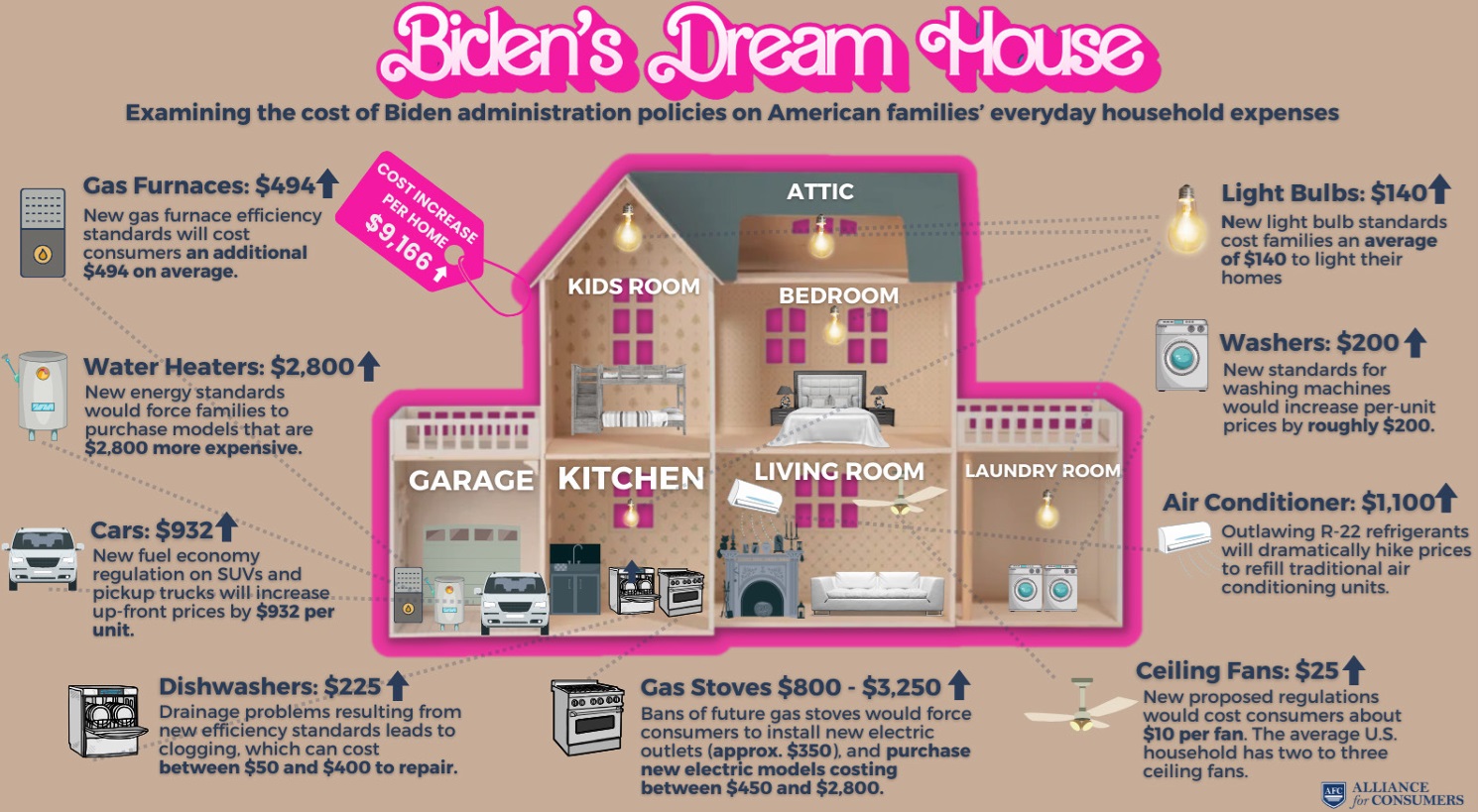
Courtesy of the Alliance for Consumers, here’s an amusing depiction of how these types of policies have increased the cost of living.

Unfortunately, Joe Biden is trying to make a bad situation even worse.

In the final days of his administration, federal bureaucrats want to make hot water heaters more expensive.

Here are some excerpts from a report in the New York Post by Ryan King.

A Biden administration ban on certain natural gas water heaters as part of the lame duck president’s climate agenda could send prices soaring for the elderly and the poor. Under the policy, new non-condensing, natural gas-fired water heaters will be prohibited for sale starting in 2029… The policy comes during President Biden’s twilight days in the White House and was quietly announced without a press release. …Customers will be pushed towards buying models that are more expensive or lean on non-instantaneous storage tank water heaters, which are generally cheaper but tend to be less efficient than the ones that are facing a ban… “Forcing low-income and senior customers to pay far more upfront is particularly concerning. DOE’s decision to go ahead with a flawed final rule is deeply disappointing,” Matthew Agen, the American Gas Association’s chief counsel for energy, told the outlet. …President-elect Donald Trump is set to take office on Jan. 20 and has expressed interest in reversing some of Biden’s climate change policies.

Trump has a decent track record on regulatory issues, so my fingers are crossed that this policy (and others like it) will be reversed.

I’ll close by observing that our leftist friends generally have two motives when pushing these types of policies.

  • The first motive, which is somewhat logical though overtly paternalistic, is that people should be forced to buy energy-efficient appliances that cost more to buy but are cheaper to operate, thus presumably saving them money in the long run.
  • The second motive, which is ideological, is that energy consumption is bad and must be discouraged.

I can understand the first motive, even though I don’t believe in one group of people imposing their preferences on another group of people (even though I agree it’s smart to buy appliances that are cheaper over a lifetime of use).

However, I obviously disagree with the left’s religious-like hostility to energy consumption (which leads them laughably preposterous choices).


Monday, February 19, 2024

Government’s War on Dishwashers

February 17, 2024 by Dan Mitchell @ International Liberty

Bureaucrats must have a knee-jerk desire to make citizens miserable. That’s the most logical explanation for their various initiatives to lower our quality of life.

Let’s focus on one of those examples today.

George Will has a new column in the Washington Post about the bureaucracy’s war against dishwashers that…well…actually clean dishes.


The Energy Department’s busy beavers, with their unsleeping search for reasons to boss us around for our own good, decided that dishwashers use too much water and energy… Responding to the Biden administration…, a slew of states sued the Energy Department… This dispute reached the U.S. Court of Appeals for the 5th Circuit, which, in its Jan. 8 ruling,swatted away what it tartly called the department’s “government-always-wins” argument…the court said, not only has the Energy Department acted in excess of statutory authority, but the record also contains “ample evidence” that the department’s new rules reduced efficiency in both energy and water use because “purportedly ‘energy efficient’ appliances do not work.” People “may use more energy and more water to preclean, reclean, or handwash their stuff before, after, or in lieu of using DOE-regulated appliances.” …DOE itself estimated in 2011 that handwashing consumes 350% more water and 140% more energy than machine washing.

The case involves the Biden Administration basically reversing some deregulation that took place during the Trump Administration.

The Wall Street Journal editorialized about this issue last year.


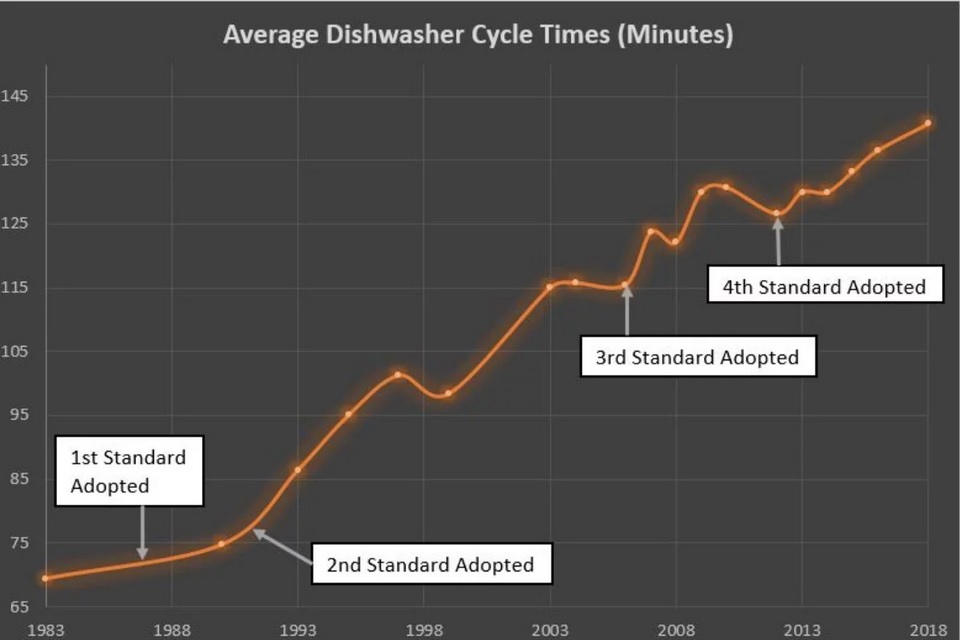
…the Energy Department dropped a sweeping proposal for “efficiency” mandates on dishwashers. Did you enjoy last night’s spaghetti, still crusted on the plate? Now you can taste it twice. …Americans have learned the hard way that stricter efficiency rules on already efficient appliances translate into higher costs, inconvenience, and ultimately waste. The Obama Administration’s dishwasher regulations raised the average price of a machine nearly $100, while producing a new norm of dirty forks and smelly glasses. …Machines can only meet much higher efficiency standards by recirculating water in longer cycles, meaning run times of two or three hours. Yet if the dishes aren’t clean, owners run them again, undermining the argument about conservation. The U.S. Energy Information Administration says that in 2020 nearly 20% of American households that owned a dishwasher never used it. That means they hand washed, which is as inefficient as it comes. The Biden …Energy Department plan gives manufacturers only until 2027 to produce the miracle of costlier washers that do a worse job.

This issue is ridiculous. I’m not sure what’s worse, the fact that bureaucrats are making our lives less pleasant, or that they’re making our lives less pleasant in a way that doesn’t actually save water or energy.

I’ll close on a related note. I was in Mexico City last week and was happily surprised at the quality of the hotel’s shower.

But then I realized that I was enjoying strong water pressure because Mexico presumably does not impose (or does not enforce) the stupid water-flow regulations we have in the United States.

This type of red tape is supposed to save water, but I wonder if that happens since you have to spend twice as long in the shower?

P.S. To its credit, the Trump Administration also tried to deregulation shower head regulations.


Thursday, June 8, 2023

The Federal War Against Your Lifestyle

@ Manhattan Contrarian

Just a week ago I had a post featuring some recent federal bureaucratic assaults against the well-being and prosperity of the population. The title was “Bureaucrats Completely Incapable Of Making Reasonable Trade-Offs.” The post featured two new rules from different corners of the federal bureaucracy, both announced on May 5: one from EPA effectively mandating electric automobiles by about 2032, and the other from the Department of Energy once again lowering the amounts of energy and water that dishwashers are allowed to use.

I stated in that post that these two new rules were just examples of a much broader federal war against our comfortable and convenient lifestyles. But to get a feel for the big picture, you need a more comprehensive list of the things the feds are trying to restrict and/or eliminate from your life. Now Noah Rothman comes along in the current issue of National Review with a much longer list, in a piece titled “The War on Things That Work.” (Although National Review has a paywall, you should get a free article or two per month, if you want to read the whole piece.)

One thing that Rothman’s list makes clear is that, although the regulations are principally rationalized as part of the fight against “climate change,” there are many respects in which the new restrictions have nothing whatsoever to do with the “climate” issue, even if you believe that greenhouse gases like CO2 are some kind of existential threat to humanity. For example, several of the restrictions in question relate to use of water, rather than energy. Other restrictions relate to the use of energy in the form of electricity, which in other contexts (like automobiles) the climate warriors call “zero emissions.” In the real world electricity is not “zero emissions” at all (because most of it comes from fossil fuels), but the climate warriors claim to believe that it is (because they think fossil fuels can be easily eliminated from the generation process), and if so, reducing the electricity use of various gadgets and appliances is also not a “climate” issue at all.

To underscore the point that most of these regulations have little to nothing to do with the climate issue, Rothman leads off his article with the well-known quote from one-time Alexandria Ocasio-Cortez chief of staff Saikat Chakrabarti:

“The interesting thing about the Green New Deal is it wasn’t originally a climate thing at all.” It was, in fact, “a how-do-you-change-the-entire-economy thing.”

So here, gathered from Rothman’s piece, is the list he has put together of some of the “things that work” that the government has currently gone to war against, or is considering going to war against: all appliances using natural gas (furnaces, stoves, hot water heaters, clothes dryers); hydrofluorocarbon refrigerants for air conditioners; dishwashers; lawn mowers and leaf blowers powered by gasoline or other fossil fuels; washing machines; incandescent light bulbs; and plastic bags and straws.

Consider some history of a few of these things:

Gas stoves.

The idea of banning gas stoves had largely proceeded at the local level until early this year. (The first U.S. municipality to ban new gas stoves was Berkeley, CA, in 2019. In April 2023 the federal Ninth Circuit threw out Berkeley’s ban on the grounds that it is pre-empted by federal law. Meanwhile New York has its own ban, put in place earlier this year as part of the state budget and taking effect in 2026.)

But the feds could not resist getting into the act. In January 2023, Richard Trumka, one of the commissioners of the Consumer Product Safety Commission, floated the idea of banning gas stoves on the ground that they are a “hidden hazard” because they cause indoor air pollution. (This despite decades of indoor burning of natural gas without any noted health effects.). That remark caused immediate pushback, including from Senators Cruz and Manchin, who proposed legislation to stop any such regulation. Chuck Schumer got into the act, issuing a statement on February 3 saying “you have to laugh at the ‘gas stove ban’ narrative being cooked up by the MAGA GOP.” Sure, Chuck. It took all the way to March 2, 2023 for the CPSC to follow up with a Request for Information, seeking public input on the supposed “chronic hazards associated with gas stoves.” The correct answer is “none,” but you can be sure that the CPSC is being flooded with input from environmental activists demanding that gas stoves be banned. As of now, they say that they have no plans on the table to ban gas stoves; but if you think that that isn’t coming, you are ridiculously naive.

Hydrofluorocarbons refrigerants in air conditioners.

EPA issued its proposed rule on this subject on December 9, 2022. According to the press release, the rule will “Advance Transition to Safer, More Efficient Heating and Cooling Technologies,” and will also save consumers “billions in costs.” Perhaps you are wondering, if the proposed replacement(s) for hydrofluorocarbons are really “safer,” “more efficient,” and will also save consumers big money, how could we be so stupid not to already have adopted these things? Rothman:

Put simply, the rule increases the cost of refrigerants, and those costs are passed on to the consumer. Even the anticipation of that increase has already made it more expensive to install new climate-control units.

Incandescent light bulbs.

Incandescent bulbs are much cheaper to buy than the newer and trendier LED bulbs, but they cost more to operate, and burn out more frequently. That’s a trade-off that different consumers might make differently. It turns out that there is a clear preference among low-income consumers for the incandescent bulbs, undoubtedly because of the cheaper up-front cost. Rothman:

[The] clear preferences of consumers, particularly low-income Americans [is for incandescent bulbs]. In 2018, University of Michigan researchers found that high-efficiency LED light bulbs “are more expensive and less available in high-poverty urban areas than in more affluent locations” and that the cost to upgrade “was twice as high in the highest-poverty areas.”

But the federal regulators are the place where elite preferences get imposed on everyone else, whether they can afford it or not. Rothman provides the following history of the light bulb regulations:

In 2007, George W. Bush signed a law designed to gradually phase out inefficient incandescent light bulbs. Barack Obama accelerated the phase-out by tightening efficiency standards via regulatory mechanisms. In 2019, however, the Trump administration rolled those requirements back, giving incandescent bulbs a new lease on life. But in 2022, Joe Biden’s Department of Energy reimposed Obama-era lumens-per-watt standards designed to finally bury the filament bulb.

Under the current regulations from the Department of Energy, the last date on which sale of incandescent bulbs will be permitted in in August 2023.

CPSC, EPA, Department of Energy. It’s the same thing for all of them: that indescribable thrill of exercising the vast federal power and showing who’s boss and making everybody’s life just a little bit worse by imposing your version of virtue by force. After all, you didn’t go to Washington and dedicate your life and career to writing regulations only to say that everything is already just fine as is. You need to prove that you are a big shot. You need to do something big. Maybe you could impose a lockdown. Failing that, banning some appliances that are cheap and work great would be one hell of a day’s work.
Wednesday, July 20, 2011

Light Bulbs - What's It All About?

By Rich Kozlovich

This whole issue of banning light bulbs is an outrageous example of central planning; the very system that has eventually brought economic ruin to every nation that has tried it. What is this strange rationale behind this drive to push incandescent light bulbs off the market and force compact fluorescent light bulbs onto an unwilling public?

First and foremost was the claim that we need to save energy because we were running out of energy sources. That has been shown to be completely false. There is more oil, coal and natural gas available than we can use in the next 200 years. As Alan Caruba notes….you can’t save energy. You either use it or you don’t use it. Not using it isn’t saving it. You may save dollars, but you aren’t saving energy. So other that saving dollars…which is no one’s business if you pay your bills….what is the reason for this totally inappropriate intrusion into the private lives of everyone in the western world?

Secondly was the claim that if we used more energy, we had to generate more energy. And if we were increasing our energy production it would exacerbate Anthropogenic Global Warming. Since the Earth seems to be cooling they changed that to Anthropogenic Climate Change. That has also been shown to be completely false. So, what now? Remember…. if you are a left/greenie….. facts and ideology can be problematic, not to mention consistency. Will they back down and say….”oops…..it seemed like a good idea at the time!” No, they won’t; because it was never about saving money or energy or conservation. It was then, and it is now, all about control.

If we really want energy efficiency we need to promote competition, which will encourage new technology. That will bring about levels of efficiency that regulation could never achieve. The reality is that punitive regulations and stifling taxes create a diametrically opposite effect than the one that is supposedly desired. We know that. We have seen that in every area of economic endeavor.

Yet we are still stuck with a light bulb that everyone, and I mean everyone, acknowledges will be more expensive, more dangerous, more difficult to dispose of, and may have long lasting toxic effects when broken in the home. Isn’t that the big beef with the greenies on everything else? Why is this different? As I said, cconsistency is problematic for the greenies.

Furthermore, because of the cost the overall energy savings is marginal; why couldn’t this be achieved in other ways? Quite frankly, knowing what we know now about the availability of so-called fossil fuels….who cares?

Well, I will tell you who cares! Those who manufacture the more expensive bulbs for one! And those who wish to control the lives of everyone on the planet. Those who believe that a small elite can make all the decisions on all aspects of life better than people can for themselves. That’s who. You can call them environmentalists or you can call them socialists. The key to understanding this issue is the effort of enforce central planning schemes through legislation, regulation and taxes.  That is the common theme between all the socialist movements, whether it is fascism, communism or environmentalism; it is always about central planning.

One of the things we have to understand is that there are businesses and there are businesses. Big business does not have the same perception of regulation and taxes as do small businesses. The big boys love all of that stuff! Why so you ask? Because it prevents the small, more efficient businesses from competing! That has been going on since the Whisky Rebellion of 1792 and nothing has changed.

So will we work toward competition and innovation to generate efficient, effective and inexpensive energy for the world? No….we won’t!  Not as long as the greenie/socialist movement have anything to say about it, because capitalism, and the wonderful benefits capitalism brings to the world, is anathema to these people.

To be green is to be irrational and misanthropic.

Monday, July 18, 2011

Observations From the Back Row: 7-18-11

Everything we are told should bear some resemblance to what we see going on in reality!

“De Omnibus Dubitandum”

The authority of the IPCC First Assessment Report and the manufacture of consensus
National Communication Association, Chicago, November, 2009
Jean Goodwin goodwin@iastate.edu,Iowa State University

It is widely perceived that "manufactured controversy" has become a serious problem for contemporary civic deliberations. Advocates for special interests have been able to delay, or even derail, much-needed policies by creating an appearance of scientific doubts where there are in fact none. "Denialists" in controversies over policies towards AIDS or towards teaching biology tread a path first laid down by advocates for Big Tobacco, who famously proclaimed "doubt is our product" (Ceccarelli; Michaels; Weinel; Paroske).

In this environment, the work of the Intergovernmental Panel on Climate Change (IPCC) seems a remarkable achievement. Through a series of (up to now) four reports starting in 1990, the IPCC has managed to establish as a political "given" that the earth is warming, and that human activity is a significant cause. The fourth report was the occasion for the Bush II administration's shift from statements like this:
"We do not know how much effect natural fluctuations in climate may have had on warming. We do not know how much our climate could, or will change in the future. We do not know how fast change will occur, or even how some of our actions could impact it.

67% Oppose Upcoming ‘Ban’ on Traditional Light Bulbs
One-in-five Americans (20%) say they or someone they know has bought large quantities of traditional light bulbs to use when those bulbs disappear off store shelves next year under new federal light bulb regulations.  A new Rasmussen Reports national telephone survey finds that 70% of Adults aren’t doing that themselves or don’t know anyone who is, but another 10% are not sure.

My Take - I have read those who claim this was an attempt to “eliminate good energy policy and sound conservation standards” and another claims this is “Marxist socialism at its apex”; and that the old bulbs were “rejected by the market place”. Amazing! Marxism doesn’t give choices…and this is what this  bill attempted to do...isn't it? It allows the people to choose what bulbs they wish to use and it allows businesses the choice to make them or not….as they CHOOSE. That is the strangest definition of Marxism I have ever read. Imagine ….free choice is now Marxism!

I am really happy to get this new understanding! Up until this point my view of Marxism was that it was all about central planning. At least that is what every socialist regime practiced in the past. Apparently I was under the impression that Congress’s actions in originally ordering (actually forcing) the country to unwillingly abandon the bulbs they liked for bulbs that are more expensive, and clearly far more dangerous than the old bulbs, was a clear act of central planning. Central planning is certainly a pattern of actions known as Marxism….isn’t it?

Now I know better. Free choice is Marxism and central planning is……well……..democracy and capitalism?????


Of course, this whole central planning scheme about light bulbs was based on the idea that we were running out of energy. We now absolutely know that is FALSE! It was also claimed that as a result the increased energy being used required increased energy production that was causing Anthropogenic Global Warming. Also FALSE! So how was this “good energy policy and sound conservation standards”, since it was based on lies; which has been another aspect of socialist/Marxist regimes? True, all the others lie too, but in capitalistic democratic republics they can and are exposed. In Marxist regimes those who attempt to expose the central planners incompetence are killed.  Hmmmmmm......Perhaps we should recap.

Well…traditionally Socialist/Marxism policies are based central planning.  Central planning killed the old light bulbs.  Democracy and capitalism decisions are based on market place performances and free choice.   And it was democratic capitalism that attempted to return choice to society.

Is it possible this was an attempt of the "Newspeak" George Orwell disucssed in 1984?


###

Tuesday, July 12, 2011

Observations From the Back Row: 7-12-11

...
Everything we are told should bear some resemblance to what we see going on in reality!
“De Omnibus Dubitandum”


The founding philosopher of the deep green movement was a Nazi
Most of the Green thinkers of Nazism are now forgotten but Heidegger is still honored -- as is his authoritarian proclivities

One of the most influential philosophers of the 20th century, foundational to the academic left and deep ecology of the greens, was committed to Nazism.

The green Nazi/deep ecology connection in the life and works of Martin Heidegger have been routinely given a pass over the years by many western scholars who love his existential philosophy.


Sieg Heil, Stephen Chu!
Steven Chu was a co-winner of the Nobel Prize in Physics in 1997. That he developed methods to cool and trap atoms with laser light does not mean he understands economics, consumer choice, or politics. A Nobel Prize does not even guarantee common sense. Often it guarantees the opposite.  In a Friday conference call with reporters, Chu argued against a House bill that would repeal a 2007 federal law outlawing incandescent bulbs. Many Americans object to being told that must buy the fluorescent, halogen, and LED bulbs starting in January of 2012 as dictated by federal law….. Chu argued the more-efficient bulbs mandated by Congress save consumers money over the bulb’s life even though the up-front price is higher. Chu defended Congress’s right to dictate what kind of light bulb Americans buy because: “We are taking away a choice that continues to let people waste their own money."

What to Do if a Compact Fluorescent Light (CFL) Bulb or Fluorescent Tube Light Bulb Breaks in Your Home: Detailed Recommendations

Other Types of Light Bulbs

Follow the recommendations on this page if you've broken another type of mercury-containing light bulb, such as:

Fluorescent bulbs:
• Linear, U-tube and circline fluorescent tubes
• Bug zappers
• Tanning bulbs
• Black lights
• Germicidal bulbs
• High output bulbs, and
• Cold-cathode fluorescent bulbs.
High intensity discharge bulbs:
• Metal halide
• Ceramic metal halide
• High pressure sodium, and mercury vapor.
Mercury short-arc bulbs; and Neon bulbs.

Related Information
• Why is it important to take these steps? Learn more about CFLs and mercury.
• Find out how to recycle and dispose of a CFL after it burns out
• Color brochure: Download and print a two-page brochure on how to safely clean up and recycle compact fluorescent bulbs (869K, about PDF) | en español (876K, about PDF)
• Main CFL page
Disclaimer

This document contains information designed to be useful to the general public. This document:
• does not impose legally binding requirements, nor does it confer legal rights, impose legal obligations, or implement any statutory or regulatory provisions;
• does not change or substitute for any statutory or regulatory provisions;
• presents technical information based on EPA’s current understanding of the potential hazards posed by breakage of mercury-containing fluorescent lamps (light bulbs) in a typical household setting;
• is a living document and may be revised periodically without public notice.
EPA welcomes comments on this document at any time and will consider those comments in any future revisions of this document.
View the most important steps to reduce exposure to mercury vapor from a broken bulb
Note that these steps are precautions and reflect best practices for cleaning up a broken CFL. If you are unable to follow them fully, don't be alarmed. CFLs contain a very small amount of mercury -- less than 1/100th of the amount in a mercury thermometer. However, if you are concerned about the risk to your health from a potential exposure to mercury, consult your physician.
Recommended steps:
• Before cleanup
• Cleanup steps for:
o Hard surfaces
o Carpeting or rugs
• Future cleaning of carpeting or rugs: air out the room during and after vacuuming
• Actions you can take to prevent broken compact fluorescent light bulbs
Before Cleanup
1. Have people and pets leave the room, and avoid the breakage area on the way out.
2. Open a window or door to the outdoors and leave the room for 5-10 minutes.
3. Shut off the central forced-air heating/air conditioning (H&AC) system, if you have one.
4. Collect materials you will need to clean up the broken bulb:
o Stiff paper or cardboard
o Sticky tape (e.g., duct tape)
o Damp paper towels or disposable wet wipes (for hard surfaces)
o Glass jar with a metal lid (such as a canning jar) or a sealable plastic bag(s)
Cleanup Steps for Hard Surfaces
1. Carefully scoop up glass fragments and powder using stiff paper or cardboard and place debris and paper/cardboard in a glass jar with a metal lid. If a glass jar is not available, use a sealable plastic bag. (NOTE: Since a plastic bag will not prevent the mercury vapor from escaping, remove the plastic bag(s) from the home after cleanup.)
2. Use sticky tape, such as duct tape, to pick up any remaining small glass fragments and powder. Place the used tape in the glass jar or plastic bag.
3. Wipe the area clean with damp paper towels or disposable wet wipes. Place the towels in the glass jar or plastic bag.
4. Vacuuming of hard surfaces during cleanup is not recommended unless broken glass remains after all other cleanup steps have been taken. [NOTE: It is possible that vacuuming could spread mercury-containing powder or mercury vapor, although available information on this problem is limited.] If vacuuming is needed to ensure removal of all broken glass, keep the following tips in mind:
o Keep a window or door to the outdoors open;
o Vacuum the area where the bulb was broken using the vacuum hose, if available; and
o Remove the vacuum bag (or empty and wipe the canister) and seal the bag/vacuum debris, and any materials used to clean the vacuum, in a plastic bag.
5. Promptly place all bulb debris and cleanup materials, including vacuum cleaner bags, outdoors in a trash container or protected area until materials can be disposed of properly.
o Check with your local or state government about disposal requirements in your area. Some states and communities require fluorescent bulbs (broken or unbroken) be taken to a local recycling center.
6. Wash your hands with soap and water after disposing of the jars or plastic bags containing bulb debris and cleanup materials.
7. Continue to air out the room where the bulb was broken and leave the H&AC system shut off, as practical, for several hours.
Cleanup Steps for Carpeting or Rugs
1. Carefully scoop up glass fragments and powder using stiff paper or cardboard and place debris and paper/cardboard in a glass jar with a metal lid. If a glass jar is not available, use a sealable plastic bag. (NOTE: Since a plastic bag will not prevent the mercury vapor from escaping, remove the plastic bag(s) from the home after cleanup.)
2. Use sticky tape, such as duct tape, to pick up any remaining small glass fragments and powder. Place the used tape in the glass jar or plastic bag.
3. Vacuuming of carpeting or rugs during cleanup is not recommended unless broken glass remains after all other cleanup steps have been taken. [NOTE: It is possible that vacuuming could spread mercury-containing powder or mercury vapor, although available information on this problem is limited.] If vacuuming is needed to ensure removal of all broken glass, keep the following tips in mind:
o Keep a window or door to the outdoors open;
o Vacuum the area where the bulb was broken using the vacuum hose, if available, and
o Remove the vacuum bag (or empty and wipe the canister) and seal the bag/vacuum debris, and any materials used to clean the vacuum, in a plastic bag.
4. Promptly place all bulb debris and cleanup materials, including vacuum cleaner bags, outdoors in a trash container or protected area until materials can be disposed of properly.
o Check with your local or state government about disposal requirements in your area. Some states and communities require fluorescent bulbs (broken or unbroken) be taken to a local recycling center.
5. Wash your hands with soap and water after disposing of the jars or plastic bags containing bulb debris and cleanup materials.
6. Continue to air out the room where the bulb was broken and leave the H&AC system shut off, as practical, for several hours
Future Cleaning of Carpeting or Rugs: Air Out the Room During and After Vacuuming
1. The next several times you vacuum the rug or carpet, shut off the H&AC system if you have one, close the doors to other rooms, and open a window or door to the outside before vacuuming. Change the vacuum bag after each use in this area.
2. After vacuuming is completed, keep the H&AC system shut off and the window or door to the outside open, as practical, for several hours.

Actions You Can Take to Prevent Broken Compact Fluorescent Light Bulbs
Fluorescent bulbs are made of glass and can break if dropped or roughly handled. To avoid breaking a bulb, follow these general practices:
• Always switch off and allow a working CFL bulb to cool before handling.
• Always handle CFL bulbs carefully to avoid breakage.
o If possible, screw/unscrew the CFL by holding the plastic or ceramic base, not the glass tubing.
o Gently screw in the CFL until snug. Do not over-tighten.
o Never forcefully twist the glass tubing.
• Consider not using CFLs in lamps that can be easily knocked over, in unprotected light fixtures, or in lamps that are incompatible with the spiral or folded shape of many CFLs.
• Do not use CFL bulbs in locations where they can easily be broken, such as play spaces.
• Use CFL bulbs that have a glass or plastic cover over the spiral or folded glass tube, if available. These types of bulbs look more like incandescent bulbs and may be more durable if dropped.
• Consider using a drop cloth (e.g., plastic sheet or beach towel) when changing a fluorescent light bulb in case a breakage should occur. The drop cloth will help prevent mercury contamination of nearby surfaces and can be bundled with the bulb debris for disposal.

Mercury from CFL debris: Above ‘safe’ levels and long-lasting, says study
Of course what these researchers fail to grasp is that the mercury in CFLs is a special non-toxic isotope of mercury called HgPC.

Here’s an excerpt from the study abstract:

This article presents an original study on the releases of mercury (Hg) from broken compact fluorescent lamps (CFLs) under various environmental conditions… Hg vapor emission test revealed that the CFLs continuously release Hg vapor once broken and the release can last over 10 weeks. Total amount of Hg vapor released from a broken CFL can exceeds 1.0 mg, which can cause Hg level in a regular room to exceed the safe human exposure limit under poor ventilation conditions.
My Take - OH NO! Say it ain't so Joe. Is it possible? Another stupid greenie solution to another non-problem gone awry?  I guess we should be grateful they have such a monoploy for being wrong.  Otherwise "wrong" would have to be spread out among the rest of society and we might not know who was wrong until it was too late.   This way.....we already know who not to pay attention to.  Now we can just ignore anything they say right from the gitgo. 


"The time has come," the Walrus said,
"To talk of many things:
Of shoes, and ships, and sealing wax -
Of cabbages and kings,
And why the sea is boiling hot,
And whether pigs have wings."

###

Wednesday, May 4, 2011

Observations From the Back Row: 5-4-11

...
“De Omnibus Dubitandum”


"The object in life is not to be on the side of the majority, but to escape finding oneself in the ranks of the insane."- Roman Emperor Marcus Aurelius (AD 121-180).

***Featured Article***
Imagine if an evil business routinely deprived us of products that would help us live longer with less pain and more comfort. We’d be outraged, and lawyers would line up to sue. Yet something similar happens today, thanks to lawsuit abuse. Makers of all kinds of products are afraid to sell them to us because one lawsuit could ruin them. Personal-injury lawyers claim they make America safer, but that’s a myth. It’s easy to see who benefits from those big damage awards we read about. Less obvious — but just as real — are the things we’d all like to have but never will get because of this climate of fear. Here are a few examples.....

Even when new vaccines are discovered, drug companies are sometimes afraid to sell them. The FDA has approved a vaccine against Lyme disease. Want some? Forget about it. No company wants to take the risk. Studies did not show that Bendectin caused birth defects, and Merrell Dow won most of the lawsuits. But after spending $100 million in legal fees and awards, the company gave up selling the drug….. “Within two years of discontinuing Bendectin, the incidence of hospitalization for dehydration during early pregnancy doubled; the incidence of birth defects was unchanged.”…. Those are just some of the life-enhancing products we know we must do without because……..lawyers….pursue extortion — like litigation. What wonderful products will we never even hear about because the lawyers have created a climate of fear?

My Take - We have lost our minds!

New Zealand: Conservative government reverses Leftist ban on incandescent light bulbs Energy and Resources Minister, Gerry Brownlee, has told Parliament today the ban on traditional light bulbs is being lifted. "This government has real concerns about telling people they have to move to energy efficient light bulbs by decree," he said.

My Take – What a novel idea….the government shouldn’t tell people what kind of light bulbs to use. Maybe we can convince the U.S. Congress that they shouldn’t tell people how much water should be flushed in down our toilets.

Energy Independence is a Myth  Answering a question on America’s foreign dependence on oil from a Northern Virginia Community College student at a town hall event on April 19, Barack Obama boldly alleged, “we have actually continually increased U.S. production, so U.S. production is as high as it’s ever been.” It was a claim so false as to be laughable……. President Nixon promised, “Let this be our national goal: At the end of this decade, in the year 1980, the United States will not be dependent on any other country for the energy we need to provide our jobs, to heat our homes, and to keep our transportation moving.”……… So, with all of the benefits of being energy independent, why is it that politicians like Obama and Nixon only have paid lip service to the idea?

My Take – Nixon sets a goal of energy independence and yet he is responsible for the creation of the EPA and the Endangered Species Act; not to mention a host of other environmental laws that have incrementally destroyed industry in the nation and the country’s ability to drill for oil, and build the refineries we need in order to turn it into gasoline and become energy independent. Does that sound a bit like cognitive dissonance? It’s like a pastor telling his congregation that he believes the Bible is a myth and then expects the church to be full.

There is sufficient oil, gas a coal reserves in the jurisdiction of the U.S. to last past the lives of our grandchildren If we really desire energy independence we must start acting on all of these insane environmental regulations that is preventing it. The Congress must order the courts to stop adjudicating all of these greenie lawsuits. The Congress actually can do that as the Constitution gives Congress the authority to set the jurisdiction of federal courts, including the Supreme Court, and has done so in the past. Let’s start with repealing the ESA and then dismantle the EPA and fire everyone there! After that we can start getting serious.


Obama on Energy: Inconsistent, Incoherent President Barack Obama's policies toward energy in general, and oil in particular, are inconsistent and incoherent. And that approach is costing US consumers dearly. The president’s confused approach to energy was laid bare last month, when the president sent a letter to Congressional leaders asking them to “eliminate unwarranted tax breaks for the oil and gas industry, and to use those dollars to invest in clean energy to reduce our dependence on foreign oil.” The bogeyman of “foreign oil” appears three times in Obama’s two-page letter. And he insists that his approach, which aims to cut $4.4 billion in tax preferences for the oil and gas sector will create an “energy policy that creates jobs and makes our country more secure.” On its face, the president’s position is incoherent.

My Take – This really is a must read article. The lack of consistency in his positions listed here is surreal, and that is being kind. It shouldn’t be a surprise though. One of the biggest common denominators between the lefties and the greenies (the terms are interchangeable) is their lack of concern about consistency…..or truth.

Obama's Other Hand While we were distracted by the president's birth certificate show-and-tell, his EPA releases its guidelines for expanding federal power under the Clean Water Act. America's economy and freedom are at stake. The 1972 Clean Water Act was originally intended to protect the "navigable waters of the United States" — you know, the kind boats travel down. It was broadly and quickly interpreted to any pool of water in America capable of supporting a bathtub-variety boat. The word "navigable" was forgotten and ignored, and the act's scope expanded to the point that water that collected after a rainstorm was considered a "wetland" worthy of environmental protection………Not just agriculture but energy production is affected. The EPA recently revoked the coal mining permit for Arch Coal's Spruce Mine No. 1 in Logan County, W.Va. The permit was issued four years ago and since then Arch Coal, which provides 16% of America's supply, has followed every jot and title of the rules it was told to operate under. It didn't matter.

Wind farms paid £900,000 to switch off for one night Wind farms operators were paid £900,000 by the National Grid to disconnect their turbines for one night because the electricity was not needed. The payments, worth up to 20 times the value of the power they would have produced, raises serious concerns about such subsidies, which are paid for by the customer.

Environmentalism as a Surrogate Religion As we reflect on Earth Day 2011 (April 22) and on passionate appeals that we support environmental initiatives almost too numerous to count, we should also reflect on a fundamental new reality. Environmentalism has replaced religion for many of its adherents……………a careful examination of the basic assumptions shows that environmentalism indeed meets the criteria of a secular religion. In environmentalism, “Mother Earth” (Gaia the Earth Goddess) replaces God as the object of special devotion, causing some of environmentalism’s subsequent assertions to be in direct opposition to fundamental teachings of Christianity and Judaism. Another cornerstone beliefs that mankind is just one species among many; this view opposes the Judeo-Christian belief that God considers mankind to be very special.

Science appears to play a major role in environmentalism, but actually its role is distinctly secondary: Science is used subjectively, not objectively. After a set of beliefs has been established, various fields of science (and scholarly studies within those fields), are carefully sifted to select facts that support those beliefs. Facts and scientific fields that contravene or fail to support core beliefs are rejected or ignored.


"The time has come," the Walrus said,
"To talk of many things:
Of shoes, and ships, and sealing wax -
Of cabbages and kings,
And why the sea is boiling hot,
And whether pigs have wings."

###