Search This Blog

De Omnibus Dubitandum - Lux Veritas

Showing posts with label Jobs. Show all posts

Friday, July 25, 2025

The “China Shock” and American Jobs

July 24, 2025 by Dan Mitchell  @ International Liberty

From an economic perspective, the most important part of this video is at 2:22, when I explain that everyone is better off in the long run when there are job losses caused by creative destruction.

 Today, I want to share some real-world data to confirm that assertion.

Here’s a chart showing the 10 metropolitan areas that reportedly suffered the most (the “China Shock”) when China became part of the world trading system.

As you can see, both low-income and average-income residents in these cities now have higher wages than they did before trade with China supposedly wreaked havoc.

The chart comes from an article by Jeremy Horpedahl.

Here are some excerpts.


Much has been made of the “China Shock,” or the impact on US manufacturing from two related trade policy changes: the US granting China permanent normal trade relations in 2000, and China’s accession to the WTO in 2001. … 

David Autor and co-authors have been some of the primary contributors to academic research on the China Shock, showing its negative impact on certain people living in various parts of the US. …we can identify 10 metropolitan statistical areas (MSAs) that are the most affected by Chinese imports… 

What happened to those “most affected” MSAs? Here’s a shocking fact: all of the MSAs hit hard by the China Shock still managed to have significant and positive real wage growth across the distribution since 2001… Wage gains in several of these places, in fact, are better than the national trends. …the 10th percentile workers saw larger gains than the median worker.

It’s also worth looking at employment data. The next chart shows that these communities have enjoyed as much job growth – on average – as the rest of the United States.

The conclusion is that protectionism is not the right way of responding to trade.

…the lesson of the China Shock isn’t that we need more tariffs and industrial subsidies. Instead, it’s that the way to help Americans and US regions that are hurt by foreign trade (or any other economic shock) is to allow them to transition to a different, more modern industrial structure and allow their service sectors to flourish. …To emphasize one more time, … 

I have focused on the MSAs that were most affected by the China Shock—in other words, the worst-case scenarios. Yet even these worst cases show that the US economy is more than able to adapt to employment changes brought on by international trade, even as we enjoy all of its other benefits.

Amen.

None of this means that there are not victims from trade. But as I’ve explained before, there are far more victims from internal trade than there are from international trade.

What’s important is making sure there is a good economic environment so that job gains are greater than job losses. And so long as government doesn’t interfere too much, that will lead to rising incomes over time for everyone.

Tuesday, June 11, 2024

The Government is Creating Jobs. Literally.

By Daniel Greenfield @ Sultan Knish Blog

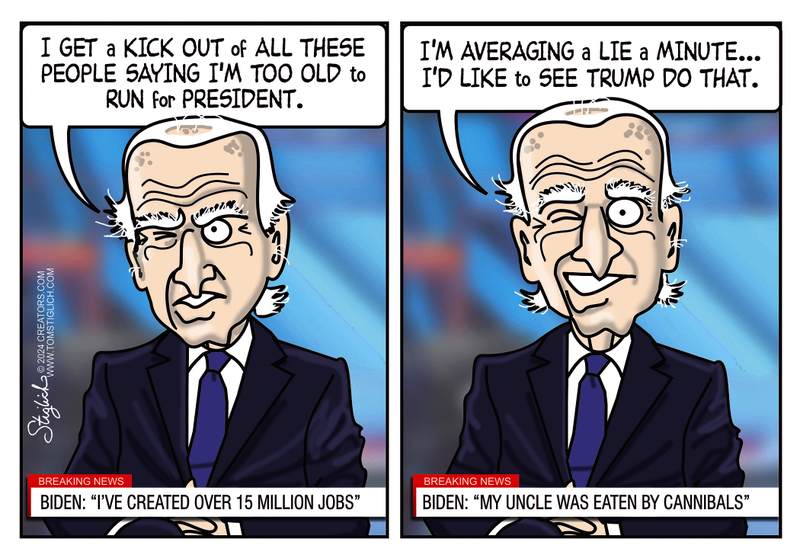
“Today’s report marks a milestone in America’s comeback,” Joe Biden bragged in March. “With today’s report of 303,000 new jobs in March, we have passed the milestone of 15 million jobs created since I took office.” Milestone or a millstone though might be a matter of opinion.

Politicians like to brag about “creating jobs” and for once it was literally true.

Of those 300,000 jobs, 71,000 or 1 in 4 were government jobs. Another 72,000 jobs came out of the healthcare industry which is heavily government funded. And 9,000 came from “employment in social assistance” or welfare. About 1 in 2 of Biden’s jobs were funded by taxpayers in one form or another. The only non-government industry showing significant job growth was the hospitality industry which was prepping temporary employment for vacation season.

An even more absurd story of government job growth came out of New York City where city officials boasted of having recovered all the jobs lost during the pandemic. But a Bloomberg article revealed that “virtually all of the jobs added in the 12 months ended in March were in home health care, a low-paying but rapidly swelling field. It’s technically classified as private employment, but home health care is actually paid for primarily through publicly funded health programs like Medicaid.” Meanwhile actual private sector jobs were vanishing in New York.

“It’s giving us this sense that our economy is growing when in fact it’s really just Medicaid that’s growing,” Bill Hammond, a senior fellow for health policy at the Empire Center for Public Policy, pointed out.

While the Education and Health and the Government job sectors boomed in New York, mostly everything else was contracting or struggling.

And it’s not just New York City.


The Bureau of Labor Statistics report for the nation in April noted 175,000 new jobs of which the majority, 95,000, were in Private Education and Health Services. This was once again the only category that showed any significant growth.

The BLS’s Occupational Outlook Handbook estimated a massive 804,000 increase in Home Health and Personal Care Aides that far outweighed any other job categories. Around 1.4 million of its projected new jobs were in the healthcare arena far outweighing any other group like construction (61,000) or accountants (67,400).

While America’s population is aging, everyone didn’t suddenly get much older and sicker in a matter of a few years, but we have been spending a whole lot more money on healthcare.

One of the disastrous COVID-19 boondoggles was the Families First Coronavirus Response Act which forced states to keep everyone on Medicaid. And as a result, Medicaid enrollment has gone on rising each year by sizable numbers with no definitive decline in enrollment until 2024. The move wiped out all of the Republican congressional reforms during the Obama era and the sharp decline in enrollment under Trump.

The latest New York State budget spends $100 billion on Medicaid. In a state with a population of 19 million, 7.6 million or 40% are on Medicaid.

How did New York City create its massive jobs boom in the “home health industry”?

The answer, discovered by Bloomberg, is that the city began paying family members to take care of Medicaid recipients while treating them as “private sector” workers. The number of people being listed as workers because they provided some care for family members shot up from less than 20,000 in 2016 to 247,538 in 2023. The cost to taxpayers for this program rose to $9 billion and federal funding of New York’s Medicaid program comes out to $66 billion.

The added advantage is that the government was creating jobs without creating any new jobs. It had simply begun paying people for what they were doing already while taking all the credit.

The Biden administration’s Centers for Medicare & Medicaid Services had begun aggressively promoting an expansion in home health care workers last year and it’s paying off. Last year, HHS Secretary Xavier Becerra boasted of having handed out $37 billion from the badly misnamed ‘American Rescue Plan’ for home based services and enhanced Medicaid funding.

Democrat states took advantage of COVID measures and Biden funding to increase their workforces. The home health care workforce more than doubled in Illinois, increased vastly in California, and Wisconsin used pandemic funding to expand its home health care program.

Health care spending and other forms of welfare are a vital part of Biden’s fake jobs boom.

Front Page Investigates (FCI) revealed earlier this year that 10% of new January jobs had come from “employment in social assistance”. The current BLS report shows that “employment in social assistance increased by 31,000 in April” out of a total of 175,000 jobs.

Employment in social assistance has been gaining an average of 22,000 jobs a month.

Along with health care, welfare continues to be the leading source of Biden’s job growth. These are not the signs of a healthy economy, but a faltering socialist economy faking its job growth.

Rather than creating private sector jobs, Biden and the Democrats are creating government funded private sector jobs some of which, like those in New York City, are not even jobs at all.

By boosting Medicaid spending and other forms of welfare assistance, Biden and the Democrats faked a jobs boom and an economic expansion that doesn’t actually exist.


With total Medicaid spending of over $800 billion and overall welfare spending that is too vast to even capture, the Biden administration, along with state and city governments, took us deep into debt to manufacture a recovery without actually doing anything more than padding out the union and welfare rolls that provide them with their voting base.

And it’s not an original idea. Health care employment has risen at a far more dramatic rate than regular employment since the Clinton administration. Health care employment increased 100% since 1990 while other forms of employment have struggled to reach 40%. And where other jobs have not recovered, health care continues to grow. 10% of all jobs are now in the health care sector. And while health care is a necessary service, much of that job increase has been ‘padded out’ by union mandated jobs that don’t actually provide vital and needful services.

The Biden administration’s formula for job gains is government spending. But government spending provides nothing but a temporary boost in the market-based private sector. However creating entitlements and boosting union rolls does create jobs. Unfortunately those jobs tend to be a net loss and a severe drain on the economy. That is what Biden and New York did.

And we’re all paying the price.


Rather than rebuilding a healthy economy, Biden and the Democrats built a health care economy. Instead of creating manufacturing jobs, they manufactured jobs. And so we’re stuck in recession with persistent inflation and the only thing that’s actually booming is the explosive rate of government spending on propping up a fake economy that only benefits the government.


Daniel Greenfield is a Shillman Journalism Fellow at the David Horowitz Freedom Center. This article previously appeared at the Center's Front Page Magazine. Click here to subscribe to my articles. And click here to support my work with a donation.

Friday, May 24, 2024

Bidenomics and Credit Card Debt

You can vote your way into socialism, but you have to shoot your way out.

By Robin Itzler

Editor's Note:  This is one of the commentaries selected from Robin's weekly newsletter Patriot Neighbors. Any cartoons appearing will have been added by me.  If you wish to get the full edition,  E-mail her at PatriotNeighbors@yahoo.com to get on her list, it's free.  RK


Getting the truth about Joe Biden’s economy from Joe Biden is like spitting into the wind and expecting to avoid getting wet.  It will not be heard from by Joe Biden, he and the Democrats spin, twist, distort, and obfuscate in order to give the impression everything is just dandy, he's created "new" jobs, as  Sen. Rick Scott shows is simply another lie.  

With Joe Biden eating ice cream in the Oval Office, anyone who wants to purchase a house in 2024 will spend one-third to one-half MORE on their monthly mortgage payment compared to what they would have spent when Donald Trump was in the White House. Interest rates on 30-year fixed-rate mortgages are now between 7 and 7.5 percent. In 2020, 30-year-fixed rate mortgages averaged 3.38 percent, according to Bankrate data.

$500,000 home at 7.5 percent = $3,496 monthly mortgage.

$500,000 home at 3.3 Percent = $2,190 monthly mortgage.

What are Americans to do?

Charge everything! Use plastic money! According to Lending Tree, the average credit card interest rate is a huge 24.66 percent. Thanks to Joe Biden and Democrat policies, credit card debt is soaring. According to a survey by Scholaroo, a national firm that matches college students with potential scholarships, the U.S. national average for credit card debt is a whopping $6,555.

New Jersey: has a massive average credit card debt of $8,155.

Mississippi: is the lowest with a still very high $5,295.

Do you think people with this large amount of debt are paying just the monthly minimum?  

GUESS!  500,000 disappeared in America?  

Half a million—that’s an alarmingly large number and yet the Biden administration doesn’t seem to care that 500,000 are gone. Kaput! No más! Farewell! No matter how much we look, these 500,000 might be gone forever. 

So then, what disappeared? 

Full-time jobs are disappearing When the Bureau of Labor Statistics announces its monthly jobs report, it includes ALL jobs—both part-time and full-time. However, over the past year 500,000 FULL-TIME jobs have disappeared. The jobs growth the Biden administration keeps touting is from part-time positions. The jobs report is a game that sadly deceives most Americans. 

 “Well That Didn’t Work”.  How's that for a title to a book about communism?


Thursday, April 18, 2024

Government Plays With Jobs Numbers

By Robin Itzler, From Her Patriots Neighbors Newsletter

Editor's Note:  This is a selected commentary from Robin's weekly newsletter Patriot Neighbors. Cartoons may  be added by me, if you wish to get the full edition,  E-mail her at PatriotNeighbors@yahoo.com to get on her list, it's free.  RK

No matter which party is in power, Deep State bureaucracies that run our federal government consistently gaslights the American public. 

Hey, didn’t you write this last week about the inflation numbers?

Speaking of inflation … the Consumer Price Index ROSE in March to 3.5 percent. FOURTH MONTH IN A ROW INCREASE. Thank you, Joe Biden! 

Government gaslighting holds true for the monthly jobs report released by the U.S. Bureau of Labor Statistics (BLS). According to BLS, in March, the U.S. economy added 303,000 jobs and left the unemployment rate at 3.8 percent.

Yeah, right. Does this feel like a healthy economy to you?

Of the 303,000 March jobs, 72,000 were healthcare related (i.e., businesses that are connected to the government, i.e., Medicare, Medicaid, Obamacare, etc.). Of the 303,000 March jobs, 71,000 were added in government.

  • The majority of new jobs are part-time.
  • For the 12 months ended March 2024, more than 650,000 native-born Americans lost their jobs. 
  • For the 12 months ended March 2024, more than 1 million foreign-born workers got jobs. The labor force participation rate has held steady and in March at 62.7 percent. 

Using BLS’ own statistics, that means there are fewer people working now than before the COVID-19 “scamdemic.” 

The BLS monthly jobs report is meaningless and should be placed at the bottom of a bird cage! Eleven out of 12 monthly reports in 2023 were revised down several months after Joey paraded to the podium to talk about the great jobs report. (Maybe they promised him ice cream afterwards.) 

This trend continues into 2024! 
  • February’s job report was revised down by 5,000.
  • January’s job report was revised down by an astounding 124,000.
  • December’s job report was revised down by 43,000.  

How many people in the private sector could continually give their CEO an important report and come back month after month with revisions?  

Of course the propaganda media insists that's all a huge Bidennomic success story.  Well, if you like that "success" story, here are 11 more Bidenomic "success" stories.

Bidenomic "Success" Stories

The executive coaching firm Challenger, Gray & Christmas released a report that employers in the U.S. announced 90,309 job cuts in March. This was a 7 percent INCREASE in job cuts from February. That is the highest monthly total since January 2023, when there were 102,943 cuts.

President and CEO of Job Creators Network Alfredo Ortiz said of the March jobs report:

"Looking under the hood of today's jobs report shows it isn't the home run that Democrats and the media claim. Approximately, half of all jobs created last month came in unproductive government or quasi-government healthcare sectors. Full-time jobs continue to decline, while part-time jobs are on the rise. The Main Street labor market is far weaker than the topline numbers or the conditions on Wall Street or K Street suggest."

Corn Pop disagrees and says that is a lot of malarkey. Let’s look at some recent Bidenomics successes:

  1.  99-Cents Only Store (discount retailer) – Began liquidating and shutting all its 371 stores on April 5.
  2.  Aludyne (lightweight solutions) – The Georgia company is letting 193 employees (8 percent) go of its 2,300-employee workforce.
  3.  Apple (technology) – Included in its state filing that it will be laying off 614 workers in California. The affected employees worked at eight different facilities in Santa Clara.
  4.  Bloomer Chocolate Company (food) – By the end of May, will be closing its factory in Chicago’s Fulton River District, which puts 226 people out of a job.
  5.  Lands’ End (retail) – Has laid off 10 percent of its corporate staff.
  6.  Lidl (grocery store chain) – Plans to layoff about 200 corporate level employees.
  7.  Quaker Oats (food) – The Chicago-based unit of Pepsico since 2001, opened its Danville, Illinois plant in 1969. The company announced the plant would be closing, which means 500+ jobs will be gone.
  8.  ShipMonk (eCommerce) – Will lay off 148 of its 600 workers (25 percent reduction) by June 30.
  9.  Student Transportation of America (transportation for public and private schools) – The Florida headquartered company has about 5,000 staffers and will say goodbye to 225 of them.
  10.  Transunion (credit reporting) – Recently reduced its staff by 640 jobs.
  11.  Unilver (consumer goods) – Will be laying off 7,500 workers worldwide.
Read my article,  “99 Reasons I’m in Mourning” about the 99-Cents-Only Store closure."


Wednesday, March 27, 2024

Democrats, Republicans, and Job Creation

March 22, 2024 by Dan Mitchell @ International Liberty

About 12 years ago, there was a controversial claim (based in part on some of my analysis) that Obama was the most fiscally conservative president of the 1980-2012 period, which includes Reagan.

I crunched the numbers to show where that claim was true and where it was false (main takeaway: Obama was not as bad as some people thought, but Reagan easily was the most fiscally prudent president).

Today, I’m going to do something similar by looking at a controversial claim about job creation.

But let’s first familiarize ourselves with some data from the Bureau of Labor Statistics.

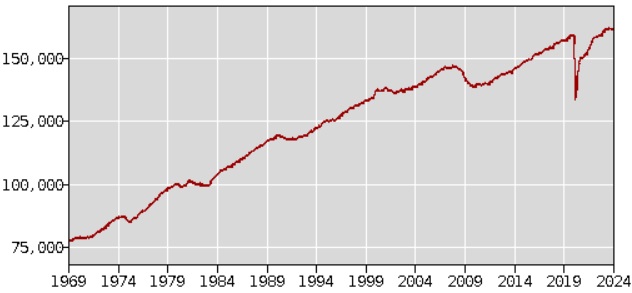
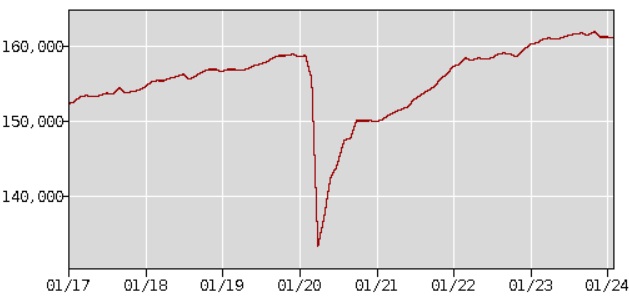
First, here is total civilian employment from 1969 to the present. As you can see, there’s an upward trend line, with occasional blips associated with recessions (if we wanted to be super-rigorous, we would adjust for factors such as size of the labor force and size of the working-age population, but let’s keep things simple).

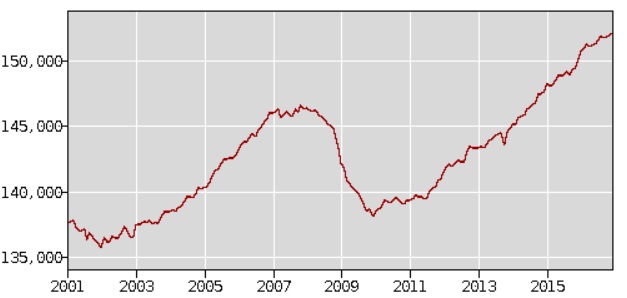
Second, let’s zoom in on the Bush-Obama years. The most notable thing about this chart was the big loss of jobs because of the financial crisis, followed by a slow recovery.

Third, let’s zoom in on the Trump-Biden years. What stands out in this chart is the massive loss of jobs during the pandemic, followed by an initially rapid recovery and then stumbling progress.

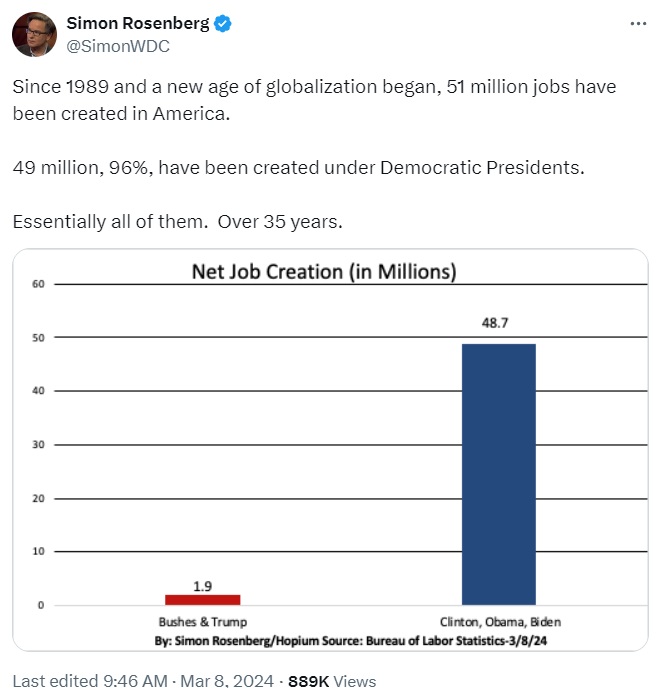
Having absorbed this background information, now let’s look at the new controversial claim.  Simon Rosenberg tweeted earlier this month that almost all jobs in recent decades have been created when Democrats were in the White House.

This certainly seems like a damning indictment of Republicans, but is it true?

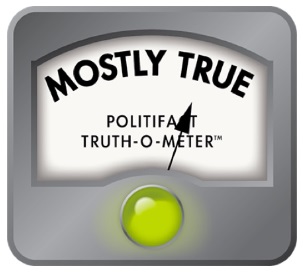
Lou Jacobsen of Politifact says yes, but with some qualifications.


Are Democratic presidents better at creating jobs and driving the economy? …We caught the latest iteration on X, in a post by Simon Rosenberg, a longtime Democratic strategist in Washington, D.C. …The talking point…has merit. But it ignores caveats around divided governance and lucky timing. …

What is the catch? Attributing job creation to policies or presidents isn’t as clear as it might seem. The Republican Congress of 1995 to 2001 might deserve a share of the credit for the job growth under Clinton… In crises especially, the parties have historically worked together. When faced with the 2008 financial crisis and the coronavirus pandemic, George W. Bush and Trump “chose the policy responses that Democrats favored,” said Dan Mitchell, a libertarian economist. …

Also, Rosenberg chose a favorable time frame for Democrats. …Job creation under each president also depends on luck. …In one recent example, the number of jobs created under Trump would have been higher had a once-in-a-century pandemic not hit during his fourth year in office.

I appreciate that Lou gave me the chance to add one of my comments to his analysis.

But I want to elaborate. Here’s everything I sent to him as part of our email exchange.

Very convenient to start after the Reagan years. Setting aside that laughable example of cherry-picking, Rosenberg’s number is largely driven by the financial crisis at the end of the George W. Bush years and the COVID crisis at the end of the Trump years. A partisan Democrat could argue “so what?”

The net result, after all, was big job losses at the end of the Bush and Trump years. As a libertarian wonk, I don’t have to worry about blindly supporting one side or the other. Instead, I’ll simply point out that Bush and Trump chose the policy responses (bailouts/spending and shutdowns/spending, respectively) that Democrats favored. The real lesson to be learned is that good policies create jobs and bad policies reduce jobs, and it doesn’t matter whether there is an R or D after a politician’s name.

And I concluded by sharing a link to this column, which expands on my point about policy being the most important variable, not partisan affiliation.

The bottom line is that any analysis based on party affiliation will be senseless because we had one pro-market Republican (Reagan, who conveniently wasn’t even included in Rosenberg’s analysis) and lots of mediocre-to-bad Republicans (Bush I, Bush II, and Trump).

Likewise, there was one reasonably good Democrat (Clinton) while the others (Obama and Biden) were statist.

In other words, the recipe for growth and prosperity applies regardless of which political party holds power.

Thursday, February 8, 2024

1 Out of 5 ‘New Jobs’ in Biden’s Booming Economy are Government Jobs

The labor market added 2.9 million jobs over the last 12 months. Of those 601,000 were government jobs. 

By @ Sultan Knish Blog

The good news is that when they lose their jobs, mainstream media reporters won’t have to “learn to code”. They’ll be able to find work in the booming “social assistance” sector, providing welfare to illegal aliens, and as long as Biden keeps the border open, they’ll have plenty to do.That’s a question no one in the media is allowed to ask. Instead reporters write headlines that defy not only the experiences of most Americans, but their own experiences, while wondering why most of the country lacks their irrational faith in Bidenomics and the “economic boom”.The Biden economy is booming. And if you don’t believe that, just ask the media which responded to the latest job reports with headlines worthy of a North Korean newspaper editor being asked to describe Kim Jong-Un’s birthday party while a gun is pointed at his head.

“Another shockingly good jobs report shows America’s economy is booming,” CNN cheered. “New report points to blockbuster U.S. job growth as 2024 begins,” MSNBC claimed. And Politico found faith in a semi-senile president with its headline, “Biden’s ‘holy grail’ economy.”

The media all agreed that this “booming economy” could turn around the presidential election. But there was a problem.. Why, the media wondered, didn’t the public believe in Bidenomics?


“Why isn’t the growing economy helping public perception of Biden?” CNN asked. “It’s Crazy That the Booming Economy Is Hurting Biden,” New York Magazine complained. “Why Americans Don’t Give Biden Credit for Strong Economy,” the Voice of America, which is funded by taxpayers and shouldn’t be pushing political propaganda at home, pontificated.

Why doesn’t the public believe in this “booming economy” where, as Axios, in a fit of feverish enthusiasm, proclaimed, “the labor market is hot, hot, hot”? Because it’s not real.

The Wall Street Journal pointed out that the unemployment rate is now actually higher than it was a year ago and the labor force participation rate is only up 0.1%. That’s not what a booming economy or labor market looks like. But if there isn’t a booming labor market, where are all those jobs actually coming from? The media could tell you if it had any ethics, integrity or the ability to actually read the reports it’s writing about instead of typing a prompt into ChatGPT.

The Bureau of Labor Statistics jobs report is revealing. And what it reveals is that the “booming economy” is the Biden administration’s attempt to create a perpetual motion economic machine.

The labor market officially added 2.9 million jobs over the last 12 months. In those last 12 months, an analysis by Will Kessler of DCNF noted, 601,000 government jobs were added.

That’s 20% or 1 in 5.

When a fifth of “new jobs” are actually government jobs, that’s not a labor market, it’s a government market. Government jobs not only don’t make the economy “boom”, they shrink it.

Each government job has to be paid for by at least several real jobs. And since these new jobs are being paid for by government borrowing at extortionate interest rates, these jobs are actually significantly increasing the national debt, and they require a whole lot more workers and businesses making money in order to even service the interest on the coming $7 trillion budget.

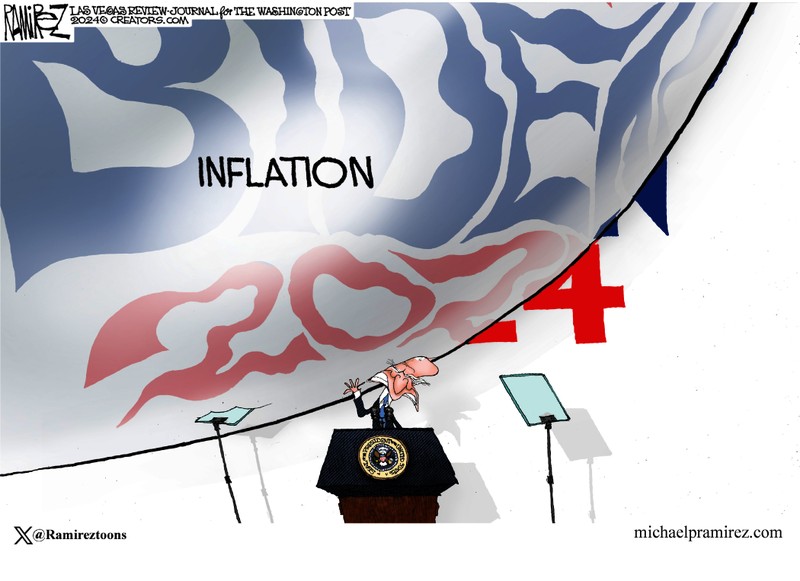
Biden’s booming economy and hot labor market is driven by creating more government jobs through inflationary spending that drives up food and goods prices, that have to be compensated for with higher Fed interest rates that kill the housing market and business growth, and that pile into a massive national debt in which every American currently owes $100,696 and $257,275 per household.

Bideonomics keeps raising prices and killing business growth, triggering bankruptcies and family hunger, to be able to add more government jobs to boost its “hot, hot, hot labor market.”

The new jobs report reveals the ugly truth about what jobs under Bidenomics look like.

The Bureau of Labor Statistics report showed that 353,000 jobs were added in January. That’s the good news that had the media hyping the glory of Bidenomics.

70,000 of those jobs (or 19%) came out of health care and 30,000 (or 10%) came from “employment in social assistance”.

When 10% of your job growth is coming from the welfare state, that’s not a sign of a “booming economy” or a “hot, hot, hot labor market.”

Why was there such a sudden boom in welfare jobs?

Apart from massive government spending, Biden’s open borders crisis flooded cities and communities with massive numbers of illegal aliens who needed everything provided for them including housing, food, education, counseling, medical care and the workers to dispense those.

Likely a significant portion of that 10% welfare job growth came from servicing illegal aliens.

And the news about the “hot, hot, hot” jobs report somehow manages to get even worse.

Government employment added 36,000 (or 10%) of the jobs in January. This is below the 57,000 average of government jobs that have been added in the previous months. That’s why government jobs made up 20% of the overall job growth in the last twelve months.

The social welfare jobs are really government jobs as are a lot of the health care jobs which are heavily funded by taxpayers and together they amount to around 40% of the January job gains.

The majority of industries, including construction, wholesale, transportation, leisure, and financial activities, showed little change. Retail increased jobs but the sector has “shown little net growth since early 2023.” And, despite the manufacturing hype, “manufacturing experienced little net job growth in 2023,” the BLS report noted.

Oil, gas and mining, industries under perpetual attack by the Biden administration, lost jobs.

Of the few non-government job growth areas, professional and business services were doing well. This appears to be the only non-government subsidized industry still thriving.

The only other industry doing well was Hollywood which is still burning a fortune in shareholder cash to create a thousand streaming woke shows and movies so that “employment in motion picture and sound recording industries increased by 12,000”: as the BLS report noted.

Hollywood and creative industries are however heavily subsidized by tax credits.

Why isn’t the public in love with this “hot, hot, hot job market”? Because it mainly benefits a thin slice of the upscale urban and suburban voters who are voting for Biden anyway.

The appearance of booming job growth is fed by the widespread employment of illegal alien invaders in various ‘dirty jobs’, often unreported, while sizable numbers of Americans continue to drop out of the economy. The labor force participation rate still isn’t back to where it was in 2019 and even the raw percentages hide the fact that many American workers have dropped out and were replaced by Venezuelan 16-year-olds working on assembly lines in cereal plants.

In this century we’ve seen a slow decline year by year from the peak labor force participation rate achieved as a result of Reaganomics. Bidenomics demands credit for raising the labor force participation rate a whopping 1% from record pandemic lows when the economy had been artificially shut down. But the job gains of Bidenomics have been artificially goosed by a mass creation of government jobs which further drags down the economy and piles on more debt.

Bidenomics is when a hot January jobs report announces that 10% of job growth is in welfare.

The media complains that Americans are paying attention to their own experiences instead of the headlines. Unlike most Americans, the media is cheerfully ignoring the reality around it.

20,000 media jobs alone were lost in 2023. Amid record layoffs and an industry collapse so severe that the Washington Post recently featured an op-ed warning that the media should prepare to transition to a nonprofit model (something I spent years warning was coming), the few media hacks still on the job are cheering Bideonomics as they wait to lose their jobs.

If the economy is booming and there’s a hot labor market, why can’t reporters find work?

Daniel Greenfield is a Shillman Journalism Fellow at the David Horowitz Freedom Center. This article previously appeared at the Center's Front Page Magazine. Click here to subscribe to my articles. And click here to support my work with a donation.  Thank you for reading. 

Monday, February 5, 2024

Jobs, Economics, and the Crises Facing America

When only the spenders get to decide on funding, and the funders have no say on spending, then spending will never be curtailed, funding will grow unendingly, and government will continue to be a ravenous beast until freedom's crushed.

By Rich Kozlovich

Recently we've seen claims about how recently over 353,000 jobs were created in America, and in this Breitbart article by Rebecca Mansour, "Carney on ‘Kudlow’: The Jobs Numbers Are Real and Not Just Government Workers, they go over the stats saying:

The surprisingly strong January jobs report reflects real employment and productivity growth and not just growth in government or government-adjacent hiring, Breitbart Economics Editor John Carney explained during a Friday interview with Fox Business host Larry Kudlow..............These jobs numbers are not only “real” but also “picking up steam,” Kudlow observed.....

While that may be true you really should be asking:  So what, and is there more to this story?

Dan Mitchell who posts on his International Liberty web site published this piece, which he allowed me to publish, The Washington Post Grades Biden’s Economy on a Curve saying:

https://danieljmitchell.files.wordpress.com/2012/08/mediadogs.jpg

I rarely comment about media bias, but sometimes there is an example that demands attention.  For today’s column, I want to examine a four-question quiz on the Biden economy put together by the Washington Post. The first indication of bias is that every answer was the one that made Biden look good (or less bad). Sort of like a quiz asking if communists killed 1 billion people, 500 million people, or 100 million. The fact that the right answer is that they “only” killed 100 million is hardly a ringing endorsement of Marx’s evil ideology.  But another problem is that some of the questions also were steroid-fueled examples of grading on a curve. For instance, based on Question #1, we’re supposed to be impressed that the United States has grown faster than Europe’s decrepit welfare states...............Biden should have spectacular job numbers, if only because the pandemic meant there were still millions of missing jobs when he took office. p>

He went on to say:

The Post obviously wants readers to conclude that Biden deserves good marks for the economy. The fact that the paper had to engage in contortions tells you what you really need to know: 

Bidenomics is unpopular for the simple reason that prices have been rising faster than incomes have been rising. And when people are sinking – or even if they are treading water – that is a recipe for dissatisfaction. Yet people like Paul Krugman claim that there is a “Biden boom.”

Okay, so a lot of jobs were created, and America is ahead internationally of all these abject losers, and again I ask:  So what?  Especially since there really does seem to be more to this story that's not being addressed by Kudlow and company.  Why hasn't this boon impacted "one small upstate New York town that epitomizes that feeling is Fulton, N.Y.?  Over the years they lost jobs created by:
 
"companies such as Nestle, Miller brewery, Sealright packaging company, Birds Eye, Hunter Arms, and backbone industries of yesteryear like paper plants and woolen mills. Today, however, the city is a burnt-out shell of its former self."  
 
That's what's happening in America.  And all the policies being put in place are making this worse, not better.  So, going back to all these new jobs the administration touts:  Are these full-time jobs or part time jobs?  This article, Full-Time Work Is Being Replaced by Part-Time Jobs as Americans and Businesses Struggle, seems to indicate many of these jobs are not full time, but in reality part time saying:
 
Since June 2023, Americans have been increasingly employed in part-time positions, with a subsequent decline in full-time work, according to data from the Bureau of Labor Statistics (BLS). The number of Americans working part-time in January grew by 96,000 compared to the previous month, while full-time employment sank by 63,000, according to the BLS.....The number of part-time positions has grown from 26,248,000 in June 2023 to 27,890,000.....Over that same time period, the number of workers employed full-time also dropped by over 1.6 million, from 134,787,000 to 133,133......Wherever possible, businesses are eliminating full-time jobs and replacing them with part-time jobs to reduce costs"...........

Like Dan Mitchell, there's a reality I find compelling.  I recently took my family out to dinner to a sushi joint, and we had a great meal, but it was just under $300 dollars, for six people. This wasn't high end dining, it was just a sushi joint.  A good one, but still a sushi joint, almost $300 dollars. Whether of not I can afford it is immaterial.  What we need to ask is this: Is that really good value?  

An Egg McMuffin meal at McDonalds in my town in Northern Ohio, with a cup of coffee and a hash brown is now $10.75, for one person.  For a family of six that would translate to just under $65 dollars. And in other areas it can be substantially higher, and based on the price of an Egg Muffing in a town in Connecticut, it could be a little over 25% higher, making it around $80 for a family of six, that makes my price a bargain by comparison.  But that's no bargain for a breakfast at McDonalds, or any other restaurant!  And that's not the most expensive McDonalds breakfast meal!  

I don't blame the restaurants for what they're charging, they're stuck between a rock and a hard place and have no choice, but we still need to recognize reality, value, and the see the long picture. 

Now, those prices are the reality people are concerned about, and these schemes to make it appear Joe Biden is just doing a bang up job for America is nothing but collusion between a corrupt and clueless media and the Biden administration creating an Alice in the looking glass world, attempting to cover over issues that impact the nation not only economically, but socially, and culturally.  At the national and international level.

We're watching unchecked mass illegal immigration and irrational geopolitical decisions impacting our economy and the very foundational Constitutional structures that created America. And the consequences of those actions are piling up explosively.

Here's reality:  We are in a depression and do not even know it.  The media talking heads, most of whom are dumb as dirt, along with the nutrolls in the Congress and administration keep trying to paper over that reality, but, we're dealing with massive national debt, unchecked spending, unchecked borrowing, and constant inflation, and any talk inflation is under control is a lie. 

According to the Bureau of Labor Statistics (BLS), the Consumer Price Index (CPI) for 2023 was 3.4% year over year.  Not horrible.  But do not forget that 6.5% occurred in 2022, and 7% in 2021.  That is a total of 16.9% in three years.  You are paying at least 17% more than at the start of this decade.  Regardless of what the BLS would like you to believe, prior year inflation does not go back to zero with the beginning of each new year. BLS uses a sampling approach to determine the CPI.  This does not work well with large, infrequent purchases such as home mortgages.  You cannot replace these purchases any time you feel like it.  During the two years following 2020, interest on home mortgages doubled.  So if you are a first-time buyer in 2024, you will be paying 100% more in interest than your next-door neighbor, who purchased 20 months earlier.  So how does BLS determine the CPI for “long-term purchases”?

All of which has been caused by government policies and mandates, and once inflation hits a certain level, it takes years to overcome the impact of those high inflation years.  Spending and borrowing are out of control, and we're now the FED is printing money with no value behind it, which the government is spending faster than the FED can create it.  

The day is coming when all this will come to a head, a destructive head, and we won't have to worry about the cost of an Egg McMuffin, because there won't be any McDonalds left to sell them, as America turns into a third world hole.  Please don't tell me that can't happen in America.  It's already happening in each and every one of America's major cities.  

Now, please tell me which party do you think is in charge in these cities?  Please tell me why you have complete confidence they can fix it.  Please tell me you're not on drugs.   

Hello America, welcome to San Francisco!

Friday, September 29, 2023

Flying the Coop – Research Finds More Young People Living at Home

The rent is too high to live on your own! 

 By Andrew Moran September 28, 2023 @ Liberty Nation News

Back in the day, the goal for many young people was to leave the nest and live on their own. They could spoil their appetites by eating chocolate chip cookies before dinner, stay up late watching television, and leave their beds untidy. Today, because the cost of living is spiraling out of control, the sweet birds of youth are staying in the coop or moving back home with mom and dad, new research has found. While this ubiquitous development might be the subject of scorn, can anyone blame Generation Zers and millennials for living at home in their room upstairs surrounded by posters of Britney Spears and the Back Street Boys?

Bidenomics 101: Living at Home

According to a new Harris Poll-Bloomberg News survey, half of young adults are still living at home with their parents. Most do not want to be shamed for the transition back, as close to 90% of polling respondents stated that their peers should not be judged for this setback. Roughly three-quarters of participants noted that the decision was mainly financial. They stated that the driving factors were saving money, taking care of older family members, being unable to live independently, helping out with family expenses, and setting aside money for a down payment.

Can Anyone Blame Them?

Sure, it is easy to poke fun at the current generation of kidults who choose to work remotely on a bed of plushies in their Power Rangers pajamas. But the reality is that the economic situation is broken for millions. Price inflation and the overall cost of living are the primary reasons for many of these unique trends. Let’s take a peek at four components that impact young people the most: food, transportation, shelter, and student loans.

Food inflation has skyrocketed in recent years, with supermarket prices still 3% higher than they were a year ago. Within the Bureau of Labor Statistics consumer price index (CPI), many items remain elevated or have reaccelerated their upward trend, from chicken (+1.3%) to potatoes (+0.6%). Outside of the CPI, shoppers are witnessing massive jumps in a basket of goods: olive oil, orange juice, and avocados.

As crude oil prices march toward the critical $100 threshold, the pain at the pump is being felt by motorists, including young folks who might already be paying an arm and a leg for their clunker. The national average for a gallon of gasoline is close to $4. This impacts standard transportation services, a CPI category that has spiked 10.3% year-over-year and risen 2% month-over-month. In addition, a McDonald’s cashier has seen his or her public transportation costs jump by 3.9%, while TikTok influencers have seen their airline fares climb by nearly 5%.

Median national rent prices stood at $2,052 in August, just $2 short of last year’s record high of $2,054. Even if young people had the means to purchase a residential property, the median mortgage payment was $2,161 in July. Across the country, shelter costs have swelled considerably; the index is up at an annualized basis of 7.3%. The good news? There has been an apartment construction boom since the onset of the public health crisis. The bad news? New builds are expected to dry up soon because of ballooning borrowing costs and surging input costs, be it labor or raw materials.

After a more than three-year COVID-related pause, student loan payments will begin again in October. In total, student loan debt is about $1.57 trillion. This massive red ink might have been serviceable before the coronavirus pandemic, but now that interest rates are at their highest levels in more than two decades, college and university graduates will find it harder to keep their heads above water.

Just Get a Good Job, Bro

But some may counter that young people living at home can get a good job. Indeed, labor conditions are tight, and nominal wage growth has been terrific. The chief challenge is that the job market is easing amid a slowing economy and rising interest rates. The other problem is that real (inflation-adjusted) wages are down 3% since 2021. So, obtaining a worthwhile employment opportunity is one ring on the ladder to success. When paychecks do not stretch very far and purchasing power is eroded daily, millions might feel financially insecure and apprehensive to wave goodbye to mom and dad and rent an overpriced apartment that may have cockroaches, zero sunlight, and a blue-haired next-door neighbor with “Orange Man Bad” and “I’m With Her” stickers plastered on the front door.

Suffice it to say, life ain’t what it used to be.

Read More From Andrew Moran

Monday, December 13, 2021

Another Case Study Comparing the Private Sector and Government

December 11, 2021 by Dan Mitchell @ International Liberty

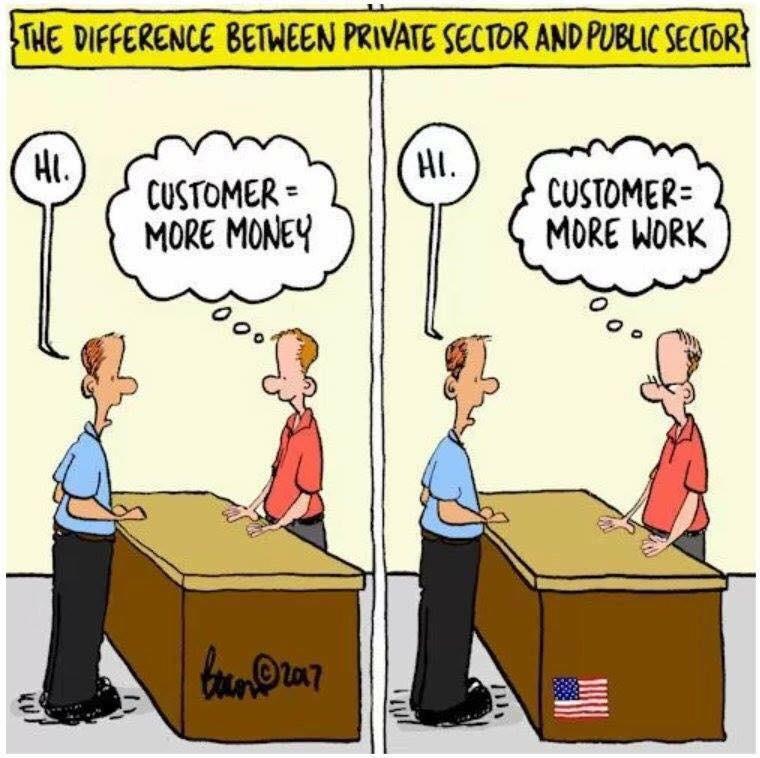
I periodically look at issues (social security, education, infrastructure, TSA, etc) to compare the private sector and the public sector. This new video from John Stossel gives us another example. 

The video reminds us that incentives matter.  Normally, the private sector does a better job then government because of competition. More specifically, profit-seeking companies fight for our dollars by offering goods and services based on quality and/or price.


But even when competition isn’t a big factor – such as the operation of a park, we can see how the private sector produces superior outcomes. The surrounding businesses benefit if there is a clean and safe park. So when they actually got the authority to run the park, they put in place effective policies.  People in government are not opposed to clean and safe parks, of course, but they often make decisions on the basis of political factors (rewarding certain contractors, providing patronage jobs, etc).  The net result is that government involvement is a bad recipe for higher costs and poor performance (click here for another example from New York City).

P.S. The superiority of the private sector is a big reason to reject industrial policy. As shown in this video, we get better results when businesses focus on attracting customers, not attracting subsidies.


Thursday, May 20, 2021

The “Evil Rich” Give Back By Creating Jobs! We Need To Get That!

https://blogger.googleusercontent.com/img/b/R29vZ2xl/AVvXsEgDdJXy3OAHLJn_MpiNbbpiEfmKMk5o52EaM_ErYTz_AQiD3zo-sQWOUuwWSVBiV4IJ3FlQV6T-I03A9NYvk-Cw_z_XUAGBaqiTjOITYXOGIJAACqAjGX9XDktXKqx-gc3w6FR9l1Ki6Us/w41-h54/My+Picture+2.jpg By Rich Kozlovich  
Editor's Note: Originally this was published on Saturday, October 27, 2012, but one thing should be abundantly clear, the thread of leftist thought is linear.  "Hate the Rich"!  No matter what the philosophical narrative of the moment may be, their underlying theme is hate, greed, envy and violence, and mostly against the producers of the nation.  We're seeing this being repeated with the Biden Administration, Antifa, BLM, and all the other leftist movements being funded by corporations, the government and even trade associations.   Ergo, I thought this was worth republishing.  RK 

An article appeared on the 26th by Daniel Halper entitled, “Over $60,000 in Welfare Spent Per Household in Poverty”. The article went on to say that; "According to the Census’s American Community Survey, the number of households with incomes below the poverty line in 2011 was 16,807,795," the Senate Budget Committee notes. "If you divide total federal and state spending by the number of households with incomes below the poverty line, the average spending per household in poverty was $61,194 in 2011."   

It further went on to say that; "If the spending on these programs were converted into cash, and distributed exclusively to the nation’s households below the poverty line, this cash amount would be over 2.5 times the federal poverty threshold for a family of four, which in 2011 was $22,350 (see table in this link).

The question I have always had when I hear this stuff about how much the nation spends on eradicating poverty I keep asking myself:  "Where in the world has all that money gone? Clearly it isn’t going to the poor.

 If when President Lyndon B. Johnson started his Great Society programs we had given every poor man, woman and child in the nation a million dollars and told them they were then on their own, it seems to me we would have saved billions. 

Let’s explore this whole problem. 

When the housing market collapsed due to the incentives created by Jimmy Carter's Community Reinvestment Act a lady, who I have known for years, told me she was going to lose her house.  I was amazed because for many years her husband had worked at a very well paying job, and they had been in the house for 27 years. Yet they still owned over $130,000, and now unfortunately her husband had lost his job permanently, and was having serious health problems that was going to keep him out of the job market.   And she wanted the government to bail her out.  

Why?  

It was time for the rich need to start giving back.

Sound familiar?  So I asked her what it was that she gave to the rich that required them to give back anything to her and how much?  Of course she touted the argument about the roads, bridges and …..... well you get the idea.  

An argument that is functionally ridiculous; after all, where did they think the money to build all that stuff came from in the first place anyway?  

The government has no money except that which they extort via taxation,  (a necessary extortion to maintain a stable society, but it is nonetheless done by force of law, making it extortion) from the people, but that is what is heard on the news from the left stream media, politicians and bureaucrats, so why wouldn’t someone in this situation jump on this bandwagon? Then I told her that “The Rich” give back constantly. She of course laughed, snorted and looked at me as if she was talking to an idiot child. 

I then asked her how much tax was taken out of her paycheck.  I then went on to outline the percentages of who pays taxes, how much they pay, and how many are paying nothing in federal income taxes at all.  Then I told her that in point of fact it is the rich that pay all the taxes!  The "Rich" pay 100% of all taxes.

She really thought I was insane at that point.

Then I asked her where that tax money came from?  None of that was her money until she received the check.  She agreed.  

I pointed out it was the owner’s money, and all the Federal, State, Local, Medicare/Medicaid and Social Security taxes paid started out as the owner’s money.  She had no money unless it was given to her from the owner of the company. Of course she worked for it, but if the owner said she was fired, then she had no money at all, because it is only her money when the owner gives it to her for labors performed. But it originated from someone else’s pocket, that nebulous reviled evil group called, "The Rich",  and that included all the taxes taken out.

Then came the old class warfare red herring about how well they live compared to the rest of us. Well….so what?  I personally could care less how big someone lives their life as long as they can pay for it. I don’t care how they got that rich as long as they didn’t steal it. I don’t care if it is worked for or it was inherited. It isn’t my business nor is it my concern what they do with their money.

In America anyone can become wealthy if they devote their lives to it and their children can reap the rewards, and should reap the rewards. It is obscene for the government to come in and steal a major part of a family’s fortune (a fortune that huge amounts of taxes had already been paid on) when the parents die due to death taxes. Those who believe this is right are morally defective.

I went on to tell her of a man who built a five million dollar home, twenty years ago, when a five million dollar home was a lot more money than it was just before the housing collapse. 

Resenting that kind of spending, she said that was the kind of thing she was talking about. I said this is the kind of give back I am talking about. 

She was clearly puzzled so I went on to ask her a series of questions: 

  • I asked her how much cement did the man pour in laying the foundation? The answer was none. 
  • How many cement blocks did he lay in building the basement? None! 
  • How many nails did he drive building the frame? None! 
  • How many sheets of dry wall did he hang? None! 
  • How much paint did he put on the walls? None! 

He hired someone to do it all! Then he filled the house with carpeting and furniture. Stuff that someone had to produce, sell, transport and deliver! 

Then after all of that was done he hired a housekeeper, a grounds keeper and an exterminator. 

He keeps giving back because he created jobs. All the giving back the “evil” and reviled “Rich” do is based on long term solutions that work. They create jobs! I told her the only thing I resent about this man is that he didn’t build ten five million dollar houses, because every penny went directly back to the community, where they spent it on houses, carpeting, dining out, going to the movies or whatever else they darned well pleased, and without any strings attached as to what they could do with it,

All this was done without going through a government that wastes untold millions on themselves and frivolous spending that had done nothing to end the poverty targeted by Johnson’s Great Society programs. If that five million had gone to the government first just how much does anyone think would have made it back to the community, and without strings?

As for my friend; how did she get into this mess?

She loved credit cards; hating making payments and the high interests so kept taking out loans on her home to pay her credit cards off. And she did it for years

For the record. I resent the government bailing out Wall Street, and General Motors. Wall Street became seriously corrupted due to the Community Reinvestment Act; but they were still chose a course of corruption nonetheless, and should have been allowed to fail and many of them should have gone to jail…including the Fanny Mae and Freddie Mac bosses along with Sen. Chris Dodd and Rep. Barney Frank. General Motors failed because it was the accumulation of years of bad decisions and they didn’t have the guts to stand up to the unions. Their failure was of their own making and should have been allowed to go through the legal bankruptcy system instead of the governments illegal solution.

Also for the record. I’m not one of the “Evil Rich”. I wouldn’t mind being one of them, but having a great deal of money and owning a lot of things never interested me. Perhaps that's a serious character flaw, but I never needed all of that to feel just as good as anyone else. I never felt wealth made the man! As long as they live honorable lives I don’t look down on people who have little, and I don’t look up to people because of their prominence in life or their income, as my friends will attest.

 I grew up in Southwest Pennsylvania, which during my youth was considered part of poverty stricken Appalachia. I always thought they were talking about all the people around us. Everyone had so little I didn't know we were poor. I used to say there was something to be said for having grown up in poverty and not knowing it. I have revised that. I now realize that I grew up in a rural mountain area where many had gardens, farms, hunted, fished, and canned their own foods, which created a general attitude of being self sufficient. That is what creates an attitude of worth in people. Self sufficiency! Knowing you can make it on your own. That is what the “Rich” give back when they create jobs. If a society can't define things properly it can't fix its problems. Perhaps we just need to reevaluate and find out who the "Evil" really are. Because it isn't the "Rich"!

Wednesday, May 12, 2021

The Upside-Down Economics of Subsidized Unemployment

May 11, 2021 by Dan Mitchell @ International Liberty 

Back in 2010, I applauded Paul Krugman for acknowledging that government unemployment benefits can encourage joblessness. And I even cited Krugman in this 2012 debate on the topic.  

We’re debating this issue again today, but it’s an even bigger problem because politicians in Washington have added a special bonus payment for people who stay unemployed.


So we’re naturally finding that people are more reluctant to work, which is a rational choice for many of them since they’re getting more money for sitting on their butts. So if Krugman recognized back in 2009 that regular-sized unemployment benefits lead to more joblessness, he must be even more worried about today’s super-sized unemployment benefits.  But there’s a catch. Krugman made his sensible observations on this issue in a textbook when he was still an academic economist, back when he felt some professional obligation to be rational and pay attention to the academic evidence and empirical research.

Today, he’s an ideologue and polemicist. So we get nonsense like this column in the New York Times.


…the Bureau of Labor Statistics announced that the U.S. economy added only 266,000 jobs in April, far short of consensus expectations that we’d gain around a million new jobs. Was this evidence that the economy really is being held back because we’re “paying people not to work”? No. For one thing, you should never make much of one month’s numbers, especially in an economy still distorted by the pandemic. …Also, if unemployment benefits were holding job growth back, you’d expect the worst performance in low-wage industries, where benefits are large relative to wages. …on the face of it the data don’t support an unemployment-benefits story. So what actually happened? We don’t know. Maybe it was a statistical aberration.

For what it’s worth, I prefer the sober-minded analysis available in editorials from the Wall Street Journal. Such as this one.

Employers nationwide have complained for months that Washington’s $300-a-week bonus has made it harder to find willing workers. Yet Mr. Biden brushed aside the complaints, saying he and his staff “don’t see much evidence” that the payments are a “major factor.” …The perverse incentive of the bonus is clear, and the evidence goes beyond the anecdotes from tens of thousands of employers. …Bank of America economist Joseph Song notes that any worker earning less than $32,000 annually would get a raise by going on unemployment… The President intended his remarks to depict his Administration as the driver of job growth instead of its main hindrance. It was a tall order. But the bright side is that his urgent appearance showed that more Americans are figuring out that when the government pays people not to work, millions choose not to.

The good news is that some governors are opting out. Here are some excerpts from a report in the Washington Post.


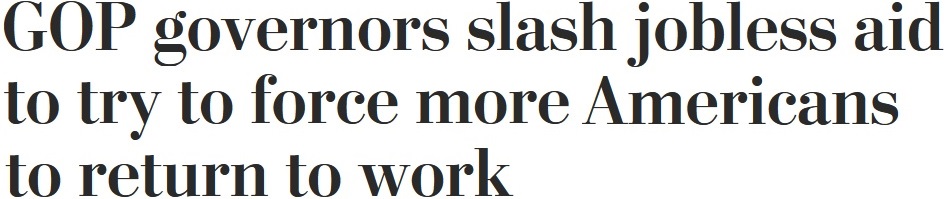
An unexpected slowdown in hiring nationwide has prompted some Republican governors to start slashing jobless benefits in their states, hoping that the loss of generous federal aid might force more people to try to return to work. …Arkansas on Friday became the latest to announce plans to cancel the extra benefits, joining Montana and South Carolina earlier in the week… Indiana Gov. Eric Holcomb signaled to local reporters that the state could soon follow suit, while Arizona Gov. Doug Ducey is considering the same.

I’m tempted to comment about the Post‘s usual bias (saying GOP governors want to “slash” when they’re simply proposing to return to regular-sized benefits).

But let’s stick to the topic.

Here’s another interview on the issue, but it’s about the current fight rather than the Obama-era fight.  


I’m especially concerned, as I noted in the interview, that bad government policy may erode the work ethic.  I’ll close with a comment about the fight we had during the Obama years. Back then, the battle revolved around extended unemployment benefits rather than turbo-charged benefits.

Republicans eventually prevailed in blocking the extended benefits. So what happened? As you might expect, there was an increase in employment.

P.S. I imagine this story from Michigan and this example from Ohio will ring a bell with many people because they have some relative or buddy who also has used government benefits as an excuse to stay unemployed.

P.P.S. Senator Rand Paul and I wrote about this issue back in 2014.

P.P.P.S. For some unintentional humor, Nancy Pelosi actually argued that the economy is stronger when people are paid not to work.