Search This Blog

De Omnibus Dubitandum - Lux Veritas

Showing posts with label Free Markets. Show all posts

Thursday, September 24, 2026

Should We Ban the Sale and Export of Diesel Fuel?

By Rich Kozlovich

It's being  reported there's about to be a trucker's rebellion/strike in America over the cost of diesel fuel, and it's skyrocketed.  Why is the cost so high?  It's because producers are happily selling diesel fuel to foreign nations, actually keeping them afloat all the while undermining national stability, and pocketing a lot of money.   

There's also a lot of talk about banning diesel fuel exports, and naturally the fight breaks out over free markets.  First, the free market isn't free, it's manipulated by nations to their own benefit, and usually at America's expense, and has been done ever since America embraced the Bretton Woods agreement to rebuild Europe after WWII.  

I read a lot of history, and one thing that comes into focus is the importance of a nation's economics when starting and/or fighting a war, and who is behind it all. I think history books clearly substantiate more wars and/or aggressive military actions have been promoted by banks and industrialists than by ideologues, and in point of fact, ideologues are the catspaws for banks and industrialists. That's how WWI erupted.

I subscribe to one particular weekly economics newsletter because he writes in ways anyone can understand, and it's been my experience that's rare when dealing with economists. It's been said that statistics is an arcane science because you can make statistics conclude anything you want them to .... reality notwithstanding.... and make the conclusion seem rational.

Economics is the same in my view. If you took the top 25 economists in the world and locked them in a room and asked them a question you'd get 25 different answers, each being more incomprehensible, complex and convoluted that the other. They spew out babble to impress other economists in my opinion, but that's not uncommon among “elite” academic types. It's the same among scientists. They all want to be “someone” among their peers and accepted in the good old boys network, and darn few of them have the courage to be the rock in the current. And those that do are punished.

It's clear America has the wherewithal to meet all it's energy needs. If that’s true, and it is, then think about this. If the nation was starving would we allow farmers to sell our food to other nations preventing Americans from starving? If not, then why would we allow oil companies to sell the energy needed to maintain the nation's economic strength to other nations? Economists, along with bankers, are as trustworthy as pollsters and industrialists are as trustworthy as Benedict Arnold.

Monday, December 6, 2021

Free Markets and the Chilean Miracle

November 24, 2021 by Dan Mitchell @ International Liberty

There are certain topics that seem to be slam-dunk wins for those who favor free markets and limited government, and one reason I make this assertion is that folks on the left don’t even bother to make counter-arguments. 

Here are just a few examples:

Prior to today, I also would have included this example:

But now I can no longer include Chile’s economic renaissance because I finally found someone who concocted an alternative explanation.

As part of a column in today’s Washington Post about Chile’s upcoming presidential election, Anthony Faiola made this claim about that nation’s economic performance.

After Pinochet’s ruthless rule came to an end in 1990, the newly democratic nation witnessed a historic period of economic growth. Gross domestic product growth between 1990 and 2018 averaged 4.7 percent annually, well above the Latin American average. Over that same period, democratic governments increased social spending. Extreme poverty (below $1.5 per day) was virtually wiped out.

But now let’s consider whether this alternative explanation is accurate.

Mr. Faiola wants readers to believe that the positive developments in Chile (“historic period of growth” and “extreme poverty…was virtually wiped out”) occurred after 1990.

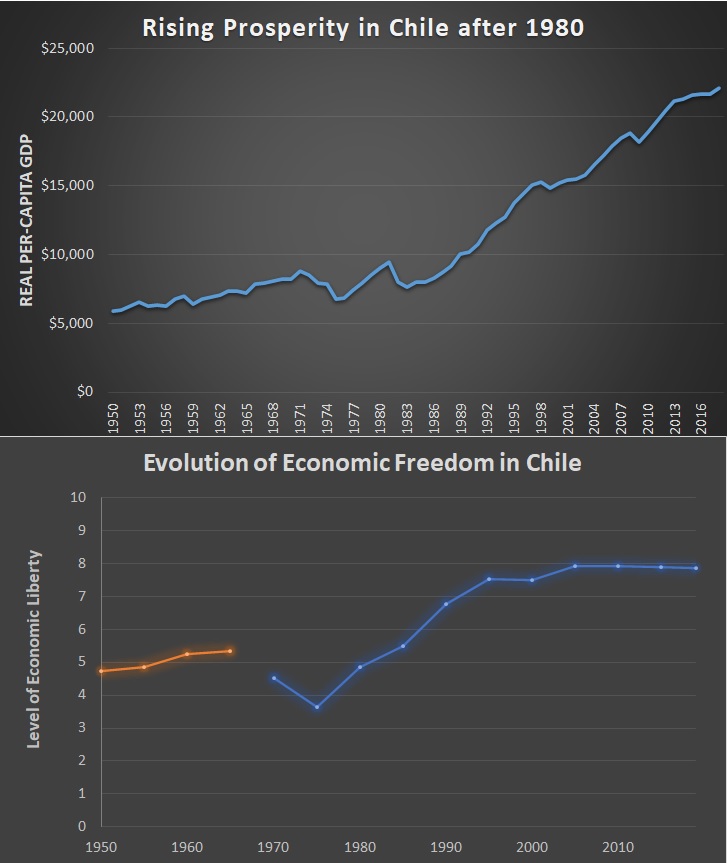
But if that’s the case, why did per-capita living standards begin to climb much earlier?

As shown by these two charts, it’s far more likely that the dramatic rise in per-capita economic performance around 1980 is the result of a big increase in economic liberty (as measured by Economic Freedom of the World) that also was occurring around that time.

(There is a separate measure of economic freedom for the years before 1970, so the orange and blue lines are discontinuous.)

One should always be careful about interpreting numbers. For instance, national economic data at a given moment in time will be affected when there are periods of global recession, such as the early 1980s and 2008.


Which is why it is important to look at longer periods of time. And when looking at decades of data for Chile, the big jump in prosperity clearly began after the economy was liberalized, not after Pinochet ceded power in 1990.

We’ll close with some bad news and good news.

The bad news, as captured by the bottom-half of the stacked charts abvoe, is that there hasn’t been much pro-market reform in recent decades.

But the good news is that Chile hasn’t deteriorated. The nation has endured some left-leaning governments, but economic freedom has remained high by world standards. Which means the economy continues to grow.

P.S. I’ll add some worrisome news. The left in Chile wants a new constitution that would give politicians more power over the economy. If that effort is successful, I fear the country will suffer Argentinian–style decline.

P.P.S. I suppose Mr. Faiola deserves some credit for cleverness. Some leftists have tried to argue Chile is a failed “neoliberal experiment.” Given the nation’s superior performance, that’s obviously an absurd strategy. So Faiola came up with a new hypothesis that acknowledges the growth, but tries to convince readers that it’s all the result of things that happened after 1990. He’s wildly wrong, but at least he tried.

P.P.P.S. I have a three-part series (here, here, and here) on how low-income people have been big winners as a result of Chile’s shift to free enterprise.

P.P.P.P.S. Here’s a column on Milton Friedman’s indirect contribution to Chilean prosperity.