That first tax had a top rate of 3.5 percent, but politicians quickly
became addicted to this new source of tax revenue. By 1984, the top
rate had jumped to 9.5 percent.
That’s the bad news.
The good news is that Ohio has been moving in the right direction over the past two decades.
The top tax rate was over 7 percent in 2005. This year, it’s less than half that level.
But the even-better news is that Ohio is shifting to a low-rate flat tax.
Here are some excerpts from a report by Mike Gaunter for WFMJ.
Ohio Gov. Mike DeWine on Monday approved the state’s new
two-year spending plan, which includes a major shift in how Ohioans pay
state income taxes. This change, pushed by Republican lawmakers, aims to
make the tax system simpler and reduce the amount of money people owe.
The thrust of the tax plan is a move towards a 2.75% flat income tax
rate…
This flat rate is set to be fully in place by the 2026 tax year.
Before the flat rate officially starts, the budget also lowers the
highest income tax rate immediately. For the 2025 tax year, the top
rate, which currently stands at 3.5%, will go down to 3.125%. A benefit
for many Ohio residents is that if their income, after certain
deductions and exemptions, is $26,050 or less, they will not pay any
state income tax at all.
While there are plenty of reasons to be depressed about public policy (particularly the growing burden of government spending), there are a few reasons to feel optimistic.
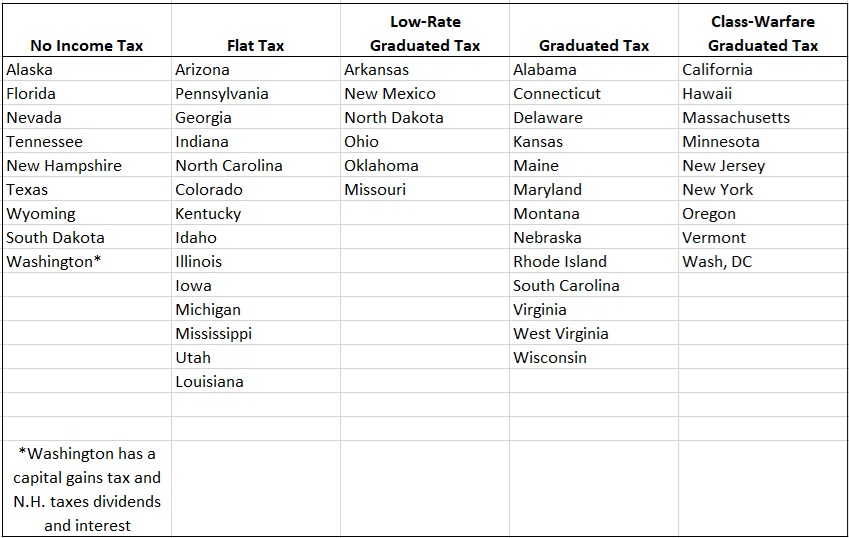
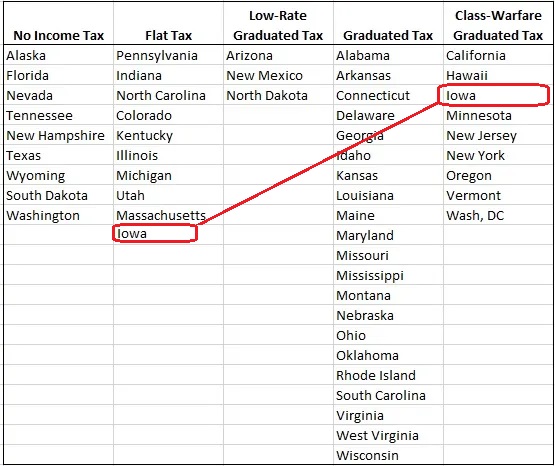
Back in 2018, I created a ranking of states based on tax policy, with the best having no income taxes and the worst having high-rate, class-warfare tax regimes.
Back then (just six years ago), about 60 percent of states were in the worst two categories.
Now it’s less than 50 percent.
And, thanks to Louisiana, there’s even more progress. The Pelican
State has joined the flat tax club. Here are some excerpts from a report in the Louisiana Illuminator by Julie O’Donoghue and Wesley Muller.
Gov. Jeff Landry scored one of the biggest victories of
his political career Friday when he managed to push major corporate and
personal income tax cuts through the Louisiana Legislature… A flat rate
of 3% will replace all three personal income tax brackets that top out
at a high rate of 4.25%. The
current sales tax rate of 4.45% will move to 5% for five years, and
then lower to 4.75% in 2030. A state corporate franchise tax has been
eliminated, and the corporate income tax rate – which now tops out at
7.5% – has been moved to a flat rate of 5.5%. …“We’re more competitive
now. We’ve lowered our rates to stay in line with our Southeastern
neighboring states, and we’re just excited with hopefully bringing our
people home and bringing more business to this state,” Rep. Julie
Emerson, R-Carencro, who carried the bulk of the bills for Landry’s tax
package.
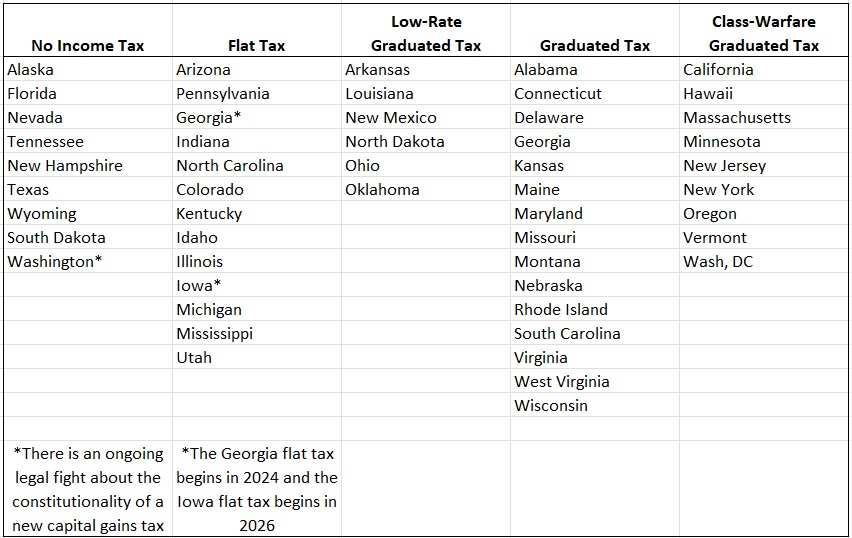
To see the improvements, here’s an updated version of state tax rankings.
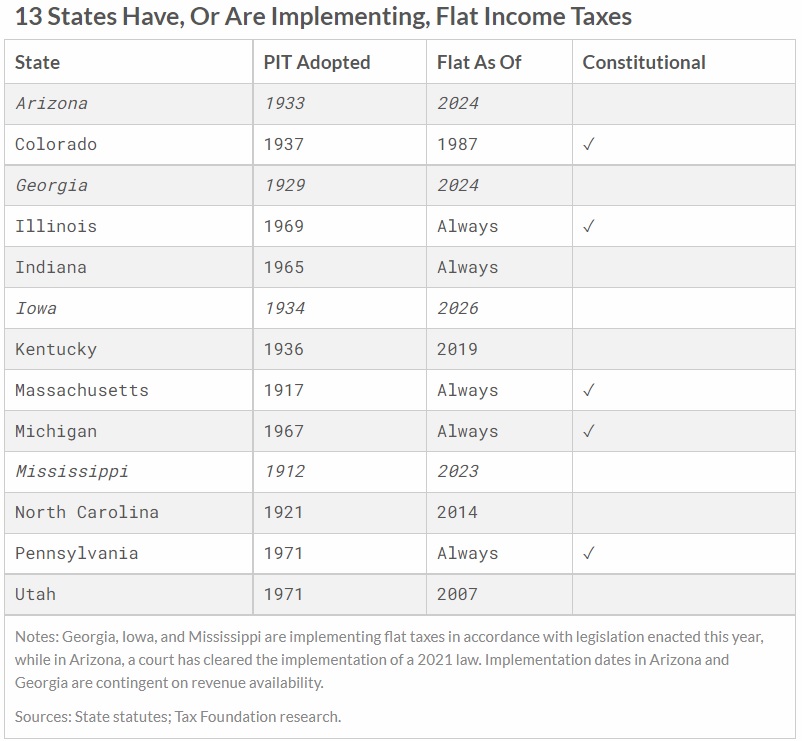
The big change is the number of flat tax jurisdictions. There are now
a dozen flat tax states, a big jump from 2018 (and since the flat taxes
in Kentucky, North Carolina, and Utah were enacted relatively recently,
the 20-year shift is even more impressive).
P.P.S. While there has been progress in many states, Massachusetts voters made a terrible choice in 2022 and moved their state from the flat tax column to the class-warfare column.
April 23, 2024 by Dan Mitchell @ International Liberty
There’s going to be a big tax fight in Washington next year,
regardless of who wins the House, the Senate, and/or the presidency.
That’s because major portions of Trump’s 2017 Tax Cuts and Jobs Act will expire on December 31, 2025.
Will those tax cuts be extended? Will they be expanded? Will they be curtailed? Politicians will be forced to choose.
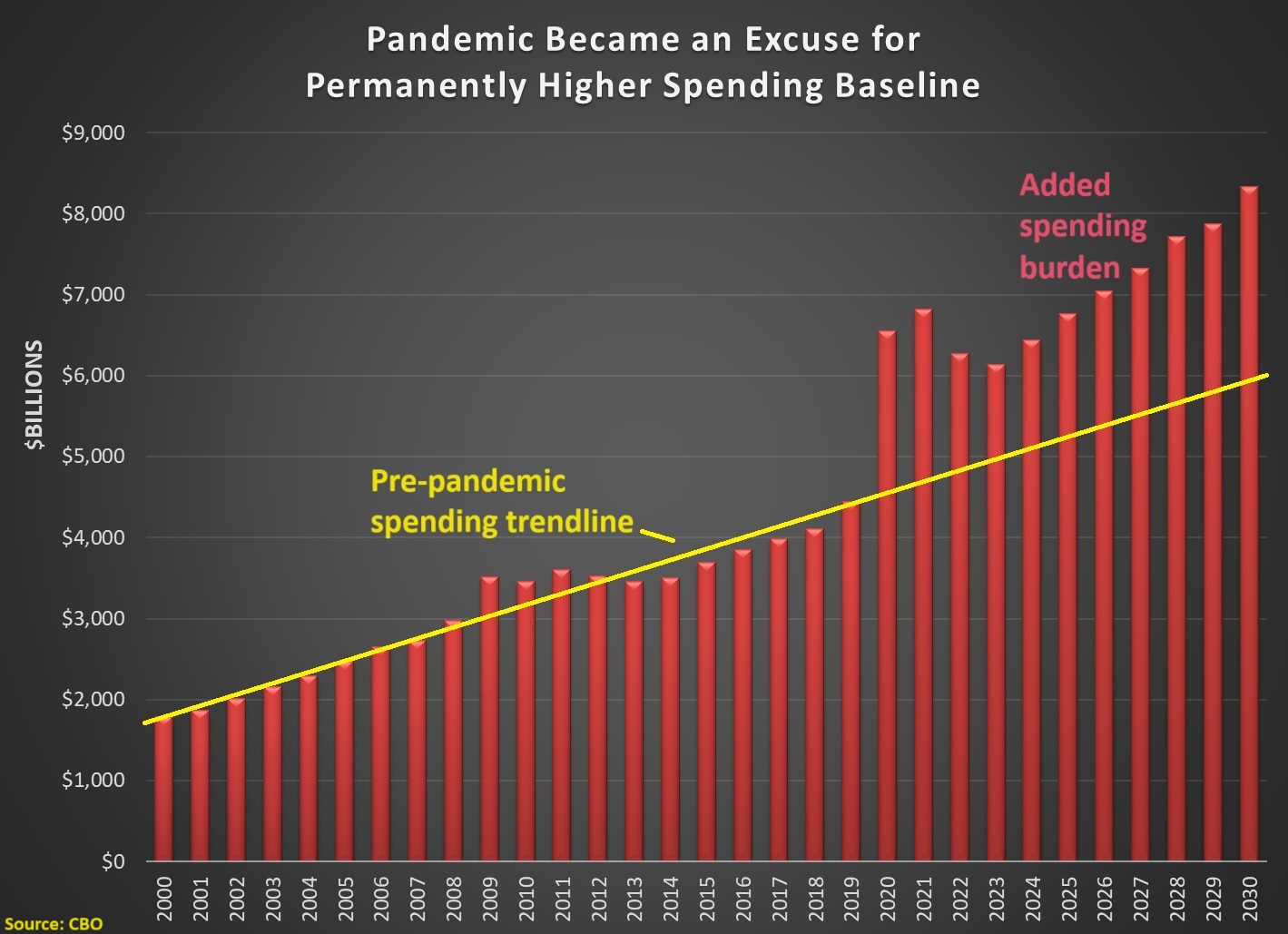
In general, I’m rather pessimistic about the outcome for the simple reason that there’s been a huge increase in the burden of government spending.
I wrote about that problem two days ago and highlighted how politicians used the pandemic as an excuse to permanently increase the cost of government.
One result of all that wasteful spending is that we now have enormous
deficits. And even though I don’t worry much about red ink (the real problem is spending, not how it’s financed), the practical reality is that it is well nigh impossible to have good tax policy when there is bad spending policy.
But that doesn’t mean we shouldn’t try. In an article for Bloomberg, Stephanie Lai, Amanda L Gordon, and Enda Curran write about the advice Trump is getting on tax policy.
Donald Trump is under pressure from economists in his
circle to embrace a flat tax rate… The efforts demonstrate how people
around the former president are already lobbying for their preferred
economic policies ahead of a potential second term where both taxes and
tariffs will be top priorities.
…Forbes said…he is advocating for Trump to support a flat 17% tax rate
for all income brackets with “generous” exemptions… For a family of
four, he said, he would suggest the first $54,000 of income be exempt
from federal income tax. …Whoever wins the White House in November will
be forced to negotiate a tax deal next year because key portions of
Trump’s 2017 tax cuts — including individual rates — expire at the end
of 2025. That will set up a complex negotiation — particularly if
control of Washington is split between Republicans and Democrats… Trump
has not detailed what his tax plan would look like.
I’m glad that people are pushing Trump to be bold on taxes, but that
advice needs to be augmented by a big push to make him better on
spending.
There’s been great progress in recent years with regards to state tax policy. When I put together my first ranking back in 2018, there were 9 states with flat taxes and and 3 states with low-rate graduated tax systems. Today, there are 11 (soon to be 13) states with flat taxes and 6 states with low-rate graduated systems.
But one thing has not changed. The ideal state tax policy is to have no income tax
and the 9 states in that category have not changed. Indeed, things may
even be moving in the wrong direction since politicians in the state of
Washington recently imposed a capital gains tax and they hope that the state’s top court somehow will decide it is constitutional. But there’s now a glimmer of hope that a few states will jettison their income taxes............To Read More....
And what happened in Eastern Europe is our topic for today. A new study
by Brian Wheaton, a professor at UCLA who examined what happened after
those nations adopted flat tax systems after the breakup of the Soviet
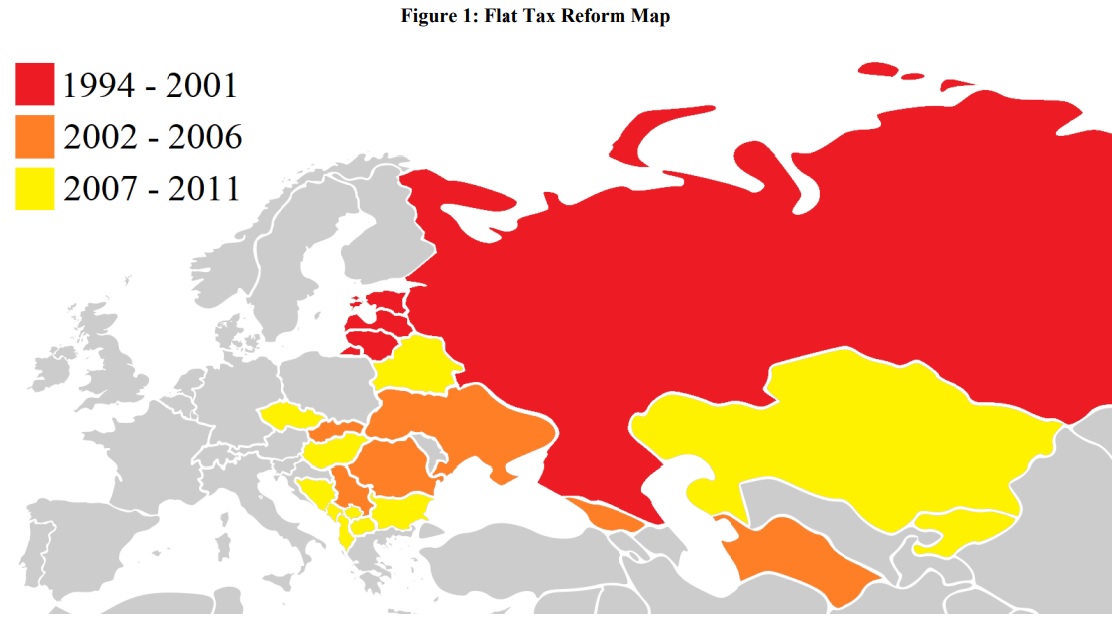
Empire. Here’s a map from the study, showing the nations that adopted the flat tax.
What were the economic results? Here are some excerpts from Prof. Wheaton’s study.
Would a flat income tax substantially improve…incentives?
To answer these questions, I study the experience of twenty
post-Communist countries, which introduced flat taxation on income. I
find that the flat tax reforms increase
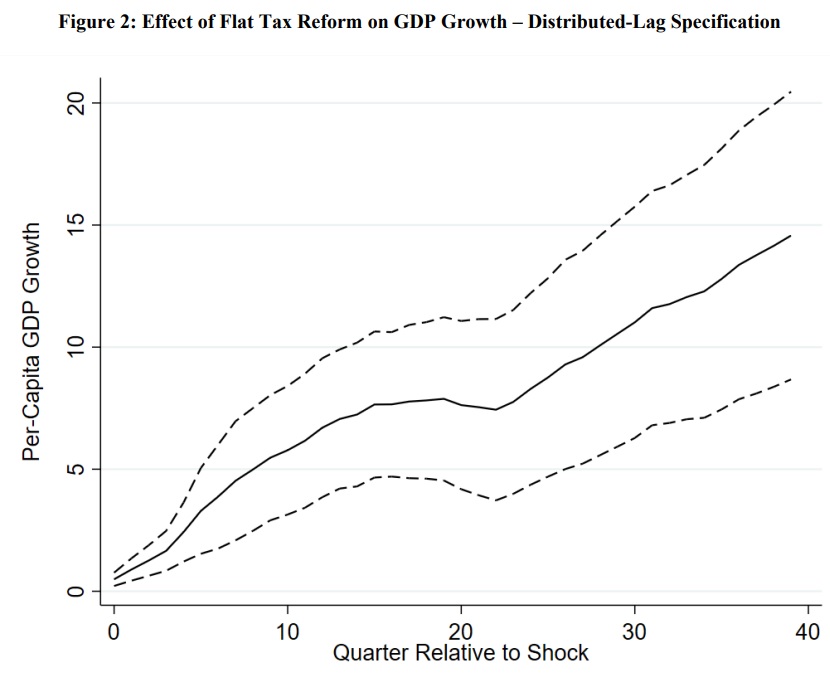
annual per-capita GDP growth by 1.38 percentage points for a
transitionary period of approximately one decade. …Further, I find that
the growth effect primarily operates through increases in investment
and, to a lesser extent, labor supply. It is driven by the reductions in
progressivity resulting from the reforms rather than merely the
reductions in the average marginal tax rate.
And here’s a chart showing the pro-growth impact.
I wrote a column about this study yesterday for Townhall.
Here’s some of my analysis.
Starting about 30 years ago, there was serious interest in replacing the internal revenue code with a simple and fair flat tax.
What motivated the desire to adopt a system based on one low rate, no
double taxation of saving and investment, and no special loopholes?
In part, it may have been because lawmakers at the time had a decent
understanding of fiscal policy, having spent much of the 1980s lowering
tax rates and seeing how that led to better economic performance.
…With Bill Clinton in the White House, however, it was not possible to
turn enthusiasm into reality. And in the following few decades, tax
reform has fallen off the radar. …That’s unfortunate. America’s tax
system has punitive features that reduce incentives for productive behavior. ..it would be a very good idea to resuscitate tax reform.
I explain that Professor Wheaton’s growth estimates are very important.
By the way, 1.38 percentage points of additional annual
growth may not sound like much to some people, but the net effect is
that flat tax nations wound up with about 15 percent more economic
output after a decade. And that’s in addition to whatever growth they
would have experienced without tax reform. A similar boost in growth in
the United States would means several thousand dollars of additional economic output for every man, woman, and child.
And I close with a political observation.
It will be interesting to see whether some of the
potential 2024 presidential hopefuls decide to battle these people and
make tax reform part of their campaigns. Combined with other good ideas
such as spending caps and federalism, there might be a winning message for the right candidate.
By the way, I’m not the only person to write about resuscitating tax reform.
Here are some excerpts from a column earlier this year by Cal Thomas for Jewish World Review.
The next time Republicans control all three branches of
government they may wish to visit an old idea – the flat tax. …The Tax
Code is a foreign language to many. As of 2018, it comprised 60 thousand
pages in 54 volumes. According to The Tax Foundation,
…the U.S. ranks 21st out of 37 nations in tax simplicity. Estonia has
been first for eight straight years. Maybe we could learn from them.
Look at states with no state taxes to see their prosperity. It is a
major reason so many Americans are moving from high tax states to those
with lower, or no state taxes. Unfortunately, one cannot escape the long
arm of the IRS. A flat tax and the elimination of the IRS might help
reduce the anger many people have about Washington and big spending
politicians.
Since I’m a policy wonk, I mostly care about tax reform in hopes of reducing what economists refer to as “deadweight loss” in the economy.
But let’s also remember what Steve Forbes said in the video about the current system being corrupt.
In a column for Forbes,
Patrick Gleason of Americans for Tax Reforms discusses the latest
developments in state tax policy – most notably Idaho’s shift to a flat
tax.
…The second half of the year is resulting in further
income tax relief and strengthening the recent trend of states moving
from graduated to flat income taxes. Most recently, Idaho legislators
returned to the state capital in Boise on the first day of September
for a special session called by Governor Brad Little (R) for the
purpose of making Idaho the newest flat tax state. …Governor Little’s
proposal, which state legislators passed on September 1, moves Idaho to a
flat 5.8% personal income tax. Idaho currently has a progressive income
tax code with a top rate of 6%, which kicks in at less than $8,000 in
annual income. …HB 1, which Little will soon sign into law, will also
cut Idaho’s corporate tax rate from 6% to 5.8%.
North Dakota also is contemplating tax reform.
…in North Dakota, Governor Doug Burgum (R) unveiled a new
tax proposal that would also move North Dakota to a flat tax. North
Dakota currently has a two-tier income tax with rates of 2.04% and 2.9%.
Governor Burgum’s proposal would move to a flat 1.5% income tax.
From a big-picture perspective, the last couple of years have been great news for taxpayers in certain states.
here are currently nine states with a flat income tax, 18
when counting the nine no-income-tax states that charge a flat 0%. Four
states (Arizona, Iowa, Georgia, and Mississippi) codified laws in 2021
and 2022 that will phase in flat taxes in the coming years. When
Governors Little and Burgum enact their tax proposals as is expected,
Idaho and North Dakota will become the the fifth and sixth states in
past two years alone to adopt a flat tax, bringing the total number of
flat or zero tax states to 24.
I’ll conclude by observing that I put together a 5-column method in 2018 for ranking state tax system.
At the beginning, 18 states were in the two good columns (no income tax or flat tax).
Today, we’re approaching 25 states and a few other states have moved in the right direction (reducing so-called progressive tax systems).
And I pointed out that this reform would help the state jump several spots in my ranking of state tax systems.
Well, the proposed reform has been approved by the state legislature
and Iowa will now have a much better (i.e., less destructive) tax
system.
Here are some details of the new law, as reported by Stephen Gruber-Miller and Ian Richardson for the Des Moines Register.
Iowa will move to a 3.9% flat income tax rate under a
compromise between legislative Republicans and Gov. Kim Reynolds… …It
would also exempt retirement income such as 401(k)s, pensions and IRAs
from state taxes… Along the way, the bill would eliminate Iowa’s
progressive income tax system,
where wealthier Iowans pay higher rates than lower-income Iowans. Iowa
would join 10 other states with some form of flat income tax. …The new
proposal would build upon a series of tax cuts that were previously set
to start for Iowans in 2023, meaning multiple new tax laws would take
effect during the same year. Iowa is already set to reduce the number of
tax brackets from nine to four starting in 2023. …It will drop the
corporate tax rate to a 5.5% flat rate over time.
I could end today’s column at this point.
After all, what happened in Iowa is a triumph for tax reform and another case study on the benefits of tax competition (just like we’ve seen in states such as Kentucky and North Carolina).
But I want to take this opportunity to address another big-picture issue.
Earlier this month, James Lynch wrote a column for the Des Moines Register on the potential impact of tax reform in the state.
He contrasted the views of both proponents and opponents.
Flattening state income tax rates and exempting
retirement income would either lead to growth in businesses and jobs and
increase Iowans wealth, or simply make wealthy Iowans wealthier,
according to speakers at a public hearing…speakers at the Monday
evening public hearing were divided between those who said a flatter tax
rate would make Iowa a more attractive place for businesses to locate
and expand — as well as a more attractive place for employees to live
and work — and those who said the plan largely benefits the wealthy
while doing little to help lower-income workers.
At the risk of sounding mushy, both supporters and critics are right.
Iowa’s tax reform will encourage more growth. And it’s also true that the rich will benefit.
But opponents are guilty of a sin of omission. That’s because tax reform will benefit lower-income and middle-class taxpayers as well.
Now let’s add a fourth item to my wish-list. The House version of tax reform actually does a decent job of curtailing some of the egregious distortions that line the pocket of companies that peddle so-called green energy.
I know it must be a decent job since the GOP plan is causing angst for leftist journalists.
The Republican-controlled House of Representatives…bill would slash incentives for renewable energy and the electric car industry. Environmental groups are frantic. …The House provision raising the most ire are proposed changes to the renewable electricity production tax credit, which benefits producers of wind, solar, geothermal and other types of renewable energy. …The House GOP plan would also repeal the Investment Tax Credit for big solar projects that start construction after 2027. House Republicans also propose eliminating the $7,500 credit for electric vehicle purchases. …the Senate bill may not include all of the House’s cuts to clean energy.
It is true that the Senate bill is very timid. But given that there will be a lot of pressure to find “offsets” in any final deal, I’m vaguely hopeful that some of the good provisions in the House bill will survive.
Let’s explore why that would be a very good outcome.
Veronique de Rugy of the Mercatus Center is not a fan of cronyist subsidies to solar energy.
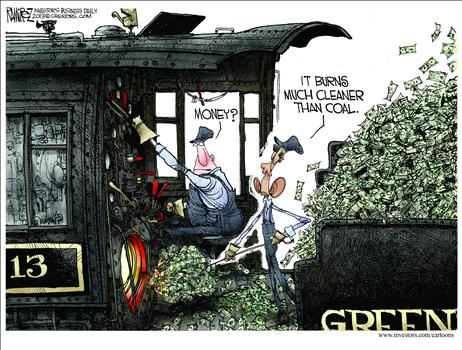
Under President Barack Obama, green energy subsidies were given out like candy. The failure of solar panel company Solyndra is well-known, but the problem extends well beyond the shady loan deal and its half-billion-dollar cost to taxpayers. Between 2010 and 2013, federal subsidies for solar energy alone increased by about 500 percent, from $1.1 billion to $5.3 billion (according to the U.S. Energy Information Administration), and all federal renewable energy subsidies grew from $8.6 billion to $13.2 billion over the same period. …However, that didn’t stop the largest U.S. solar panel manufacturer, SolarWorld, from filing for bankruptcy earlier this year despite $115 million in federal and state grants and tax subsidies since 2012, along with $91 million in federal loan guarantees. SolarWorld and fellow bankrupt manufacturer Suniva are now begging for even more government assistance, in the form of a 40-cent-per-watt tariff on solar imports and a minimum price of 78 cents (including the 40-cent tariff) a watt on solar panels made by foreign manufacturers.
Mark Perry of the American Enterprise Institute explains that wind energy is reliant on taxpayer handouts.
…government data shows that offshore wind power cannot survive in a competitive environment without huge taxpayer subsidies. Today, wind power receives subsidies greater than any other form of energy per unit of actual energy produced. …public subsidies for wind on a per megawatt-hour basis are 26 times those for fossil fuels and 16 times those for nuclear power. …The tax credit gives $23 for every megawatt-hour of electricity a wind turbine generates during the first 10 years of operation. …Yet, even with these incentives, only 4.7 percent of the nation’s electricity is currently supplied by wind power and that is entirely wind power from on-land turbines. …Think about it: Four large power plants could produce as much electricity as offshore wind turbines placed side by side along the entire Atlantic seaboard from Maine to Florida. Moreover, power plants last longer than wind turbines. A British study found that turbines need to be replaced within 12 to 15 years, and they must be imported from Europe.
In any event, Senator Alexander of Tennessee agrees that wind subsidies are a bad idea.
As we look at all the wasteful and unnecessary tax breaks that are holding us back, I have a nomination: At the top of the list should be ending the quarter-century-old wind production tax credit now — not two years from now. This giveaway to wind developers was meant to end in 1999 but has been extended by Congress ten different times. While the wind production tax credit is scheduled to be phased out by the end of 2019, we should do better and end it at the end of this year, and use the $4 billion in savings to lower tax rates. …Congress needs to stop its habit of picking winners and losers in the marketplace. Twenty-five years of picking wind developers over more-reliable sources of electricity hasn’t paid off. Imagine what innovation we might unleash if we used the billions wasted on wind energy to invest in research to help our free-enterprise system provide the abundance of cheap, clean, reliable energy we need to power our 21st-century economy.
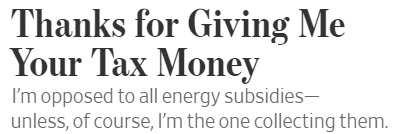
A recipient of tax preferences discusses his undeserved benefits in a Wall Street Journal column.
…it’s only appropriate that I express appreciation for the generous subsidy you provided for the 28-panel, four-array, 8,540-watt photovoltaic system I installed on my metal roof last year. Thanks to the investment tax credit, I slashed my 2016 federal tax bill by $7,758. …thanks to the incentives for rooftop solar, I’ve snared three subsidies. …fewer rooftop solar projects are being installed in low-income neighborhoods. …According to a study done for the California Public Utility Commission, residents who have installed solar systems have household incomes 68% higher than the state average. Ashley Brown, executive director of the Harvard Electricity Policy Group, calls the proliferation of rooftop solar systems and the returns they provide to lucky people like me, “a wealth transfer from less affluent ratepayers to more affluent ones.” It is, Mr. Brown says, “Robin Hood in reverse.” Do I feel bad about being a solar freeloader? Yes, a little. …the local barista or school janitor—people who likely can’t afford solar panels—are paying incrementally more for the grid’s maintenance and operation. And the more that people like me install panels, the more those baristas and janitors have to pay.
By the way, the United States is not the only nation with green-energy boondoggles (remember Solyndra?).
I’ve previously written about the failure of such programs in Germany.
Britain is wasting hundreds of millions of pounds subsidising power stations to burn American wood pellets that do more harm to the climate than the coal they replaced, a study has found. Chopping down trees and transporting wood across the Atlantic Ocean to feed power stations produces more greenhouse gases than much cheaper coal, according to the report. It blames the rush to meet EU renewable energy targets… Green subsidies for wood pellets and other biomass were championed by Chris Huhne when he was Liberal Democrat energy and climate change secretary in the coalition government. Mr Huhne, 62, who was jailed in 2013 for perverting the course of justice, is now European chairman of Zilkha Biomass, a US supplier of wood pellets.
In a perverse way, I admire Mr. Huhne, who didn’t follow the usual revolving-door strategy of politician-to-cronyist. He apparently went politician-to-prisoner-to-cronyist.
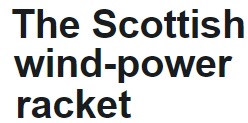
…the blackmailing, money-printing sausage factory is a wind farm in Scotland. There are currently about 750 wind farms north of the border, with roughly 3,000 wind turbines. …The wind farms are distributed across Scotland, sometimes in very remote regions, so there is a real problem in getting their energy down to the English border – let alone getting it across. …Why has so much been built? Partly, it is because of income-support subsidies. This top-up of nearly 100 per cent over the wholesale price – funded, of course, from consumer bills – makes wind farms very attractive… Subsidies to onshore wind in the UK now cost a little under £600 million a year, with Scottish wind taking about half, yet the Scottish government continues to ignore the protests and consent to new wind farms as if they cost almost nothing at all. Which as far as Holyrood is concerned, is in fact true. Part of the attraction for Scottish politicians is that the subsidies that pay for Scottish wind farms come from consumers all over Great Britain. Scottish consumption is about 10 per cent of the British total – so when the Scottish government grants planning permission to the wind industry, it is simply writing a cheque drawn overwhelmingly on English and Welsh accounts. …The result is that there is a perverse incentive to locate wind farms in Scotland, even though they aren’t welcome and the grid can’t take their output.
You won’t be surprised to learn, by the way, that taxpayers in the U.K. have been subsidizing green groups.
From an economic perspective, the bottom line is that green energy is more expensive and it requires subsidies that line the pockets of politically connected people and companies. That’s true in America, and it’s true in other nations.
Which is unfortunate, because it gives a bad name to energy sources that probably will be capable of producing low-cost energy in some point in the future.
Indeed, my long-run optimism about green energy is one of the reasons why I’m such a big believer in capitalism and private property. I just don’t want politicians to intervene today and make it harder to achieve future innovation.